How Resin Based Fertilizer Coating Polymers Control Nutrient Release
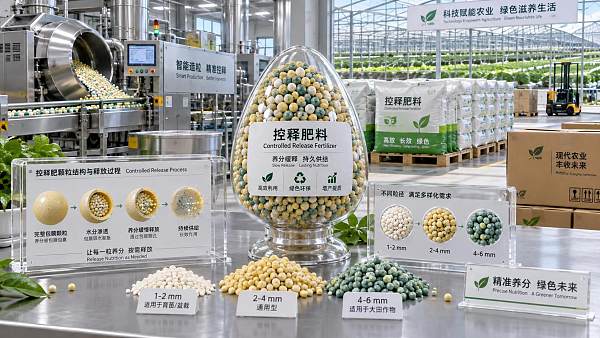
Resin based fertilizer coating polymers control nutrient release by placing a permeable barrier between a soluble fertilizer core and its surroundings. Water enters the granule, dissolves the nutrient salts, and the resulting solution moves outward through the coating. The rate depends on the properties and condition of the entire coated granule, not simply on the name of the resin.
For technical evaluators, the central question is whether that barrier produces a release profile suited to a crop and application under credible field conditions. A coating can slow release in a laboratory test yet deliver nutrients too early in warm soil, too late during crop establishment, or unevenly if a proportion of granules are damaged. Chemistry, coating thickness, manufacturing consistency, and test conditions all need to be considered together.
How the Coating Regulates Nutrient Movement
Once a coated granule encounters moisture, water moves through the polymer layer or through pathways within it. Soluble material in the core dissolves, creating a concentrated internal solution. Nutrients then move toward the lower-concentration environment outside the granule. Depending on the coating system, transport may involve diffusion through the polymer, movement through microscopic pores, or a combination of pathways.
The coating does not act as a simple on-off valve. Water entry, dissolution, internal pressure, and outward transport can occur simultaneously. Some products show an initial delay before substantial release; others release a portion of their nutrients relatively quickly and then follow a slower phase. The shape of the release curve depends on both the coating and the fertilizer core.
For a sufficiently intact, nonporous film, a simplified diffusion model helps explain the main variables: nutrient flux increases with permeability and the concentration difference across the coating, and decreases as the diffusion path becomes longer. This model is useful for comparing design choices, but it does not fully describe a real fertilizer granule. Coating thickness varies across the surface, the core changes as it dissolves, and pores, defects, swelling, and pressure can alter transport over time.

That distinction matters when interpreting a release claim. A specified duration is an outcome observed under defined conditions, not a fixed property of the polymer alone. Changing the fertilizer salt, granule size, coating process, or test temperature can change the observed curve even when the same resin family is used.
What Determines Release Rate?
Polymer chemistry and film structure
Resin chemistry influences how readily a coating absorbs water, how nutrients move through it, and how the film responds to temperature and mechanical stress. Polymer composition, molecular structure, degree of crosslinking, and the presence of additives can all affect these properties. The finished coating may behave differently from a laboratory film made from the same nominal ingredients because curing, film formation, and interactions with the core affect its structure.
A more water-permeable coating can allow faster water entry, but water permeability alone does not establish nutrient release rate. Dissolved nutrient species must also pass through the film or its defects. Swelling may open transport pathways in one system, while another relies mainly on diffusion through a comparatively stable layer. Evaluators should ask which mechanism is expected to dominate and whether the release data support that explanation.
Some coatings are designed to change after application through chemical or biological processes. Others are intended to retain their barrier function through most of the release period. Slower nutrient release should not be treated as proof that the coating itself breaks down rapidly in soil; nutrient release and coating degradation are separate properties requiring separate evidence.
Thickness, coverage, and granule size
Increasing coating thickness will generally slow transport when composition and film quality remain comparable. It also increases the amount of coating material used and may reduce the proportion of fertilizer nutrients in the finished product by mass. That trade-off cannot be assessed from coating percentage alone.
Coating percentage is a mass-based measure, not a direct measurement of film thickness. Granule size distribution, shape, density, and surface roughness influence how much area must be covered. Two products with the same coating percentage can therefore have different average thicknesses and different distributions of thin spots.
Uniform coverage matters because release from a batch is the combined result of many individual granules. A small population with incomplete coverage or cracks can contribute to an early release burst even when the average coating weight meets specification. Conversely, an overly thick coating on part of the batch can leave nutrients unavailable when the crop needs them.
For evaluation purposes, particle-size distribution and coating uniformity should be reviewed alongside coating weight. A single average is less informative than a release curve supported by evidence that the production process controls granule-to-granule variation.
Core composition and internal conditions
The fertilizer core supplies the soluble material that drives the process. Salt composition, solubility, core porosity, moisture content, and granule strength can influence how water enters and how quickly a solution forms. A coating developed for one core formulation should not automatically be expected to produce the same release profile on another.
As water enters, internal osmotic pressure may build. Depending on the coating’s flexibility and strength, that pressure can contribute to swelling or mechanical failure. Cracks and weak areas can then provide faster pathways for nutrient solution, shifting the behavior away from the intended controlled-release mechanism.
Multinutrient cores add another complication: different nutrient species may not emerge at identical rates. Measurements of total dissolved material or conductivity can be useful for screening, but they may not show whether each nutrient is being supplied in the required proportion. Where nutrient timing is critical, element-specific measurements provide a more useful basis for evaluation.
Why Laboratory Release and Field Availability Differ
Temperature is often a major source of variation. As temperature rises, polymer mobility and transport rates may increase, and salts can dissolve more rapidly. A product characterized at one temperature may therefore release sooner under warmer conditions and more slowly under cooler conditions. The size of that response depends on the particular coating and core; it should be established from product-specific data rather than assumed from a resin category.
Moisture also matters. A granule held continuously in water experiences a different environment from one in soil subject to wetting and drying. Limited contact with water can slow the start of release or interrupt it. Soil placement, irrigation pattern, and the physical contact between granules and surrounding material can all influence exposure.
Laboratory media introduce further differences. A large volume of frequently replaced water can maintain a strong concentration gradient and capture released nutrients efficiently. Soil solution contains dissolved salts and interacts with nutrients through adsorption, precipitation, biological transformation, and movement with water. Release from the coating is therefore only one step between application and plant uptake.
For example, a nitrogen source can leave the granule and subsequently undergo transformations that affect its movement or loss. A phosphorus-containing nutrient may interact strongly with soil constituents after release. A coating’s laboratory curve cannot, by itself, establish crop recovery, yield response, or reduced nutrient losses in a particular field.
Timing is just as important as total release. A long-duration product may be a poor fit if too little nutrient is available during establishment. A faster profile may be unsuitable when the application is intended to supply a crop over an extended period. In some programs, a blend of immediately available and coated nutrients can address different demand periods, but the blend requires its own assessment of early availability and later supply.
How to Evaluate a Release Profile
Start by defining the intended use: nutrient source, target crop demand, application method, expected temperature range, moisture regime, and desired period of supply. Then compare products using release data generated under conditions that are as consistent and relevant as possible. Curves measured by different methods should not be ranked solely by their stated release duration.
A useful technical package should make the following points clear:
- Material tested: the nutrient composition, granule size range, coating level, and whether the sample represents production material.
- Test environment: temperature, medium, liquid-to-product ratio, sampling intervals, and whether the medium was replaced.
- Measurement basis: whether results represent individual nutrients, total nutrient content, or an indirect measure such as conductivity.
- Release curve: cumulative release over time, including the initial period, rather than only a single end point or nominal longevity.
- Variability: replicate results and relevant batch-to-batch data, where available.
- Physical condition: how granules were handled before testing and whether damaged material was included.
Ask suppliers to identify the method used and provide the complete procedure when results are intended for comparison. An applicable standard method can improve consistency, but its scope and conditions still need to match the question being asked. A standardized test does not automatically reproduce a particular soil, climate, or crop.
Initial release deserves particular attention. A rapid early fraction may be intentional, useful for establishment, or evidence of coating defects. The distinction depends on the formulation design and the distribution of results. A curve showing only an acceptable final release percentage can conceal a burst followed by a long period of insufficient nutrient supply.
Likewise, a smooth average curve can hide substantial variability between replicates or production batches. If a specification includes a release window, define the test temperature, sampling time, nutrient measured, and acceptable range. Without those conditions, the same duration claim can describe materially different performance.
Handling and Coating Integrity
The release mechanism assumes that the film reaching the field is sufficiently similar to the film tested. Conveying, blending, packaging, transport, and application can expose granules to abrasion or impact. Damage may create local fast-release paths even where the coating chemistry is suitable.
Mechanical resistance should therefore be evaluated in relation to the intended handling chain. A product that performs well before processing may need further testing after representative blending or application equipment. Visual inspection can identify obvious cracking and fines, but intact-looking granules can still have thin or weakened areas; release testing after handling provides a more direct assessment of functional integrity.
Storage conditions also deserve attention where moisture, heat, or prolonged compression can affect the product. Packaging and storage recommendations should be assessed against the expected distribution period and environment, particularly when a product will pass through several handling steps before use.
The strongest technical comparison connects these pieces: a characterized coating and core, a release curve with disclosed test conditions, evidence of production consistency, and performance after representative handling. Field or soil-based testing can then determine whether the measured release pattern aligns with nutrient demand under the intended conditions.
Facing technical bottlenecks in manufacturing or looking for more efficient industrial solutions? Leave your details below and let the engineering experts at FCAS solve them for you.
We respect your privacy. Your information is strictly confidential.
Related News
 Controlled-Release ThermodynamicsHow to Select a Microcrystalline Cellulose Excipient for TabletsChoose the right microcrystalline cellulose excipient for tablets. Compare MCC grades, processing properties, and supplier documentation with this practical guide.MORE+
 Controlled-Release ThermodynamicsHow Temperature Responsive Coating Resins Control Nutrient ReleaseDiscover how temperature responsive coating resins control fertilizer nutrient release, and learn what affects performance in real soil conditions.MORE+
 Controlled-Release ThermodynamicsHow Resin Based Fertilizer Coating Polymers Control Nutrient ReleaseDiscover how resin based fertilizer coating polymers control nutrient release and learn which factors matter when choosing a coating for your crop.MORE+
 Controlled-Release ThermodynamicsModified Cyclodextrins Explained for Controlled Fragrance ReleaseModified cyclodextrins enable controlled fragrance release, odor control, and volatile-note protection. Explore how they optimize performance in detergents, fabric care, and more.MORE+
 Controlled-Release ThermodynamicsHow Cyclodextrin Inclusion Complexes Stabilize Fragrance ReleaseCyclodextrin inclusion complexes for fragrances help control volatile aroma release, protect key notes, and support longer-lasting sensory performance across formulations.MORE+
 Controlled-Release ThermodynamicsWhat Determines Controlled Release Fertilizer Systems PriceControlled release fertilizer systems price explained: compare coating technology, release performance, logistics, and per-hectare value for smarter purchasing decisions.MORE+
 Controlled-Release ThermodynamicsWhen Potassium Sulfate Fertilizer 52 K2O Is the Better ChoicePotassium sulfate fertilizer 52 K2O delivers low-chloride potassium and sulfur for quality-focused crops. Explore when SOP can improve nutrient balance, crop value, and sourcing decisions.MORE+
 Controlled-Release ThermodynamicsHow Stabilized Cyclodextrin Inclusion Complexes Improve Active StabilityStabilized cyclodextrin inclusion complexes improve active stability, reduce volatility, and support controlled release for demanding formulations.MORE+
 Controlled-Release ThermodynamicsHow to Choose Controlled Release Fertilizer Systems for Healthy TurfControlled release fertilizer systems for turf: learn how to match nutrient release, irrigation, soil, and maintenance needs for healthier, more predictable results.MORE+