
What to Check When Choosing a Compound Fertilizer Granules Supplier
A compound fertilizer granules supplier should be assessed as a source of a repeatable field-input system, not simply as a seller of an N-P-K grade. Two products with the same declared nutrient ratio can behave differently in storage, spreading equipment, soil moisture, and root-zone conditions. The differences often originate in raw-material selection, granulation control, screening discipline, coating, moisture management, and the supplier's ability to document each batch.
Start by defining the intended use before requesting quotations. A blend used for broad-acre basal application has different priorities from one intended for orchard banding, vegetable production, mechanical side-dressing, or distribution through a specific spreader. Crop nutrient demand, soil test results, application timing, local humidity, bag handling, and storage duration all affect which product characteristics matter most. Without this use profile, comparing supplier specifications becomes an exercise in matching labels rather than evaluating fitness for use.
Read the nutrient declaration as a formulation, not a headline
The declared nitrogen, phosphorus, and potassium values are necessary, but they do not explain the full agronomic behavior of a granulated product. Nitrogen form deserves attention. Urea nitrogen, ammoniacal nitrogen, nitrate nitrogen, and stabilized forms differ in solubility, transformation in soil, handling sensitivity, and timing of availability. A grade with the same total nitrogen can therefore suit one crop program while creating avoidable losses or timing problems in another.
Phosphorus also needs more context than its total declared content. Its performance is influenced by the phosphate source, granule distribution in the soil, soil pH, moisture, temperature, and the placement method. Potassium source matters where chloride sensitivity, salinity management, or specific crop quality requirements are relevant. A supplier should be able to identify the nutrient sources used in the formulation and explain whether substitutions are controlled or allowed between production batches.
Secondary nutrients and micronutrients should be evaluated separately from the primary N-P-K grade. Their inclusion on a product label does not automatically mean they are uniformly distributed, readily available under the intended soil conditions, or compatible with the rest of the granule. For example, a micronutrient may be present as a simple mineral salt, a more protected form, or a coated component. These approaches can differ in storage stability and nutrient availability. Requesting the form and basis of declaration avoids treating all added micronutrients as equivalent.
Granule quality affects delivery to the field
Granule appearance is not merely cosmetic. Particle-size distribution, crushing strength, abrasion resistance, moisture content, and dust level influence whether the fertilizer reaches the soil evenly. Uniformly sized granules generally support more predictable spreading patterns. A wide size range can separate during transport or handling, especially when different nutrient-containing particles vary in density or shape. The resulting field application may depart from the intended nutrient ratio even when the bagged product initially meets the stated analysis.
Ask for the product's particle-size range and the method used to control fines and oversized material. The most useful answer is tied to the spreading equipment and application width under consideration. A supplier that only offers a broad statement such as “uniform granules” leaves an important performance question unresolved. Screening records, retained samples, and batch test results provide a clearer indication of control than photographs alone.
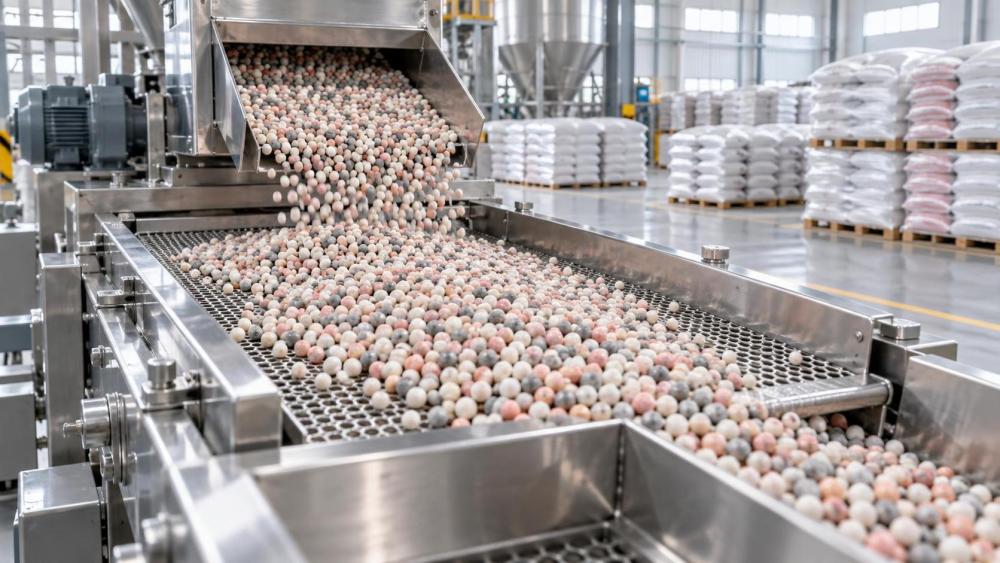
Granule strength must be balanced rather than maximized without context. Weak granules can break under stacking, loading, auger transfer, or pneumatic movement, producing dust and uneven application. Excessively hard or poorly soluble particles may persist longer than intended in dry or cool soil. The relevant question is whether the granule withstands the planned logistics route while breaking down and releasing nutrients appropriately after placement. This is especially important where fertilizer is transferred several times before reaching the farm or stored in bulk for an extended period.
Moisture is closely related to caking and flow. Hygroscopic ingredients can draw water from humid air, making granules tacky or causing bags to form hard masses. Surface coatings may improve handling, but their value depends on coating consistency and compatibility with the formulation. A product that flows well immediately after production may behave differently after weeks in a warm warehouse or after exposure to repeated temperature changes. Storage-condition guidance should therefore be specific enough to use: maximum stacking arrangement, protection from floor moisture, ventilation expectations, and whether opened bags require special handling.
Separate ordinary granulation from controlled nutrient release
Granulated fertilizer is not automatically slow-release or controlled-release fertilizer. Conventional granulation combines nutrients into particles designed for practical handling and distribution; once water reaches the granule, nutrient dissolution may occur relatively quickly. Controlled-release performance normally depends on a coating, matrix, inhibitor, or other mechanism that changes the nutrient-release pattern.
Where a supplier describes a product as extended-release, request an explanation of the mechanism rather than relying on the marketing term. Is nutrient release governed by a polymer coating, sulfur-containing layer, mineral matrix, inhibitor system, or simply by the selected nutrient sources? Does the stated release behavior refer to laboratory immersion, soil incubation, or a particular temperature condition? Release data without its test conditions can be misread. Warm, wet soil and cool, dry soil do not produce the same result, and damaged coated granules can release nutrients earlier than intact ones.
A practical review also asks whether the release behavior aligns with the crop schedule. A long-duration product may be useful where applications are infrequent, but it may be poorly matched to a short-cycle crop or a program that requires rapid early nutrition. Conversely, a fast-dissolving granule should not be treated as a substitute for a product intended to feed a crop over a long period. The supplier's technical material should connect product behavior to timing and placement, while leaving final rate and agronomic program to local crop and soil guidance.
Look beyond a certificate of analysis
A certificate of analysis is important, yet its value depends on what it covers and how it is tied to the delivered lot. It should identify the batch or lot, product grade, sampling basis, test date, and relevant results. For compound fertilizer granules, the useful set of controls commonly extends beyond total nutrient content to moisture, particle-size distribution, and other attributes that affect application. Where the formulation includes micronutrients or controlled-release features, supporting information should address those claimed properties as well.
Documentation should be internally consistent across the specification, product label, safety information, transport papers, packing list, and certificate. Small discrepancies create practical problems: one document may state a different nutrient basis, another may omit a declared component, or the bag marking may not allow the delivered material to be traced back to the analytical record. These are not administrative details when a product is being received across multiple lots or used in a regulated agricultural market.
It is also useful to ask how nonconforming material is handled. The answer should cover lot segregation, investigation, disposition, and communication when a result falls outside an agreed specification. A supplier may occasionally face process variation; the differentiator is whether that variation is detected before shipment and whether the response is traceable. Retained samples and a defined complaint process are relevant because problems such as caking, dusting, or variable spreadability may become visible only after delivery.
Assess production consistency through the manufacturing route
Compound fertilizer granules can be made through different processes, including chemical granulation, drum or pan granulation, compaction, and blending of preformed materials. The route affects particle structure, nutrient distribution, dust generation, and the extent to which every granule carries the intended nutrient composition. A physical blend may be suitable for some applications, but it should not be assumed to perform like a chemically or mechanically integrated compound granule.
Ask whether each granule is intended to contain the full nutrient formulation or whether the product consists of separate nutrient particles mixed together. This distinction becomes important during handling. Blended components with different density, size, or shape can segregate during transport and loading. A homogeneous compound granule reduces that particular risk, though it still requires adequate size control and physical strength.
Raw-material flexibility should be examined carefully. Flexibility can protect supply continuity, but uncontrolled substitution can alter solubility, chloride level, nitrogen form, color, pH behavior, and storage performance. A reliable arrangement defines which characteristics are fixed, which raw materials may be substituted, and when advance notice or reapproval is required. This prevents a nominally identical grade from changing in ways that affect field use or downstream labeling.
Packaging and logistics are part of product quality
Fertilizer granules are exposed to moisture, compression, puncture risk, and repeated handling. The package needs to match the route from factory to storage and final application. Bag material, inner liner design, sealing method, pallet stability, unit weight tolerance, and labeling durability should be reviewed together. A strong product inside weak packaging can arrive as a caked, contaminated, or partially lost shipment.
For bagged material, confirm how bags are sealed and whether pallets are stretch-wrapped, hooded, or otherwise protected against humidity and weather during staging. For bulk supply, examine loading cleanliness, contamination controls between grades, vehicle protection, and the receiving site's ability to keep material dry. A delivery plan should also define whether partial bags, damaged bags, or wet material are accepted, rejected, or quarantined. Leaving this undefined often turns a straightforward quality issue into a disagreement after unloading.
Lead time alone is an incomplete supply-capacity measure. The relevant capacity is the supplier's ability to make the required grade, in the required packaging, through the expected seasonal demand window, with stable raw-material access and sufficient quality release time. A supplier can have large nominal output while having limited availability for a specific micronutrient blend, coating process, or bag format. Production scheduling, minimum order quantities, lot sizes, and contingency arrangements should be discussed before a seasonal commitment is made.
Compare offers on an equivalent basis
The lowest price per tonne does not necessarily represent the lowest cost for the required nutrient program. Compare offers using the same nutrient basis, package configuration, delivery point, and quality requirements. Differences in nutrient concentration, net weight, moisture, fines, or chloride content can make direct price comparisons misleading. Freight and handling losses also become more relevant when the material has poor flow, inconsistent bags, or a higher tendency to cake.
Before approving regular supply, use a sample or trial lot in a way that tests the conditions most likely to expose a problem. Examine bag integrity after receipt, granule condition after storage, flow through relevant equipment, dust during loading, and application uniformity. A small laboratory sample is useful for confirming declared composition, but it cannot fully represent the mechanical stresses of transport and spreading. The trial should be tied to agreed acceptance criteria rather than an informal visual impression.
The strongest supplier evaluation links the formulation, granule properties, documentation, and delivery process to one defined use. That approach reveals whether an apparently attractive grade will remain consistent from the certificate to the warehouse and from the spreader to the soil.
Related News
 Antioxidants & Natural PreservativesWhat Quality Checks Matter When Sourcing Butylparaben for Personal CareButylparaben for personal care sourcing guide: compare assay, impurities, physical performance, documentation, traceability, and supplier quality to reduce formulation risk.MORE+
 Nano-microcapsule FormulationsHow Encapsulated Flavors Protect Taste During Processing and StorageEncapsulated Flavors protect taste from heat, oxygen, moisture, and storage loss. Explore smarter release, carrier selection, and processing strategies.MORE+
 Chelated Trace Element FertilizersHow Greenhouse Fertigation Systems Reduce Water and Fertilizer WasteGreenhouse fertigation systems reduce water and fertilizer waste with precise dosing, uniform irrigation, drainage monitoring, and smarter crop-zone control. Learn practical strategies.MORE+
 Supercritical CO2 Essential OilsHow Natural Essential Oil Blends Improve Consistent Product FragranceNatural essential oil blends help brands achieve consistent, appealing fragrance across batches. Explore smart blend design, stability testing, and product compatibility strategies.MORE+
 Non-ionic Surfactants & DefoamersHow to Choose Non Ionic Low Foaming Surfactants for CIP CleaningNon ionic low foaming surfactants for CIP cleaning: learn how to balance wetting, foam control, compatibility, and rinseability for reliable cleaning performance.MORE+
 Nano-microcapsule FormulationsHow Food Grade Cyclodextrin Complexes Protect Sensitive FlavorsFood grade cyclodextrin inclusion complexes help protect sensitive flavors from oxidation, evaporation, and processing loss while supporting controlled release and consistent sensory quality.MORE+
 Polymer-Coated Water Soluble NPKHow Fertilizer Coating Polymers Improve NPK Granule ReleaseFertilizer coating polymers for NPK granules improve controlled nutrient release, reduce loss risks, and enhance product consistency. Discover key selection and process insights.MORE+
 Chelated Trace Element FertilizersWhat Diammonium Phosphate Means for Crop Nutrition PlanningDiammonium Phosphate: learn how DAP supports early phosphorus access, nitrogen budgeting, smart placement, and balanced crop nutrition planning.MORE+
 Maillard Reaction Savory FlavorsHow to Assess a Flavor Bases Supplier List for Reliable SourcingGlobal Fine Chemicals & Agrochemical Intelligence Network flavor bases supplier list: assess specs, samples, supply risk, and true cost to source with confidence.MORE+
 Hydrocolloids & EmulsifiersHow Konjac Gum Powder Improves Texture in Low-Calorie FoodsKonjac gum powder improves body, stability, and mouthfeel in low-calorie foods. Discover practical tips for smoother sauces, beverages, and reduced-fat formulations.MORE+
 Supercritical CO2 Essential OilsWhat to Check Before Choosing a Botanical Essential Oils ManufacturerChoose a botanical essential oils manufacturer with confidence. Explore key checks for purity, traceability, compliance, batch consistency, and reliable supply.MORE+
 Microencapsulated FragrancesHow Fragrance Carriers for Detergents Improve Scent PerformanceFragrance carriers for detergents improve stability, fabric deposition, and long-lasting scent. Explore practical solutions for better wash-to-wear fragrance performance.MORE+
 Antioxidants & Natural PreservativesWhen Propyl Gallate Antioxidant Is the Right Choice for Oil StabilityPropyl gallate antioxidant: learn when it is the right choice for oil stability, shelf-life protection, processing compatibility, and smarter formulation decisions.MORE+
 Antioxidants & Natural PreservativesHow Potassium Sorbate Extends Shelf Life in Food and Beverage ProductsPotassium Sorbate helps food and beverage brands control yeast and mold spoilage. Explore pH, dosage, processing, and packaging strategies for reliable shelf life.MORE+
 Antioxidants & Natural PreservativesHow to Source Bulk Herbal Extracts With Reliable Quality ControlBulk herbal extracts sourcing guide: compare suppliers, verify traceability, review CoAs, and build reliable quality controls for safer, consistent purchasing.MORE+
 Antioxidants & Natural PreservativesWhat to Check Before Sourcing Butylparaben for Personal Care FormulasButylparaben for personal care sourcing guide: check market eligibility, purity, supplier controls, formula compatibility, packaging, and total risk before buying.MORE+
 Targeted Bio-pesticides & APIsChoosing Microbial Fungicides for Foliar Diseases in Integrated Crop ProgramsMicrobial fungicides for foliar diseases: learn how to match biology, formulation, tank compatibility, and timing for stronger integrated crop protection.MORE+
 Targeted Bio-pesticides & APIsHow Microbial Insecticides Control Caterpillars With Lower Crop Residue RiskMicrobial insecticides for caterpillars help protect crops with targeted early-larval control and lower residue-management pressure. Learn timing, coverage, compliance, and scouting essentials.MORE+
 Microencapsulated FragrancesHow to Add Encapsulated Laundry Fragrances Without Weakening Wash ResultsEncapsulated laundry fragrances: learn how to boost long-lasting scent while protecting cleaning power, stability, foam control, and fabric care.MORE+
 Supercritical CO2 Essential OilsHow Aroma Ingredients Shape Lasting and Skin-Safe Personal Care ProductsAroma ingredients for personal care: discover how to achieve lasting scent, formulation stability, skin safety, and confident product performance.MORE+
 Targeted Bio-pesticides & APIsInsecticides Explained Through Labels, Active Ingredients, and SafetyInsecticides explained through labels, active ingredients, formulations, and safety. Learn how to compare products, manage risk, and make informed crop protection decisions.MORE+
 Heavy-duty Industrial DegreasersHow to Select Parts Wash Cleaners for Automotive ComponentsParts wash cleaners for automotive components: learn how to match chemistry, materials, rinsing, safety, and waste controls for reliable cleaning results.MORE+
 Chelated Trace Element FertilizersHow Precision Fertigation Systems Improve Water and Nutrient ControlPrecision fertigation systems improve water and nutrient control with accurate dosing, uniform irrigation, smart monitoring, and reduced waste. Discover how to optimize crop performance.MORE+
 Hydrocolloids & EmulsifiersHow Bulk Price Factors Affect Hydrocolloid Stabilizer Blend SourcingHydrocolloid stabilizer blends bulk price: compare dosage efficiency, quality consistency, logistics, and documentation to reduce total sourcing costs.MORE+
 Zero-Calorie Sweeteners & AcidulantsHow to Choose a Natural Sweeteners Supplier for Clean-Label ProductsNatural sweeteners supplier selection guide for clean-label products: compare formulation fit, traceability, documentation, and supply reliability.MORE+
 Non-ionic Surfactants & DefoamersWhat Cationic Surfactants Do and Where They Are UsedCationic Surfactants deliver antimicrobial action, conditioning, antistatic control, and surface treatment benefits. Explore key uses, compatibility, and safe selection tips.MORE+
 Targeted Bio-pesticides & APIsHow to Evaluate Pesticide Suspension Concentrates for Field StabilityPesticide Suspension Concentrates: learn how to evaluate field stability, redispersibility, dilution, tank-mix compatibility, and spray safety for reliable performance.MORE+
 Hydrocolloids & EmulsifiersHow Hydrocolloid Systems for Meat Products Improve Texture and YieldHydrocolloid systems for meat products improve yield, texture, water retention, and slicing quality. Explore practical formulation strategies for stable, high-performing meat products.MORE+
 Microencapsulated FragrancesHow Laundry Fragrances for Liquid Detergents Improve Scent LongevityLaundry fragrances for liquid detergents: discover how fragrance design, deposition, and encapsulation create lasting fabric freshness and stronger product appeal.MORE+
 Nano-microcapsule FormulationsChoosing Fragrance Preparations That Perform Well in Personal WashFragrance preparations for personal wash: learn how to select options that protect clarity, stability, foam, scent performance, and packaging compatibility.MORE+
 Controlled-Release ThermodynamicsModified Cyclodextrins Explained for Controlled Fragrance ReleaseModified cyclodextrins enable controlled fragrance release, odor control, and volatile-note protection. Explore how they optimize performance in detergents, fabric care, and more.MORE+
 Microencapsulated FragrancesHow Fragrance Delivery Systems Improve Fabric Softener LongevityFragrance delivery systems for fabric softeners improve scent longevity through smart protection, reliable deposition, and controlled release for lasting freshness.MORE+
 Supercritical CO2 Essential OilsHow to Evaluate a Natural Cardamom Oil Supplier for Reliable SupplyNatural cardamom oil supplier evaluation guide: verify botanical origin, purity, batch consistency, documentation, packaging, and delivery reliability for confident sourcing.MORE+
 Maillard Reaction Savory FlavorsHow Ethyl Maltol Purity Testing Supports Flavor Safety ComplianceEthyl Maltol purity testing strengthens flavor safety compliance through identity checks, impurity profiling, supplier verification, and audit-ready documentation.MORE+
 Microencapsulated FragrancesEssential Oil Extracts Compared for Fragrance and Wellness UsesEssential Oil Extracts compared for fragrance and wellness: explore scent profiles, extraction methods, stability, safety, and sourcing insights for smarter formulation choices.MORE+
 Zero-Calorie Sweeteners & AcidulantsWhat Drives Zero Calorie Sweeteners Bulk Price in 2026Zero calorie sweeteners bulk price in 2026: compare specifications, dosage, quality, freight, and supply risk to make smarter sourcing decisions.MORE+
 EPA FIFRA & FDA GRAS RegsSynthetic Food Preservatives Rules That Support Safer FormulasSynthetic Food Preservatives: learn the rules for safer formulas, compliant use levels, validated shelf life, labeling, and reliable microbial control.MORE+
 Micelle Fluidics & ChelationHow Anionic Industrial Dispersants Improve Coating StabilityAnionic industrial dispersants improve coating stability, pigment wetting, viscosity control, gloss, and storage performance. Learn how to select and test the right solution.MORE+
 Supercritical CO2 Essential OilsHow to Choose Eucalyptus Oil Grades for Clean, Consistent ProductsChoose the right Eucalyptus Oil grade with confidence. Compare cineole content, purity, origin, processing, documentation, and application fit for consistent products.MORE+
 Micelle Fluidics & ChelationWhat Are Cationic Surfactants and Where Are They Commonly Used?Cationic Surfactants deliver powerful surface affinity for disinfection, fabric softening, hair conditioning, antistatic control, and industrial treatments. Explore key uses and selection factors.MORE+







































