
How Precision Fertigation Systems Improve Water and Nutrient Control
Precision fertigation systems improve water and nutrient control by treating irrigation volume, fertilizer concentration, timing, and distribution uniformity as one operating process. Water carries dissolved nutrients into the active root zone, so a change in flow rate, irrigation duration, pressure, or fertilizer injection rate changes the crop’s exposure. A well-designed system makes those changes visible and controllable instead of leaving them to broad, infrequent field applications.
The practical result is a narrower gap between what the crop requires and what reaches the soil. Nutrients can be supplied in smaller portions through the season, irrigation can respond to root-zone moisture rather than calendar habit, and separate zones can receive different runtimes or nutrient programs. This control is especially valuable where soil texture changes across a block, crop stages have distinct water demand, or leaching risk increases after heavy irrigation or rainfall.
Water control starts with hydraulic consistency
Fertigation cannot correct an irrigation network that delivers uneven water. If emitters at the end of a lateral receive less pressure than those near the inlet, the nutrient solution follows the same pattern: plants near one end receive a stronger dose or a larger water volume than plants elsewhere. Apparent nutrient deficiency in a weak-pressure area may therefore be a hydraulic problem rather than a fertilizer selection problem.
System design should establish the expected operating pressure at filters, mainlines, submains, valves, laterals, and emitters. Elevation changes, pipe diameter, lateral length, friction loss, valve capacity, and the number of zones running at the same time all affect distribution. Pressure-regulating emitters can reduce variation across difficult terrain, but they do not eliminate the need to size pipework and pumping capacity correctly. A regulator operating outside its pressure range cannot deliver its intended performance.
Flow measurement adds a useful second reference. Pressure may appear normal while a damaged mainline, partially closed valve, leaking connection, or clogged filter changes actual flow. Comparing measured zone flow with the commissioning baseline helps distinguish a field-wide issue from a local blockage. A sudden increase can indicate leakage or an open bypass; a gradual decline often points toward filter loading, sediment accumulation, or emitter fouling.
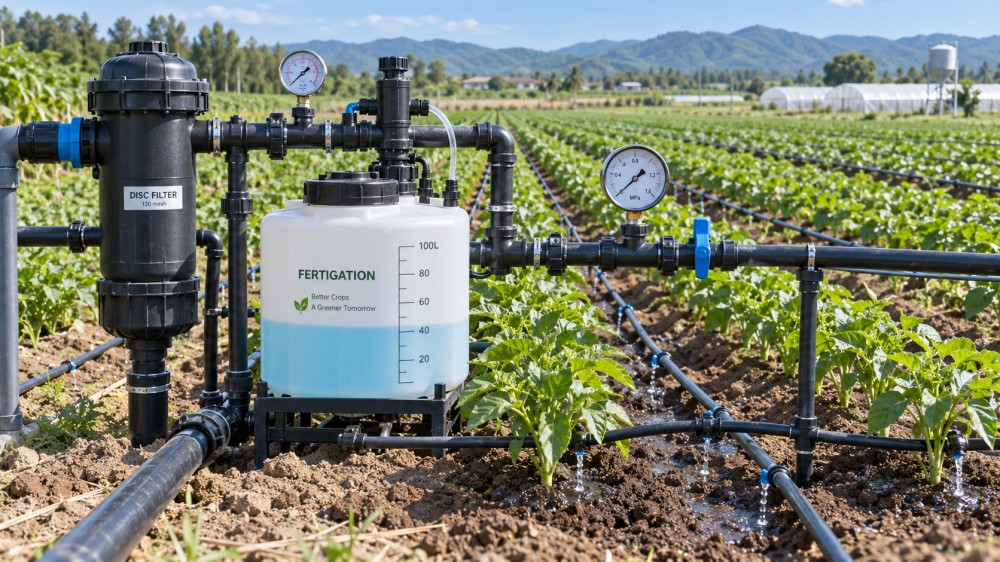
Water scheduling should account for more than daily crop demand. Root depth, soil water-holding capacity, bed geometry, mulch, rainfall, salinity, and the wetted pattern created by the emitter all influence the correct irrigation pulse. Short, frequent applications can maintain a stable moisture band in coarse soils, but excessively short cycles may fail to move nutrients far enough into the active root zone. Longer cycles improve horizontal and vertical wetting, yet they also increase the chance that nitrate moves below shallow roots in sandy profiles. The suitable duration is defined by wetting behavior, not by a universal runtime.
Nutrient placement is shaped by the irrigation pulse
A precision fertigation program separates three decisions that are often confused: how much nutrient is required over a crop period, when the plant can use it, and how the nutrient should be distributed during an irrigation event. Delivering the correct seasonal fertilizer quantity does not ensure effective uptake if most of it arrives before root activity is established or after water has moved beyond the root zone.
Injection timing within a cycle is particularly important. Starting fertilizer injection immediately can leave little clean water ahead of the nutrient solution to establish a wetted path. Injecting too late may leave fertilizer in headers, laterals, or shallow soil near emitters when the system stops. A common operating sequence uses an initial water phase to stabilize pressure and wet the zone, a measured injection period, and a final flushing phase that clears the distribution lines while moving dissolved nutrients into the intended soil volume. The duration of each phase should be verified through field observation, not assumed from controller settings alone.
Crop stage changes the preferred nutrient ratio and delivery frequency. Early root development often benefits from a program that avoids high salt concentration near young roots. During rapid vegetative growth, nitrogen demand may rise alongside water use. Reproductive stages can require a different balance, while late-season programs often need tighter control to avoid stimulating unwanted vegetative growth or leaving salts in the root zone. These are scheduling questions as much as fertilizer questions.
Concentration must be judged with water volume
Fertilizer concentration in the stock tank is not the same as concentration at the emitter. The final concentration depends on stock solution strength, injection rate, total irrigation flow, and the time the injector remains active. A highly concentrated stock solution can still produce an acceptable field concentration if it is proportioned accurately into a large water stream. Conversely, a modest stock solution can become problematic when zone flow is low or an injection pump delivers more than expected.
Electrical conductivity and pH provide operational indicators, but neither should be interpreted alone. A conductivity increase confirms that dissolved salts are present; it does not identify which nutrients are present, whether distribution is uniform, or whether the root zone is accumulating unwanted salts. Water pH affects solubility and compatibility, yet the pH of the irrigation water does not directly describe the chemical conditions at every root surface. Soil or substrate testing, water analysis, and emitter-area observations remain necessary when diagnosing poor response.
Fertilizer chemistry has to match the irrigation hardware
Water-soluble fertilizer is not automatically suitable for every fertigation installation. The source water may contain calcium, magnesium, bicarbonate, iron, suspended solids, or high alkalinity. These constituents can react with phosphate-containing products, sulfates, or alkaline materials and form deposits in tanks, injectors, filters, and emitters. A product that dissolves cleanly in a laboratory container can still create precipitation after dilution into hard irrigation water.
Compatibility should be considered at the actual mixing concentration and temperature. Calcium-containing fertilizers and phosphate or sulfate sources are frequently kept in separate stock tanks because direct mixing at high concentration can create insoluble solids. Acidification can help manage bicarbonate-related deposits under controlled conditions, but the acid source, target water chemistry, injection point, equipment materials, and safety arrangements must be evaluated together. An acidic solution that protects emitters may damage unsuitable metal components, seals, or fittings.
Tank design matters. Dry products require enough agitation to dissolve without leaving sediment below the suction point. Liquid formulations can stratify or crystallize during storage if temperature conditions change. The suction line should be positioned to avoid drawing settled material, while the tank should still be capable of being fully cleaned. Clear labeling of stock tanks, backflow protection, and isolation valves reduce the risk of introducing the wrong material into a line or allowing irrigation water to enter a fertilizer tank.
Injection equipment must be selected for the fluid being handled. Venturi injectors depend on pressure differential and can be effective in stable hydraulic conditions, but their dosing rate can shift when zone pressure changes. Positive-displacement pumps provide more direct metering, although diaphragm materials, seals, tubing, and check valves must tolerate the fertilizer solution. Corrosive or acidic products demand compatible wetted materials and routine inspection. A dosing pump that is chemically compatible but poorly calibrated still creates application error.
Monitoring needs a decision path
Moisture sensors, flow meters, pressure gauges, conductivity probes, weather information, and controller records produce useful data only when readings lead to a defined response. Installing sensors without agreeing on placement, baseline conditions, and follow-up action often creates a stream of numbers with little operating value.
Sensor depth should reflect root distribution and the question being asked. A shallow sensor may show rapid wetting and drying near the emitter, while a deeper sensor indicates whether water is moving beyond the primary root zone. Placing all sensors in the visually best area can hide the variation that the system must manage. Representative locations may include different soil textures, elevation positions, irrigation zones, and crop vigor areas, provided each location remains practical to inspect and maintain.
Data interpretation also requires timing. A moisture reading taken immediately after a long irrigation event describes a different condition from a reading taken before the next cycle. Conductivity trends can be affected by drying soil, fertilizer injection, rainfall, and sensor location. Rather than reacting to one abnormal value, compare the reading with the irrigation record, recent weather, injection log, and nearby pressure or flow observations. This prevents a controller adjustment from being used to solve a blockage, and prevents extra fertilizer from being used to solve inadequate wetting.
Commissioning exposes errors before they become crop variability
The period after installation should verify both water delivery and nutrient delivery. Each zone needs a known baseline for inlet pressure, end-of-line pressure, flow, runtime, and emitter discharge at representative points. Filters should be checked under clean and loaded conditions. Automatic valves need to open and close fully at the expected pressure, and pressure regulators should be tested while adjacent zones are operating in the planned sequence.
Fertilizer injection requires a separate test. A measured volume of water can be used to confirm injector output over a defined period before nutrient solutions are introduced. The test should include normal zone flow and the lowest expected flow condition, because proportional performance can change when a small zone is irrigated. Line travel time must also be established: material injected at the headworks does not reach every emitter instantly. Controller programs that ignore this travel time tend to underdose early zones or leave fertilizer in pipes after shutdown.
Backflow prevention and flushing arrangements deserve equal attention. Fertilizer solution must be prevented from moving toward the source water line during pressure loss or pump stoppage. After injection, flushing should clear fertilizer from the distribution network without applying unnecessary deep percolation. The required flush duration depends on pipe volume, flow rate, and network layout. It should be calculated from the system and then confirmed at the farthest practical point.
Common symptoms can have different causes
Patchy crop response is often attributed to nutrient formulation, but the pattern offers clues. A repeated issue at the ends of laterals suggests hydraulic loss or plugging. Random weak areas may follow soil texture, compaction, root disease, or installation damage. Uniform stress across a zone can arise from a scheduling error, injector calibration drift, source-water change, or a valve that does not deliver the planned flow. Treating every symptom as a nutrient shortage can increase salt load while leaving the original fault untouched.
Emitter clogging also has several pathways. Mineral precipitation is linked to water chemistry and fertilizer compatibility; biological growth is often associated with untreated water sources and stagnant sections; physical blockage points toward sediment management, filtration rating, damaged lines, or poor flushing. The corrective treatment must match the deposit. Acid treatment will not remove all organic matter, and increased filtration will not resolve a compatibility reaction occurring inside the stock tank.
Precision fertigation works best when the irrigation network, fertilizer program, and monitoring routine are operated as a connected control system. Stable hydraulics place water predictably, compatible soluble inputs keep the system open, calibrated injection establishes dose, and field measurements reveal whether the intended root-zone conditions are actually being achieved.
Related News
 Antioxidants & Natural PreservativesWhat Quality Checks Matter When Sourcing Butylparaben for Personal CareButylparaben for personal care sourcing guide: compare assay, impurities, physical performance, documentation, traceability, and supplier quality to reduce formulation risk.MORE+
 Nano-microcapsule FormulationsHow Encapsulated Flavors Protect Taste During Processing and StorageEncapsulated Flavors protect taste from heat, oxygen, moisture, and storage loss. Explore smarter release, carrier selection, and processing strategies.MORE+
 Chelated Trace Element FertilizersHow Greenhouse Fertigation Systems Reduce Water and Fertilizer WasteGreenhouse fertigation systems reduce water and fertilizer waste with precise dosing, uniform irrigation, drainage monitoring, and smarter crop-zone control. Learn practical strategies.MORE+
 Supercritical CO2 Essential OilsHow Natural Essential Oil Blends Improve Consistent Product FragranceNatural essential oil blends help brands achieve consistent, appealing fragrance across batches. Explore smart blend design, stability testing, and product compatibility strategies.MORE+
 Non-ionic Surfactants & DefoamersHow to Choose Non Ionic Low Foaming Surfactants for CIP CleaningNon ionic low foaming surfactants for CIP cleaning: learn how to balance wetting, foam control, compatibility, and rinseability for reliable cleaning performance.MORE+
 Nano-microcapsule FormulationsHow Food Grade Cyclodextrin Complexes Protect Sensitive FlavorsFood grade cyclodextrin inclusion complexes help protect sensitive flavors from oxidation, evaporation, and processing loss while supporting controlled release and consistent sensory quality.MORE+
 Polymer-Coated Water Soluble NPKHow Fertilizer Coating Polymers Improve NPK Granule ReleaseFertilizer coating polymers for NPK granules improve controlled nutrient release, reduce loss risks, and enhance product consistency. Discover key selection and process insights.MORE+
 Chelated Trace Element FertilizersWhat Diammonium Phosphate Means for Crop Nutrition PlanningDiammonium Phosphate: learn how DAP supports early phosphorus access, nitrogen budgeting, smart placement, and balanced crop nutrition planning.MORE+
 Maillard Reaction Savory FlavorsHow to Assess a Flavor Bases Supplier List for Reliable SourcingGlobal Fine Chemicals & Agrochemical Intelligence Network flavor bases supplier list: assess specs, samples, supply risk, and true cost to source with confidence.MORE+
 Hydrocolloids & EmulsifiersHow Konjac Gum Powder Improves Texture in Low-Calorie FoodsKonjac gum powder improves body, stability, and mouthfeel in low-calorie foods. Discover practical tips for smoother sauces, beverages, and reduced-fat formulations.MORE+
 Supercritical CO2 Essential OilsWhat to Check Before Choosing a Botanical Essential Oils ManufacturerChoose a botanical essential oils manufacturer with confidence. Explore key checks for purity, traceability, compliance, batch consistency, and reliable supply.MORE+
 Microencapsulated FragrancesHow Fragrance Carriers for Detergents Improve Scent PerformanceFragrance carriers for detergents improve stability, fabric deposition, and long-lasting scent. Explore practical solutions for better wash-to-wear fragrance performance.MORE+
 Antioxidants & Natural PreservativesWhen Propyl Gallate Antioxidant Is the Right Choice for Oil StabilityPropyl gallate antioxidant: learn when it is the right choice for oil stability, shelf-life protection, processing compatibility, and smarter formulation decisions.MORE+
 Antioxidants & Natural PreservativesHow Potassium Sorbate Extends Shelf Life in Food and Beverage ProductsPotassium Sorbate helps food and beverage brands control yeast and mold spoilage. Explore pH, dosage, processing, and packaging strategies for reliable shelf life.MORE+
 Antioxidants & Natural PreservativesHow to Source Bulk Herbal Extracts With Reliable Quality ControlBulk herbal extracts sourcing guide: compare suppliers, verify traceability, review CoAs, and build reliable quality controls for safer, consistent purchasing.MORE+
 Antioxidants & Natural PreservativesWhat to Check Before Sourcing Butylparaben for Personal Care FormulasButylparaben for personal care sourcing guide: check market eligibility, purity, supplier controls, formula compatibility, packaging, and total risk before buying.MORE+
 Targeted Bio-pesticides & APIsChoosing Microbial Fungicides for Foliar Diseases in Integrated Crop ProgramsMicrobial fungicides for foliar diseases: learn how to match biology, formulation, tank compatibility, and timing for stronger integrated crop protection.MORE+
 Targeted Bio-pesticides & APIsHow Microbial Insecticides Control Caterpillars With Lower Crop Residue RiskMicrobial insecticides for caterpillars help protect crops with targeted early-larval control and lower residue-management pressure. Learn timing, coverage, compliance, and scouting essentials.MORE+
 Microencapsulated FragrancesHow to Add Encapsulated Laundry Fragrances Without Weakening Wash ResultsEncapsulated laundry fragrances: learn how to boost long-lasting scent while protecting cleaning power, stability, foam control, and fabric care.MORE+
 Supercritical CO2 Essential OilsHow Aroma Ingredients Shape Lasting and Skin-Safe Personal Care ProductsAroma ingredients for personal care: discover how to achieve lasting scent, formulation stability, skin safety, and confident product performance.MORE+
 Targeted Bio-pesticides & APIsInsecticides Explained Through Labels, Active Ingredients, and SafetyInsecticides explained through labels, active ingredients, formulations, and safety. Learn how to compare products, manage risk, and make informed crop protection decisions.MORE+
 Heavy-duty Industrial DegreasersHow to Select Parts Wash Cleaners for Automotive ComponentsParts wash cleaners for automotive components: learn how to match chemistry, materials, rinsing, safety, and waste controls for reliable cleaning results.MORE+
 Chelated Trace Element FertilizersHow Precision Fertigation Systems Improve Water and Nutrient ControlPrecision fertigation systems improve water and nutrient control with accurate dosing, uniform irrigation, smart monitoring, and reduced waste. Discover how to optimize crop performance.MORE+
 Hydrocolloids & EmulsifiersHow Bulk Price Factors Affect Hydrocolloid Stabilizer Blend SourcingHydrocolloid stabilizer blends bulk price: compare dosage efficiency, quality consistency, logistics, and documentation to reduce total sourcing costs.MORE+
 Zero-Calorie Sweeteners & AcidulantsHow to Choose a Natural Sweeteners Supplier for Clean-Label ProductsNatural sweeteners supplier selection guide for clean-label products: compare formulation fit, traceability, documentation, and supply reliability.MORE+
 Non-ionic Surfactants & DefoamersWhat Cationic Surfactants Do and Where They Are UsedCationic Surfactants deliver antimicrobial action, conditioning, antistatic control, and surface treatment benefits. Explore key uses, compatibility, and safe selection tips.MORE+
 Targeted Bio-pesticides & APIsHow to Evaluate Pesticide Suspension Concentrates for Field StabilityPesticide Suspension Concentrates: learn how to evaluate field stability, redispersibility, dilution, tank-mix compatibility, and spray safety for reliable performance.MORE+
 Hydrocolloids & EmulsifiersHow Hydrocolloid Systems for Meat Products Improve Texture and YieldHydrocolloid systems for meat products improve yield, texture, water retention, and slicing quality. Explore practical formulation strategies for stable, high-performing meat products.MORE+
 Microencapsulated FragrancesHow Laundry Fragrances for Liquid Detergents Improve Scent LongevityLaundry fragrances for liquid detergents: discover how fragrance design, deposition, and encapsulation create lasting fabric freshness and stronger product appeal.MORE+
 Nano-microcapsule FormulationsChoosing Fragrance Preparations That Perform Well in Personal WashFragrance preparations for personal wash: learn how to select options that protect clarity, stability, foam, scent performance, and packaging compatibility.MORE+
 Controlled-Release ThermodynamicsModified Cyclodextrins Explained for Controlled Fragrance ReleaseModified cyclodextrins enable controlled fragrance release, odor control, and volatile-note protection. Explore how they optimize performance in detergents, fabric care, and more.MORE+
 Microencapsulated FragrancesHow Fragrance Delivery Systems Improve Fabric Softener LongevityFragrance delivery systems for fabric softeners improve scent longevity through smart protection, reliable deposition, and controlled release for lasting freshness.MORE+
 Supercritical CO2 Essential OilsHow to Evaluate a Natural Cardamom Oil Supplier for Reliable SupplyNatural cardamom oil supplier evaluation guide: verify botanical origin, purity, batch consistency, documentation, packaging, and delivery reliability for confident sourcing.MORE+
 Maillard Reaction Savory FlavorsHow Ethyl Maltol Purity Testing Supports Flavor Safety ComplianceEthyl Maltol purity testing strengthens flavor safety compliance through identity checks, impurity profiling, supplier verification, and audit-ready documentation.MORE+
 Microencapsulated FragrancesEssential Oil Extracts Compared for Fragrance and Wellness UsesEssential Oil Extracts compared for fragrance and wellness: explore scent profiles, extraction methods, stability, safety, and sourcing insights for smarter formulation choices.MORE+
 Zero-Calorie Sweeteners & AcidulantsWhat Drives Zero Calorie Sweeteners Bulk Price in 2026Zero calorie sweeteners bulk price in 2026: compare specifications, dosage, quality, freight, and supply risk to make smarter sourcing decisions.MORE+
 EPA FIFRA & FDA GRAS RegsSynthetic Food Preservatives Rules That Support Safer FormulasSynthetic Food Preservatives: learn the rules for safer formulas, compliant use levels, validated shelf life, labeling, and reliable microbial control.MORE+
 Micelle Fluidics & ChelationHow Anionic Industrial Dispersants Improve Coating StabilityAnionic industrial dispersants improve coating stability, pigment wetting, viscosity control, gloss, and storage performance. Learn how to select and test the right solution.MORE+
 Supercritical CO2 Essential OilsHow to Choose Eucalyptus Oil Grades for Clean, Consistent ProductsChoose the right Eucalyptus Oil grade with confidence. Compare cineole content, purity, origin, processing, documentation, and application fit for consistent products.MORE+
 Micelle Fluidics & ChelationWhat Are Cationic Surfactants and Where Are They Commonly Used?Cationic Surfactants deliver powerful surface affinity for disinfection, fabric softening, hair conditioning, antistatic control, and industrial treatments. Explore key uses and selection factors.MORE+







































