
Is Semiconductor Cleaner Packaging Critical to Shelf Life?
A high-purity cleaner can leave the supplier’s plant within specification and still become a process risk before it reaches the fab. The formulation may be chemically sound, yet the container can introduce particles, extractables, moisture, dissolved gases, or trace metals that are unacceptable in a sensitive cleaning step.
So, is semiconductor process cleaner packaging critical for shelf life? In most high-purity applications, yes. Shelf life is not simply the date printed on a label. It is the period during which a cleaner remains chemically stable, contamination-controlled, safely handled, and fit for its intended process. Packaging is part of that protection system—not an afterthought added once the chemistry is finished.
For procurement teams, process engineers, and quality managers, this changes the sourcing conversation. The question is not only “What is the cleaner’s purity at release?” It is also “What will it be like after storage, transport, partial use, and connection to our chemical delivery system?”
Why shelf life means more than chemical stability
In many chemical categories, shelf life is mainly associated with active-content loss, color change, viscosity drift, or phase separation. Semiconductor process cleaners require a broader view because their performance can be affected by extremely low levels of unwanted material. A change that would be insignificant in a general industrial cleaner may create yield concerns, residue issues, or inconsistent surface preparation in a semiconductor-related application.
A cleaner’s usable life commonly depends on five linked conditions:
- Formula stability: whether the acid, base, solvent, surfactant, chelant, oxidizer, or other functional component remains within its intended composition range.
- Particle control: whether the package sheds particles or allows external particulate ingress during filling, storage, and dispensing.
- Trace contamination control: whether metals, organics, ions, plastic additives, or other extractables migrate from the packaging system.
- Atmospheric protection: whether the material is protected from moisture, oxygen, carbon dioxide, and airborne contaminants.
- Process compatibility: whether the package and transfer components preserve the cleaner’s fitness for the specific wafer, substrate, metal, or equipment-cleaning process.
This is why a shelf-life statement should never be reviewed in isolation. A supplier may define shelf life under unopened, controlled storage conditions. Once a drum is opened repeatedly, stored in a warm warehouse, or transferred through unsuitable tubing, the original assumptions may no longer apply.
The packaging is part of the contamination-control boundary
Semiconductor cleaning chemistry often interacts with materials more aggressively than buyers expect. Acidic, alkaline, oxidizing, solvent-based, or surfactant-rich cleaners can slowly attack certain plastics, seals, pigments, adhesives, linings, and closures. Even when the container does not visibly deform, small amounts of extractable material may enter the liquid over time.
For this reason, packaging selection should be evaluated as a complete system: bottle or drum body, cap, gasket, vent, inner liner, dip tube, dispensing port, label adhesive, pallet protection, and any intermediate transfer connection. A compatible container with an incompatible closure is not a fully compatible package.
Common high-purity packaging materials include fluoropolymer-based containers and selected high-density polyethylene systems, but suitability depends on the formulation and purity target. The phrase “chemical resistant” is not enough. A material may resist swelling or leakage while still contributing organic extractables, ionic contamination, or particles that matter at the point of use.
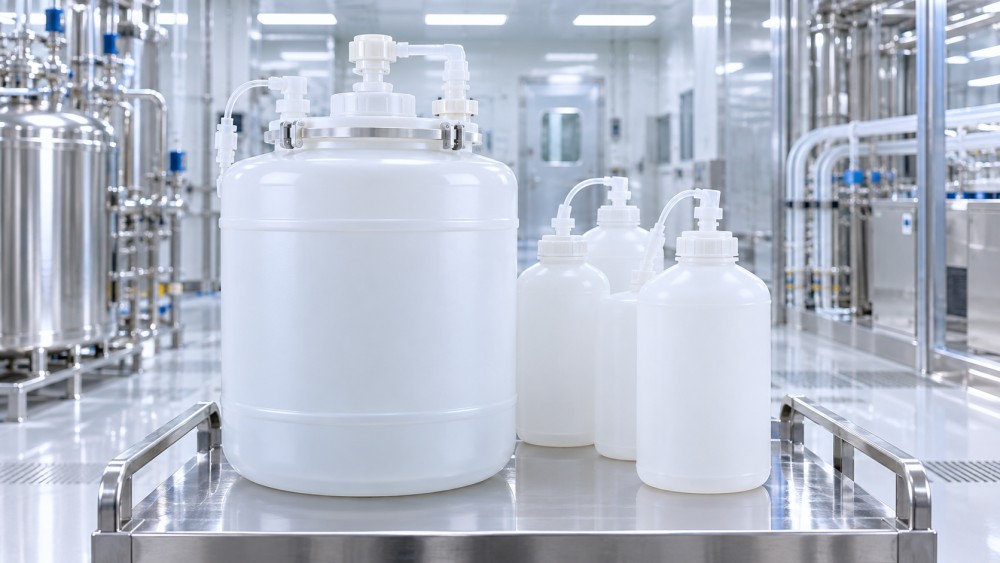
The practical takeaway is simple: packaging should be qualified against the actual cleaner, not merely chosen from a generic chemical-resistance chart. This matters especially for products intended for wafer cleaning, precision metal cleaning, electronic assembly cleaning, or maintenance of high-purity processing equipment.
How packaging can shorten the effective shelf life
Several failure pathways can occur quietly. They may not be visible in a routine warehouse inspection, which is why receiving checks and supplier documentation deserve attention.
Moisture uptake and atmospheric exposure
Hygroscopic cleaners can absorb water through repeated opening or insufficiently protected closures. In some formulations, this changes concentration, density, conductivity, or cleaning behavior. Other chemistries may absorb carbon dioxide from air, shifting pH or creating unwanted carbonate species. Solvent-containing products can lose volatile components if vapor transmission through packaging is too high or if closure integrity is poor.
The risk becomes greater when containers are partially used. Each opening introduces a new opportunity for humid air and airborne particles to enter. A package designed only for shipment may not be adequate for frequent plant-floor dispensing.
Extractables, leachables, and chemical interaction
Plasticizers, antioxidants, slip agents, mold-release residues, pigments, and polymer degradation products can migrate into a cleaner. The effect may be gradual, and the level may depend on storage temperature, contact time, surface area, and chemical aggressiveness. Strong solvents and surfactant systems are particularly worth reviewing because they can solubilize organic residues that less aggressive products would leave untouched.
Leachables are not merely an analytical curiosity. They can affect residue profiles, downstream coating adhesion, wetting behavior, bath performance, or sensitive analytical controls. Where a cleaner supports critical production, buyers should ask what extractables or leachables evaluation has been performed and under which storage conditions.
Particle shedding and closure wear
Particles may originate from the container wall, cap threads, liner, gasket, or transfer fitting. Mechanical abrasion during transport can worsen the problem. So can repeatedly opening and tightening a closure in a busy production environment. If the cleaner is filtered before shipment, packaging-related particles can undermine that control after filling.
Particle expectations should be aligned with the application. The acceptable particulate level for general industrial degreasing is very different from that for a cleaner used near sensitive semiconductor process steps.
Light, heat, and transport stress
Some formulations are sensitive to light or elevated temperature. A package with poor light protection can accelerate degradation, while heat exposure during container storage or global logistics can increase diffusion, vapor loss, pressure buildup, or extractable migration. Temperature excursions are not always avoidable, but they should be considered during packaging design and logistics planning.
What to ask a supplier before approving a cleaner package
Packaging review does not need to become an endless technical exercise. It should, however, go beyond asking for a safety data sheet and a container photo. A well-structured discussion can reveal whether the supplier understands the real operating conditions of the product.
For critical applications, request a certificate of analysis that is meaningful for the intended use rather than relying solely on a generic product specification. A technical data sheet may describe cleaning performance, while a separate packaging and quality discussion addresses how that performance is preserved until use.
Choose the package around the use pattern, not just the shipment size
A common purchasing mistake is selecting the largest available container because the unit cost appears lower. That decision may be sensible for high-throughput, closed-loop consumption. It can be counterproductive when consumption is slow and the same container is opened repeatedly over weeks or months.
Smaller packages may reduce the time a partially used cleaner remains exposed to the plant environment. Closed-dispense containers may reduce operator handling and improve consistency. Bulk delivery can be appropriate where facilities have validated receiving, storage, filtration, and transfer infrastructure. No format is universally best; the right choice depends on consumption rate, storage capability, handling discipline, and process sensitivity.
Consider a cleaner used only during occasional maintenance of precision equipment. A large drum may sit half-empty, experiencing repeated exposure every time a technician draws material. In that situation, the nominal shelf life of the unopened drum tells only part of the story. A smaller sealed format, even at a higher per-liter cost, may lower practical contamination risk and reduce waste from expired residual material.
Storage discipline protects the package’s intended performance
Even the best packaging cannot compensate for poor storage practice. Cleaner containers should remain sealed until needed and should be stored within the supplier’s stated temperature range. Avoid direct sunlight, heat sources, and areas with sharp temperature cycling. Containers should be inspected for swelling, discoloration, leakage, damaged closures, unreadable labels, or signs of mishandling before use.
Once opened, define a clear site procedure. Record the opening date, use compatible dispense equipment, minimize open-pour operations, and avoid returning unused material to the original container unless the supplier explicitly permits it. Returning material can introduce contamination from tools, the production environment, or another chemical stream.
It is also wise to separate the concept of supplier shelf life from an internal open-container use period. The first applies to a sealed package under defined conditions. The second is a site-specific control based on exposure, use frequency, and process risk. High-purity operations often need both.
Warning signs that packaging may be affecting cleaner quality
Visible changes deserve attention, but they are not the only indicators. Cloudiness, sediment, unexpected color shift, container deformation, cap cracking, pressure release on opening, or an unusual odor can all warrant investigation. Yet many relevant contaminants are invisible. A cleaner may look normal while carrying a change in trace metals, particles, organic background, or water content.
When process results drift, packaging should be included in the root-cause review alongside formulation, storage history, filtration, dispense lines, and tool conditions. It is easy to focus on the chemical because it is the obvious variable. In practice, the container and handling path may be where the quality boundary was lost.
A practical approval path for procurement and process teams
Start by defining what “fit for use” means for the cleaner: residue sensitivity, allowable ions or metals, particle expectations, storage duration, and point-of-use delivery method. Then compare the supplier’s package design and shelf-life evidence against those requirements.
If the application is especially sensitive, qualify a representative lot after realistic storage and handling. Review not only the unopened container but also the consequences of connection, partial withdrawal, and exposure during normal operations. Procurement can lead the documentation process, while quality, EHS, process engineering, and facilities teams each examine the parts that affect their responsibilities.
FCAS tracks high-purity industrial cleaning materials, specialty surfactants, solvents, and formulation considerations because buying decisions in these categories are rarely based on chemical name alone. Packaging safety, logistics conditions, documentation readiness, material compatibility, and batch consistency all shape whether a cleaner delivers the expected result at the point of application.
The bottom line
Semiconductor cleaner packaging is critical to shelf life because it influences far more than transport convenience. It helps determine whether the formulation remains stable, whether contamination stays controlled, and whether the product reaching the process is still equivalent to the product originally qualified.
The most reliable approach is to treat the cleaner, its package, and its dispensing route as one system. When suppliers and buyers evaluate that system together, they are better positioned to protect process consistency, avoid avoidable investigation work, and make shelf-life claims meaningful in the real world.
Related News
 Antioxidants & Natural PreservativesWhat Quality Checks Matter When Sourcing Butylparaben for Personal CareButylparaben for personal care sourcing guide: compare assay, impurities, physical performance, documentation, traceability, and supplier quality to reduce formulation risk.MORE+
 Nano-microcapsule FormulationsHow Encapsulated Flavors Protect Taste During Processing and StorageEncapsulated Flavors protect taste from heat, oxygen, moisture, and storage loss. Explore smarter release, carrier selection, and processing strategies.MORE+
 Chelated Trace Element FertilizersHow Greenhouse Fertigation Systems Reduce Water and Fertilizer WasteGreenhouse fertigation systems reduce water and fertilizer waste with precise dosing, uniform irrigation, drainage monitoring, and smarter crop-zone control. Learn practical strategies.MORE+
 Supercritical CO2 Essential OilsHow Natural Essential Oil Blends Improve Consistent Product FragranceNatural essential oil blends help brands achieve consistent, appealing fragrance across batches. Explore smart blend design, stability testing, and product compatibility strategies.MORE+
 Non-ionic Surfactants & DefoamersHow to Choose Non Ionic Low Foaming Surfactants for CIP CleaningNon ionic low foaming surfactants for CIP cleaning: learn how to balance wetting, foam control, compatibility, and rinseability for reliable cleaning performance.MORE+
 Nano-microcapsule FormulationsHow Food Grade Cyclodextrin Complexes Protect Sensitive FlavorsFood grade cyclodextrin inclusion complexes help protect sensitive flavors from oxidation, evaporation, and processing loss while supporting controlled release and consistent sensory quality.MORE+
 Polymer-Coated Water Soluble NPKHow Fertilizer Coating Polymers Improve NPK Granule ReleaseFertilizer coating polymers for NPK granules improve controlled nutrient release, reduce loss risks, and enhance product consistency. Discover key selection and process insights.MORE+
 Chelated Trace Element FertilizersWhat Diammonium Phosphate Means for Crop Nutrition PlanningDiammonium Phosphate: learn how DAP supports early phosphorus access, nitrogen budgeting, smart placement, and balanced crop nutrition planning.MORE+
 Maillard Reaction Savory FlavorsHow to Assess a Flavor Bases Supplier List for Reliable SourcingGlobal Fine Chemicals & Agrochemical Intelligence Network flavor bases supplier list: assess specs, samples, supply risk, and true cost to source with confidence.MORE+
 Hydrocolloids & EmulsifiersHow Konjac Gum Powder Improves Texture in Low-Calorie FoodsKonjac gum powder improves body, stability, and mouthfeel in low-calorie foods. Discover practical tips for smoother sauces, beverages, and reduced-fat formulations.MORE+
 Supercritical CO2 Essential OilsWhat to Check Before Choosing a Botanical Essential Oils ManufacturerChoose a botanical essential oils manufacturer with confidence. Explore key checks for purity, traceability, compliance, batch consistency, and reliable supply.MORE+
 Microencapsulated FragrancesHow Fragrance Carriers for Detergents Improve Scent PerformanceFragrance carriers for detergents improve stability, fabric deposition, and long-lasting scent. Explore practical solutions for better wash-to-wear fragrance performance.MORE+
 Antioxidants & Natural PreservativesWhen Propyl Gallate Antioxidant Is the Right Choice for Oil StabilityPropyl gallate antioxidant: learn when it is the right choice for oil stability, shelf-life protection, processing compatibility, and smarter formulation decisions.MORE+
 Antioxidants & Natural PreservativesHow Potassium Sorbate Extends Shelf Life in Food and Beverage ProductsPotassium Sorbate helps food and beverage brands control yeast and mold spoilage. Explore pH, dosage, processing, and packaging strategies for reliable shelf life.MORE+
 Antioxidants & Natural PreservativesHow to Source Bulk Herbal Extracts With Reliable Quality ControlBulk herbal extracts sourcing guide: compare suppliers, verify traceability, review CoAs, and build reliable quality controls for safer, consistent purchasing.MORE+
 Antioxidants & Natural PreservativesWhat to Check Before Sourcing Butylparaben for Personal Care FormulasButylparaben for personal care sourcing guide: check market eligibility, purity, supplier controls, formula compatibility, packaging, and total risk before buying.MORE+
 Targeted Bio-pesticides & APIsChoosing Microbial Fungicides for Foliar Diseases in Integrated Crop ProgramsMicrobial fungicides for foliar diseases: learn how to match biology, formulation, tank compatibility, and timing for stronger integrated crop protection.MORE+
 Targeted Bio-pesticides & APIsHow Microbial Insecticides Control Caterpillars With Lower Crop Residue RiskMicrobial insecticides for caterpillars help protect crops with targeted early-larval control and lower residue-management pressure. Learn timing, coverage, compliance, and scouting essentials.MORE+
 Microencapsulated FragrancesHow to Add Encapsulated Laundry Fragrances Without Weakening Wash ResultsEncapsulated laundry fragrances: learn how to boost long-lasting scent while protecting cleaning power, stability, foam control, and fabric care.MORE+
 Supercritical CO2 Essential OilsHow Aroma Ingredients Shape Lasting and Skin-Safe Personal Care ProductsAroma ingredients for personal care: discover how to achieve lasting scent, formulation stability, skin safety, and confident product performance.MORE+
 Targeted Bio-pesticides & APIsInsecticides Explained Through Labels, Active Ingredients, and SafetyInsecticides explained through labels, active ingredients, formulations, and safety. Learn how to compare products, manage risk, and make informed crop protection decisions.MORE+
 Heavy-duty Industrial DegreasersHow to Select Parts Wash Cleaners for Automotive ComponentsParts wash cleaners for automotive components: learn how to match chemistry, materials, rinsing, safety, and waste controls for reliable cleaning results.MORE+
 Chelated Trace Element FertilizersHow Precision Fertigation Systems Improve Water and Nutrient ControlPrecision fertigation systems improve water and nutrient control with accurate dosing, uniform irrigation, smart monitoring, and reduced waste. Discover how to optimize crop performance.MORE+
 Hydrocolloids & EmulsifiersHow Bulk Price Factors Affect Hydrocolloid Stabilizer Blend SourcingHydrocolloid stabilizer blends bulk price: compare dosage efficiency, quality consistency, logistics, and documentation to reduce total sourcing costs.MORE+
 Zero-Calorie Sweeteners & AcidulantsHow to Choose a Natural Sweeteners Supplier for Clean-Label ProductsNatural sweeteners supplier selection guide for clean-label products: compare formulation fit, traceability, documentation, and supply reliability.MORE+
 Non-ionic Surfactants & DefoamersWhat Cationic Surfactants Do and Where They Are UsedCationic Surfactants deliver antimicrobial action, conditioning, antistatic control, and surface treatment benefits. Explore key uses, compatibility, and safe selection tips.MORE+
 Targeted Bio-pesticides & APIsHow to Evaluate Pesticide Suspension Concentrates for Field StabilityPesticide Suspension Concentrates: learn how to evaluate field stability, redispersibility, dilution, tank-mix compatibility, and spray safety for reliable performance.MORE+
 Hydrocolloids & EmulsifiersHow Hydrocolloid Systems for Meat Products Improve Texture and YieldHydrocolloid systems for meat products improve yield, texture, water retention, and slicing quality. Explore practical formulation strategies for stable, high-performing meat products.MORE+
 Microencapsulated FragrancesHow Laundry Fragrances for Liquid Detergents Improve Scent LongevityLaundry fragrances for liquid detergents: discover how fragrance design, deposition, and encapsulation create lasting fabric freshness and stronger product appeal.MORE+
 Nano-microcapsule FormulationsChoosing Fragrance Preparations That Perform Well in Personal WashFragrance preparations for personal wash: learn how to select options that protect clarity, stability, foam, scent performance, and packaging compatibility.MORE+
 Controlled-Release ThermodynamicsModified Cyclodextrins Explained for Controlled Fragrance ReleaseModified cyclodextrins enable controlled fragrance release, odor control, and volatile-note protection. Explore how they optimize performance in detergents, fabric care, and more.MORE+
 Microencapsulated FragrancesHow Fragrance Delivery Systems Improve Fabric Softener LongevityFragrance delivery systems for fabric softeners improve scent longevity through smart protection, reliable deposition, and controlled release for lasting freshness.MORE+
 Supercritical CO2 Essential OilsHow to Evaluate a Natural Cardamom Oil Supplier for Reliable SupplyNatural cardamom oil supplier evaluation guide: verify botanical origin, purity, batch consistency, documentation, packaging, and delivery reliability for confident sourcing.MORE+
 Maillard Reaction Savory FlavorsHow Ethyl Maltol Purity Testing Supports Flavor Safety ComplianceEthyl Maltol purity testing strengthens flavor safety compliance through identity checks, impurity profiling, supplier verification, and audit-ready documentation.MORE+
 Microencapsulated FragrancesEssential Oil Extracts Compared for Fragrance and Wellness UsesEssential Oil Extracts compared for fragrance and wellness: explore scent profiles, extraction methods, stability, safety, and sourcing insights for smarter formulation choices.MORE+
 Zero-Calorie Sweeteners & AcidulantsWhat Drives Zero Calorie Sweeteners Bulk Price in 2026Zero calorie sweeteners bulk price in 2026: compare specifications, dosage, quality, freight, and supply risk to make smarter sourcing decisions.MORE+
 EPA FIFRA & FDA GRAS RegsSynthetic Food Preservatives Rules That Support Safer FormulasSynthetic Food Preservatives: learn the rules for safer formulas, compliant use levels, validated shelf life, labeling, and reliable microbial control.MORE+
 Micelle Fluidics & ChelationHow Anionic Industrial Dispersants Improve Coating StabilityAnionic industrial dispersants improve coating stability, pigment wetting, viscosity control, gloss, and storage performance. Learn how to select and test the right solution.MORE+
 Supercritical CO2 Essential OilsHow to Choose Eucalyptus Oil Grades for Clean, Consistent ProductsChoose the right Eucalyptus Oil grade with confidence. Compare cineole content, purity, origin, processing, documentation, and application fit for consistent products.MORE+
 Micelle Fluidics & ChelationWhat Are Cationic Surfactants and Where Are They Commonly Used?Cationic Surfactants deliver powerful surface affinity for disinfection, fabric softening, hair conditioning, antistatic control, and industrial treatments. Explore key uses and selection factors.MORE+







































