How Ultra-Pure Semiconductor Cleaners Improve Post-CMP Cleaning Results
Post-CMP cleaning succeeds or fails at the interface between contamination removal and surface preservation. A cleaner that removes visible slurry residue but leaves trace metals, organic fragments, ionic species, or chemistry-induced surface changes can still create downstream defects. Ultra-pure semiconductor cleaners improve results not merely because they contain fewer contaminants at delivery, but because their composition, filtration, packaging, and process behavior are controlled to reduce the number of variables introduced during an already contamination-sensitive step.
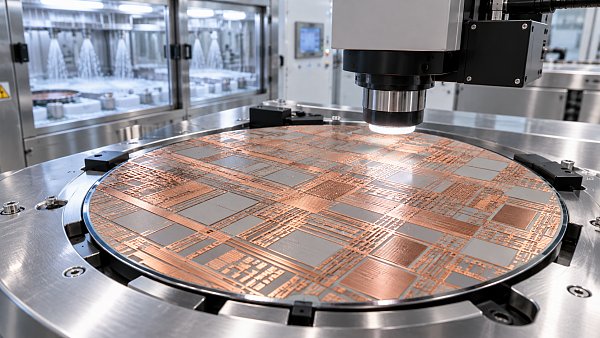
After chemical mechanical planarization (CMP), the wafer surface may carry abrasive particles, oxidizer residues, dissolved or redeposited metal species, pad debris, organic additives, and reaction by-products. The exact residue profile depends on the film being polished, slurry formulation, platen conditions, pad state, rinse sequence, and time before cleaning. Post-CMP chemistry therefore cannot be evaluated as a general-purpose detergent. It must be assessed as part of a coupled polishing-and-cleaning system.
Why post-CMP residues are difficult to remove
CMP does not leave one uniform type of contamination. Silica, ceria, alumina, and other abrasive systems behave differently on oxide, nitride, copper, cobalt, tungsten, barrier films, and dielectric stacks. Some particles are weakly retained and can be displaced through wetting and mechanical energy. Others are electrostatically bound, trapped at pattern features, associated with reaction films, or embedded in organic and inorganic residue layers.
Metal contamination adds a separate concern. During polishing, metal ions may originate from the film itself, slurry components, tool surfaces, or upstream process carryover. If they are not effectively complexed and rinsed away, they may redeposit as the chemistry changes during the cleaning sequence. In copper and cobalt processes, the cleaning chemistry must remove residues without accelerating corrosion, pitting, galvanic effects, or unacceptable dissolution. For dielectric surfaces, a formulation that is too aggressive can alter surface condition, affect hydrophilicity, or create pattern-dependent cleaning behavior.
This is why apparent particle-removal performance alone is an incomplete indicator. A wafer can pass a limited particle check while carrying ionic residues, metal traces, watermarks, or organic films that influence later deposition, adhesion, electrical reliability, or defect inspection results.
Ultra-purity changes the baseline contamination load
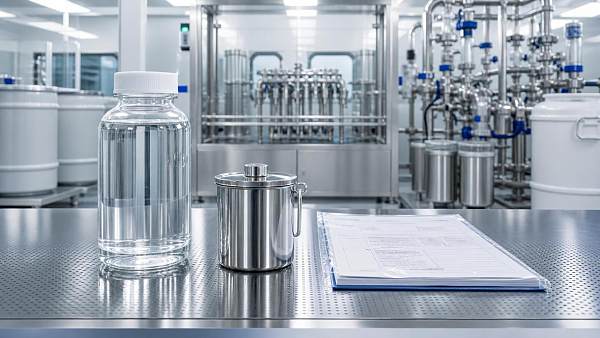
Ultra-pure semiconductor cleaners are designed to minimize contamination introduced by the cleaning material itself. The relevant concern extends beyond the active chemical. Water quality, raw-material impurity profiles, trace-metal control, anion and cation levels, total organic carbon, particles, microbial control where applicable, filtration performance, container extractables, and lot-to-lot consistency all affect the practical cleanliness of a delivered formulation.
In a high-purity process, a cleaning chemistry must not become a secondary contamination source. A formulation may have the correct nominal concentration and still create yield risk if it carries particles, trace metals, nonvolatile residues, or leachables from packaging. Such contaminants can be especially difficult to diagnose because their occurrence may be intermittent, lot-related, or linked to storage and dispensing conditions rather than to the nominal formulation design.
The benefit of ultra-pure chemistry is therefore partly preventive: it narrows the incoming contamination budget. It also improves interpretability during process optimization. When cleaner composition is stable and well characterized, changes in post-CMP defectivity are more likely to be traced to slurry behavior, tool condition, rinse performance, wafer handling, or process settings rather than uncontrolled variation in the cleaning chemical.
Cleaning performance depends on chemical selectivity, not cleaning strength alone
A useful post-CMP cleaner must create sufficient removal force against the target residue while remaining selective toward the underlying film stack. This balance is governed by several linked mechanisms.
Particle detachment depends on wetting, surface charge interactions, dispersancy, and the ability to prevent removed particles from reattaching. Surfactant and dispersant components can lower interfacial tension and help lift contamination from the wafer. Their value is limited, however, if they leave organic residues, generate difficult-to-rinse foam, or interact unfavorably with the slurry residue already present on the surface.
Metal-ion control often requires carefully selected complexing agents. A chelating component can keep dissolved metals in solution and reduce redeposition during the clean-and-rinse sequence. Yet excessive complexation or unsuitable pH can alter corrosion behavior, particularly for exposed metal features. The objective is not simply to dissolve more material; it is to remove unwanted residues at a controlled rate while preserving film integrity.
Organic residue removal may require oxidation, hydrolysis, solubilization, or emulsification, depending on the chemistry of polishing additives and pad-derived debris. The appropriate approach varies by CMP module. A formulation effective against organic residues from one slurry family may not perform similarly with another, because polymeric dispersants, inhibitors, oxidizers, and abrasives can form different residual layers.
pH control is particularly consequential. It affects particle charge, metal solubility, complexation equilibria, corrosion tendencies, and compatibility with oxide and dielectric surfaces. A broad statement that acidic or alkaline cleaning is “better” has little technical value without considering the polished material, slurry residue, downstream integration requirement, and equipment materials.
Rinse quality is part of cleaning quality
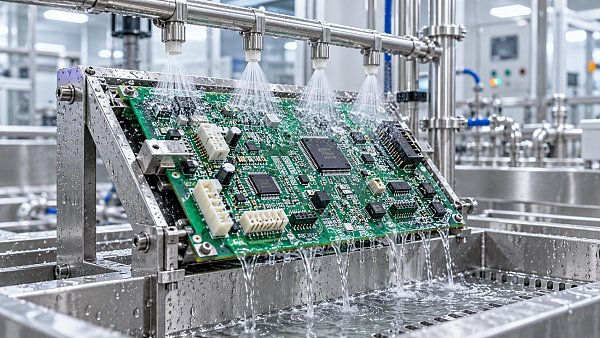
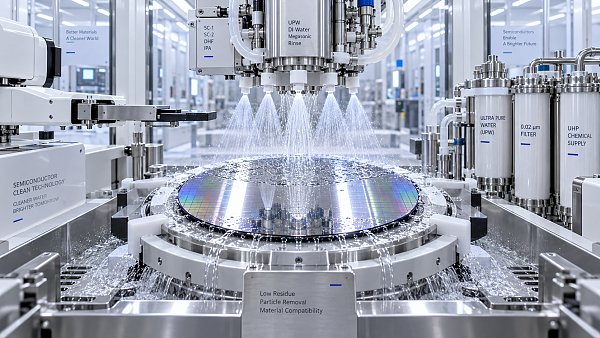
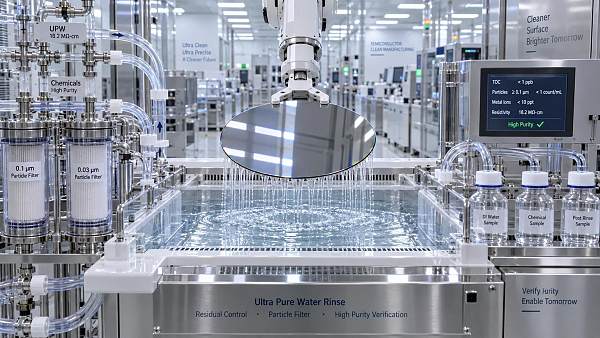
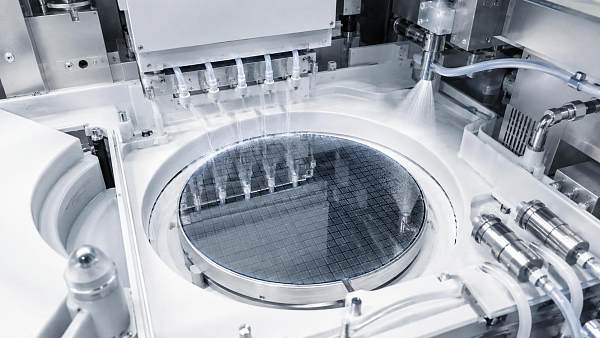
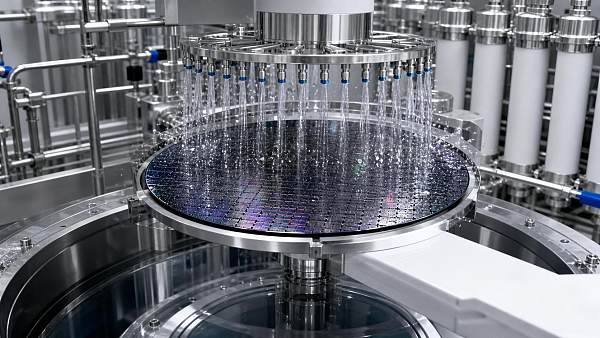
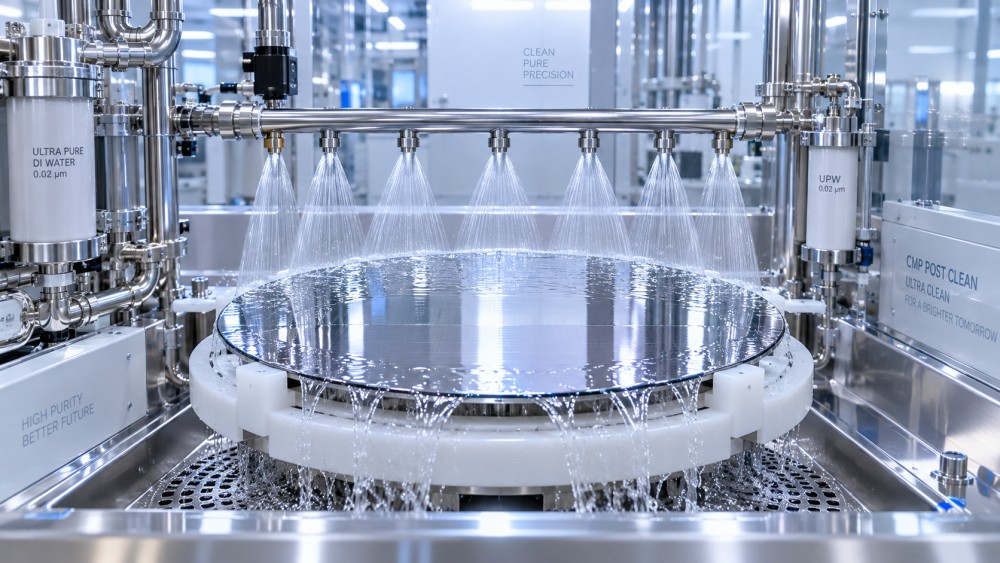
A post-CMP sequence is not complete when the active cleaner contacts the wafer. The rinse must displace the chemistry, carry away mobilized contamination, and prevent residues from drying onto the surface. Ultra-pure cleaning formulations support this stage when they are designed for low residue and predictable rinse-out behavior.
Low nonvolatile residue is especially important. Components that improve wetting or dispersion during cleaning can become liabilities if they adsorb strongly onto the wafer or are difficult to remove in ultrapure water. Residual organics may interfere with subsequent film growth, adhesion, lithography, or metrology. A cleaner should consequently be judged by the surface state after its entire clean-rinse-dry sequence, rather than by removal efficiency measured immediately after chemical exposure.
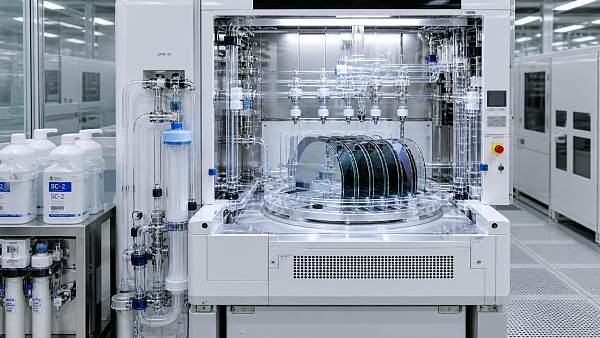
Water quality and rinse hydrodynamics remain equally important. Even a highly purified chemical cannot compensate for inadequate ultrapure water control, poor nozzle condition, insufficient exchange at the wafer surface, dead zones in the chamber, or delayed processing that permits residues to dry. The chemistry should be evaluated alongside dispense volume, contact time, wafer rotation, brush or megasonic energy where used, rinse duration, and drying method.
Material compatibility must be verified across the actual stack
Post-CMP cleaning often occurs after the wafer has developed topography, exposed multiple materials, and formed features whose sensitivity cannot be captured by blanket-wafer testing alone. A chemistry that appears benign on a single blanket film may behave differently at interfaces, within recessed regions, around barrier layers, or across dense and isolated pattern areas.
For copper CMP, central concerns include corrosion inhibition, copper loss, galvanic interaction with adjacent materials, and residue removal from low-k dielectric regions. For tungsten and cobalt processes, dissolution control and interaction with barrier or liner materials require separate attention. Oxide and nitride polishing presents a different balance: particle removal and watermark prevention may be more prominent than metal corrosion, but surface chemistry and pattern integrity still matter.
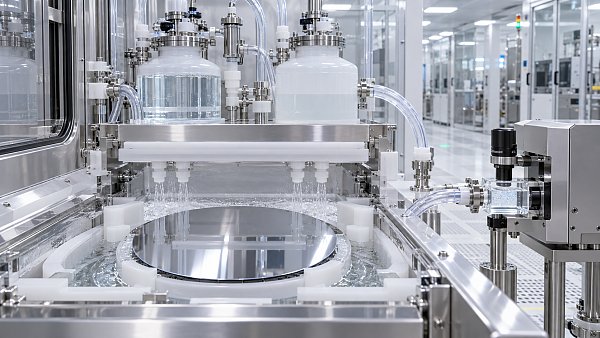
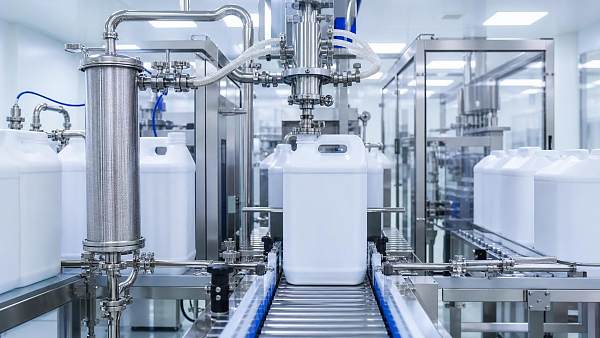
Compatibility also includes the process hardware. Filters, valves, pumps, tubing, dispense lines, seals, tanks, and point-of-use components may contribute particles or extractables, or may degrade under a given pH and solvent environment. A cleaner’s laboratory performance is not enough if the complete delivery system cannot maintain purity from bulk container to wafer surface.
What should be measured during technical qualification
A rigorous assessment combines chemical qualification, wafer-level results, and tool-level stability. The exact test plan depends on the process node and integration scheme, but several questions should remain visible throughout the evaluation.
- Does the formulation remove the relevant abrasive, metallic, and organic residues from the specific CMP slurry and film combination?
- What is the post-clean particle response across wafer center, middle, and edge regions, including patterned wafers where available?
- Are trace-metal levels on the wafer reduced to the required internal contamination targets without evidence of redeposition?
- Does the cleaning sequence change film thickness, roughness, corrosion behavior, electrical characteristics, or pattern profile beyond acceptable process limits?
- Does the cleaner rinse completely under the intended tool conditions, with no unacceptable organic or nonvolatile residue after drying?
- Are results stable across chemical lots, storage periods, dilution conditions, and point-of-use filtration intervals?
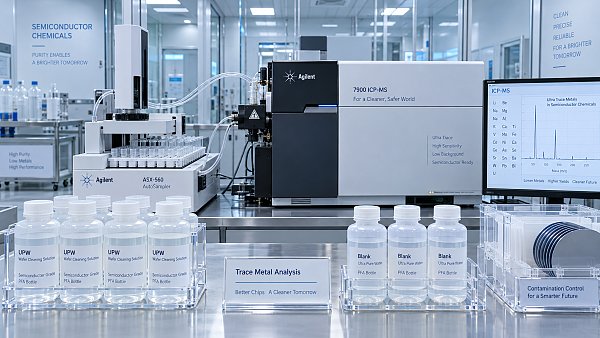
Analytical methods should be selected according to the defect mechanism under investigation. Surface particle inspection can identify count and size-distribution changes, but it does not independently establish chemical cleanliness. Total reflection X-ray fluorescence (TXRF), vapor-phase decomposition coupled with ICP-MS, or other suitable trace-metal methods may be required where metallic contamination is a concern. Time-of-flight secondary ion mass spectrometry (ToF-SIMS), X-ray photoelectron spectroscopy (XPS), contact-angle measurements, ellipsometry, and electrical test structures can provide complementary evidence when organic residue, surface modification, film loss, or corrosion is suspected.
No single metrology result should be treated as a complete answer. The more useful approach is to link the observed defect signature to a plausible mechanism: particle retention, slurry carryover, metallic redeposition, insufficient rinse displacement, chemical attack, drying marks, or contamination introduced through the chemical delivery path.
Purity specifications need to be interpreted in process context
A supplier specification can provide useful controls, but a low value for one impurity category does not prove suitability for every post-CMP application. Trace metals, particles, ionic contaminants, organic background, and nonvolatile residue have different relevance depending on the wafer surface and the downstream process sensitivity.
For example, particle specifications should be considered together with the intended dilution, filtration point, dispense architecture, and shelf-life behavior. A bulk chemistry may meet an incoming particle target but generate particles through precipitation, incompatibility with dilution water, temperature excursions, or interaction with filters and tubing. Similarly, a trace-metal specification must be read with attention to the metals that matter for the device stack, the analytical detection method, sampling practice, and lot release criteria.
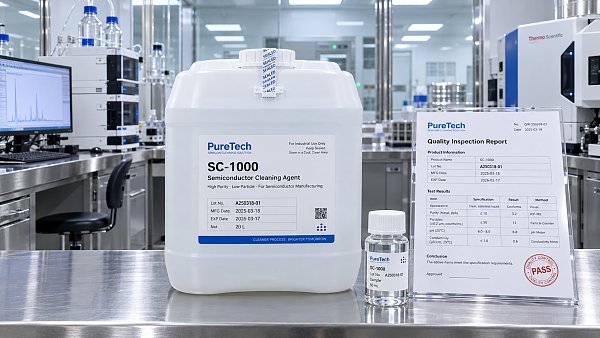
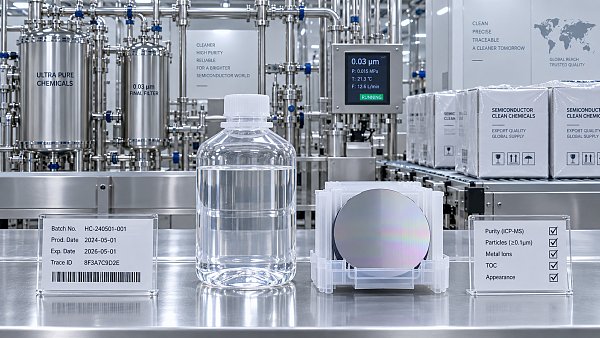
Documentation quality is therefore part of technical evaluation. Useful documentation generally includes a controlled certificate of analysis, lot traceability, defined test methods, change-notification practice, storage conditions, shelf-life limits, packaging information, and contamination-control measures relevant to transport and handling. For critical materials, the ability to investigate deviations rapidly can be as important as the nominal specification itself.
Common mistakes in post-CMP cleaner selection
One common error is selecting chemistry by removal rate alone. Faster removal can conceal increased film loss, corrosion exposure, or downstream residue. Another is qualifying on blanket wafers only and assuming that patterned devices will behave similarly. Pattern density, feature geometry, local fluid exchange, and mixed-material interfaces can reveal weaknesses that blanket surfaces do not show.
A further mistake is treating the cleaner as independent of the slurry. The slurry generates the residue that the cleaner must remove. Changes in abrasive type, oxidizer concentration, inhibitor chemistry, pad condition, or polish endpoint can shift the cleaning burden substantially. A cleaning formulation should be re-examined whenever upstream CMP chemistry or operating conditions change in a meaningful way.
It is also risky to view high purity as a substitute for process engineering. Ultra-pure semiconductor cleaners for post-CMP cleaning reduce contamination risk and improve control, but they cannot correct poor rinse design, inadequate filtration maintenance, unstable chemical dilution, wafer queue-time excursions, or drying problems. The strongest results come from matching the formulation to the residue mechanism and maintaining cleanliness throughout delivery, cleaning, rinsing, and drying.
A more defensible basis for selection
The most reliable cleaner is not necessarily the most chemically aggressive or the one with the longest list of purity claims. It is the formulation that demonstrates repeatable residue removal, low additive carryover, controlled interaction with the full material stack, and compatibility with the actual tool and rinse sequence.
Ultra-pure chemistry matters because post-CMP cleaning is both a removal process and a contamination-control process. It enables a tighter, more predictable baseline for evaluating defectivity and process stability. When paired with appropriate slurry matching, material compatibility testing, high-quality rinse water, and disciplined chemical delivery control, it can improve the probability that a polished wafer enters the next process step with a surface that is not only visibly clean, but chemically and electrically fit for integration.
Facing technical bottlenecks in manufacturing or looking for more efficient industrial solutions? Leave your details below and let the engineering experts at FCAS solve them for you.
We respect your privacy. Your information is strictly confidential.
Related News
 Ultra-pure Semiconductor CleanersHow to Select Non Ionic Semiconductor SurfactantsSelect non ionic semiconductor surfactants with confidence. Explore purity, rinseability, compatibility, and supplier checks for a reliable cleaning process.MORE+
 Ultra-pure Semiconductor CleanersHow to Choose Electronic Cleaning Chemicals for Corrosion ProtectionElectronic cleaning chemicals corrosion protection starts with the right selection. Discover how to assess compatibility, residues, drying, and safety.MORE+
 Ultra-pure Semiconductor CleanersWhat Affects the Bulk Price of Semiconductor Process Cleaners?Semiconductor process cleaners bulk price depends on purity, packaging, logistics, and more. Discover how to compare quotes and control costs.MORE+
 Ultra-pure Semiconductor CleanersHow to Evaluate Low Ionic Electronic Grade Cleaners for ChipmakingDiscover how to evaluate low ionic electronic grade cleaners for chipmaking, from surface residue and material compatibility to supplier qualification.MORE+
 Ultra-pure Semiconductor CleanersHow to Choose Water-Based Electronic Cleaning Chemicals That Rinse CleanChoose water based electronic cleaning chemicals that rinse clean. Learn how to compare residue removal, material compatibility, and rinse performance for reliable production.MORE+
 Ultra-pure Semiconductor CleanersHow to Select Aqueous Semiconductor Process Cleaners for CopperSelect aqueous semiconductor process cleaners for copper with confidence. Learn how to balance residue removal, corrosion control, and process compatibility for reliable results.MORE+
 Ultra-pure Semiconductor CleanersHow Can You Verify Purity When Buying Semiconductor Cleaners Wholesale?Buying semiconductor cleaners wholesale? Learn how to verify batch purity, assess test methods, and check packaging to reduce contamination risks and buy with confidence.MORE+
 Ultra-pure Semiconductor CleanersHow Are Trace Metals Measured in Low Metal Wafer Cleaning Solutions?How are trace metals measured in low metal wafer cleaning solutions? Explore ICP-MS, contamination controls, and validation essentials for confident batch-release decisions.MORE+
 Ultra-pure Semiconductor CleanersWhat Should You Check Before Buying Ultrapure Cleaning Chemicals?Buying Ultrapure Cleaning Chemicals? Discover key checks for purity, test results, packaging, and supplier reliability to reduce contamination risks and make smarter purchasing decisions.MORE+
 Ultra-pure Semiconductor CleanersHow Ultra-Pure Semiconductor Cleaners Improve Post-CMP Cleaning ResultsSemiconductor cleaners for post CMP cleaning improve residue removal, reduce contamination risk, and protect sensitive wafer surfaces for more reliable yields.MORE+
 Ultra-pure Semiconductor CleanersA Practical Guide to Semiconductor Process Cleaner Purity RequirementsSemiconductor process cleaners purity requirements explained: assess metals, particles, ions, residues, packaging, and batch consistency to protect yield and process reliability.MORE+
 Ultra-pure Semiconductor CleanersHow to Select Semiconductor Process Cleaners for Fab UseSemiconductor process cleaners for fab use: learn how to match chemistry, material compatibility, particle control, rinse performance, and tool requirements to protect yield.MORE+
 Ultra-pure Semiconductor CleanersHow Precision Cleaning Agents Protect Semiconductor Yield and ReliabilityPrecision cleaning agents for semiconductors protect yield and reliability by removing trace contaminants, safeguarding sensitive materials, and improving rinse performance.MORE+
 Ultra-pure Semiconductor CleanersHow to Assess a Semiconductor Wafer Cleaners ExporterSemiconductor wafer cleaners exporter assessment guide: compare purity controls, packaging, documentation, process fit, and supply reliability before sourcing.MORE+
 Ultra-pure Semiconductor CleanersHow to Verify Semiconductor Process Cleaners Purity RequirementsSemiconductor process cleaners purity requirements: learn how to verify trace metals, ions, particles, residues, COAs, and packaging controls for reliable wafer cleaning.MORE+
 Ultra-pure Semiconductor CleanersIs Semiconductor Cleaner Packaging Critical to Shelf Life?Is semiconductor process cleaner packaging critical for shelf life? Discover how packaging controls contamination, stability, and process-ready purity in high-sensitivity applications.MORE+
 Ultra-pure Semiconductor CleanersCan Electronic Cleaning Chemicals Be Used on Sensitive Circuit Boards?Can electronic cleaning chemicals be used on sensitive circuit boards? Discover safe cleaner selection, material compatibility, targeted application, and drying steps for reliable results.MORE+
 Ultra-pure Semiconductor CleanersHow to Verify Residue Control in Semiconductor Process CleanersSemiconductor Process Cleaners: learn how to verify ionic, organic, metal, and particle residue control with risk-based qualification, rinse testing, and ongoing process monitoring.MORE+
 Ultra-pure Semiconductor CleanersSelecting Low Residue Semiconductor Wafer Cleaners for Critical ProcessesLow residue semiconductor wafer cleaners: learn how to select compatible, rinse-ready solutions that protect critical processes, reduce contamination risk, and support reliable yield.MORE+
 Ultra-pure Semiconductor CleanersHow to Evaluate a Semiconductor Cleaners Factory for Ultra-Pure SupplySemiconductor cleaners factory evaluation guide: verify ultra-pure specifications, contamination controls, packaging integrity, and supply resilience before qualification.MORE+
 Ultra-pure Semiconductor CleanersHow to Evaluate an Electronic Grade Cleaners SupplierElectronic grade cleaners supplier evaluation made simple: learn how to assess purity, batch consistency, compatibility, documentation, packaging, and supply resilience.MORE+
 Ultra-pure Semiconductor CleanersIs Higher Purity Worth the Switch for Semiconductor Process Cleaners?Is it worth switching to semiconductor process cleaners with higher purity? Explore contamination control, compatibility, and cost factors to make a confident choice.MORE+
 Ultra-pure Semiconductor CleanersHow Semiconductor Cleaners for Post CMP Cleaning Prevent DefectsSemiconductor cleaners for post CMP cleaning help prevent particle defects, metal contamination, corrosion, and yield loss. Explore smarter qualification strategies.MORE+
 Ultra-pure Semiconductor CleanersHow to Compare Metal Cleaning Chemicals Wholesale OffersMetal cleaning chemicals wholesale: compare true in-use cost, cleaning performance, compatibility, compliance, and supply reliability to choose the best offer.MORE+
 Ultra-pure Semiconductor CleanersHow to Compare Semiconductor Process Cleaners from Different SuppliersHow to compare semiconductor process cleaners from different suppliers? Learn a practical method to assess purity, residue, compatibility, stability, and supplier support for safer qualification.MORE+
 Ultra-pure Semiconductor CleanersChoosing Degreasing Solvents for Electronic Components Without ResidueDegreasing solvents for electronic components: learn how to choose low-residue, compliant, and material-safe cleaners that improve reliability, reduce risk, and support smarter QC decisions.MORE+
 Ultra-pure Semiconductor CleanersHow Bulk Semiconductor Wafer Cleaners Improve Yield and Defect ControlBulk semiconductor wafer cleaners improve yield by reducing particles, residue, and repeatable defect risks. Learn what technical teams should verify before selecting a system.MORE+
 Ultra-pure Semiconductor CleanersHow to Choose Electronic Cleaning Chemicals for Sensitive PCB and Semiconductor LinesElectronic Cleaning Chemicals for sensitive PCB and semiconductor lines demand more than strong cleaning—they need low residue, material compatibility, and stable process control. Learn how to choose the right chemistry for reliable results.MORE+
 Ultra-pure Semiconductor CleanersWhat Semiconductor Process Cleaners Remove Most Effectively in Advanced Fab ProcessesSemiconductor Process Cleaners remove photoresist, etch residues, particles, and metal ions most effectively in advanced fabs—helping protect yield with precise, low-residue cleaning.MORE+