How Can You Verify Purity When Buying Semiconductor Cleaners Wholesale?
When buying semiconductor cleaners wholesale, verify purity through batch-specific test results, suitable analytical methods, and evidence that packaging and delivery preserve the tested quality. A high assay percentage alone cannot establish whether a cleaner is suitable for a sensitive process. Trace metals, particles, moisture, or unwanted organic compounds may still exceed your process limits.
The purchasing decision should connect three things: what contamination your application can tolerate, what the supplier actually measures, and what reaches the point of use. Establish those requirements before comparing bulk prices. Otherwise, apparently equivalent quotations may cover very different levels of contamination control.
Define acceptable contamination before comparing grades
“Semiconductor grade,” “electronic grade,” and “high purity” are useful starting descriptions, but they do not replace a written specification. Suppliers may use different impurity limits, analytical methods, and release criteria under similar grade names. Compare the underlying requirements rather than assuming the labels are interchangeable.
Start with the intended cleaning step. A solvent used before a sensitive deposition process may need tight control of moisture and nonvolatile residue. An aqueous cleaner contacting exposed metal may require particular attention to ionic contamination, corrosion, and rinsability. Requirements for wafer cleaning can differ substantially from those for equipment maintenance or less sensitive component cleaning.
For formulated cleaners, identify which ingredients are intentional. Surfactants, chelating agents, and corrosion inhibitors may be necessary for performance. Treating all organic content as contamination would make little sense for such a product. Instead, specify the formulation’s critical composition limits, unwanted contaminants, and acceptable residue after the defined rinse.
Have the process or quality owner approve these limits before requesting quotations. Buying a tighter grade than the application needs can add cost; accepting a loosely defined grade can create qualification failures and production interruptions.
Read the certificate of analysis beyond the pass statement
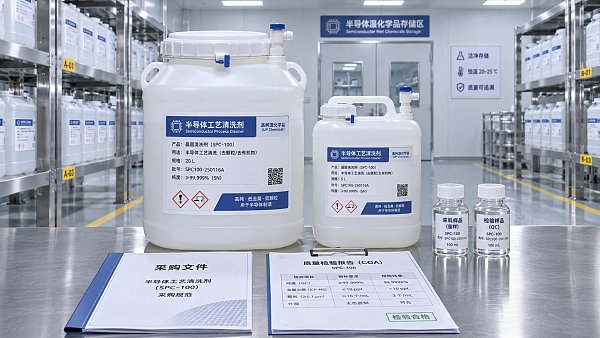
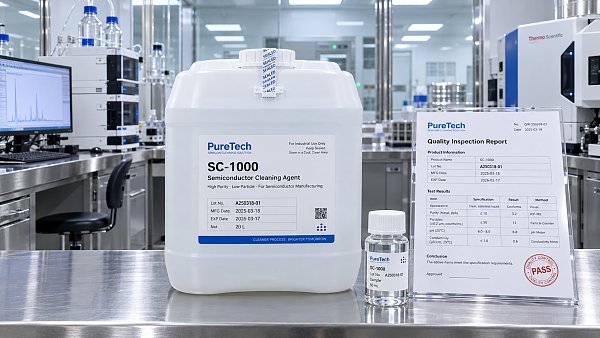
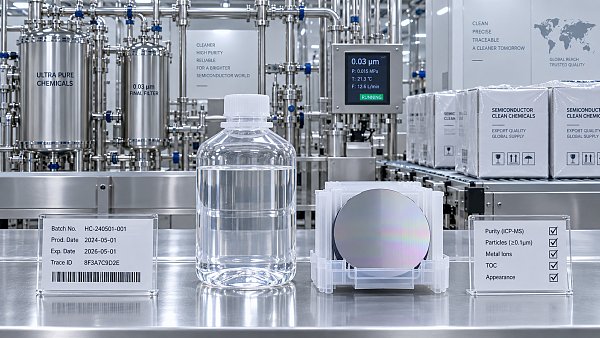
A certificate of analysis, or CoA, should identify the actual supplied batch and show how it compares with the agreed specification. A generic example is useful during supplier screening, but it does not establish the quality of a shipment.
Check that the product identifier, grade, manufacturing lot, specification revision, and relevant dates match the order and container labels. If a distributor repackages the material, establish how the original manufacturing lot connects to the repacked lot. A certificate from the original producer does not, by itself, demonstrate that transfer operations preserved purity.
The most useful certificate distinguishes numerical results from simple compliance statements. “Pass” may be acceptable for some agreed checks, but critical contaminants deserve more detail. Also establish which properties are tested on every batch and which rely on periodic testing or process controls. A listed specification does not necessarily mean every attribute was measured for that shipment.
Pay close attention to units and reporting conventions. Results expressed by mass and results expressed by volume are not directly interchangeable without the appropriate conversion. A result reported as “not detected” also needs a stated detection or reporting limit.
For example, if your permitted impurity level is below the laboratory’s reporting limit, a “not detected” result cannot demonstrate compliance. The method must be capable of resolving the acceptance decision. For results close to a contractual limit, agree how measurement uncertainty will affect release or rejection.
Check whether the analytical methods can support the claim
A method name alone does not establish reliable measurement. The method must work for the specific chemical matrix and at the required impurity level. Concentrated acids, solvents, and surfactant-containing blends can present different analytical challenges.
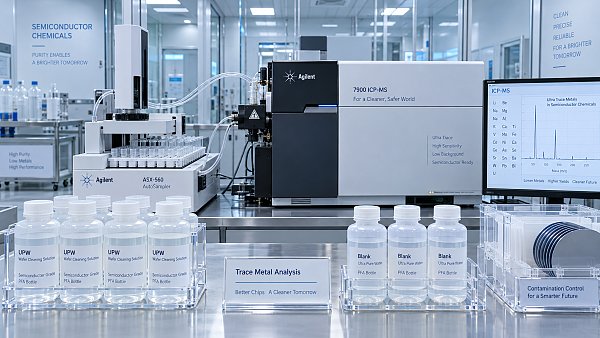
Inductively coupled plasma mass spectrometry, commonly called ICP-MS, is widely used for trace-element analysis. However, sample preparation, dilution, interferences, and laboratory contamination can affect the result. Ask whether the stated reporting limits apply to the original product after accounting for preparation and dilution.
Other measurements answer different questions:
- Gas chromatography: Can assess suitable volatile organic components and impurities, depending on the method and detector.
- Ion chromatography: Can measure selected ionic contaminants when the method is appropriate for the sample.
- Karl Fischer titration: Can determine water content in compatible materials, with suitable handling and interference controls.
- Liquid particle counting: Reports particles within defined measurement ranges and requires a method suitable for the liquid.
- Nonvolatile residue testing: Measures material remaining after evaporation under specified conditions, without identifying every residue component.
Total organic carbon can be useful for selected aqueous materials or rinse evaluations, but it is not a universal purity test. In an organic solvent or a cleaner containing intentional organic ingredients, the result may largely reflect the product itself.
Similarly, conductivity can help monitor certain aqueous systems, but it cannot substitute for a complete impurity assessment. Use each measurement for the question it can answer, and avoid treating one convenient number as proof of overall cleanliness.
Verify that the tested material represents the bulk delivery
A clean qualification sample establishes little if it comes from a different filling route or package than the commercial order. Request samples that represent the intended product grade, manufacturing route, and final packaging configuration. Where this is impractical, document the differences and address them during qualification.
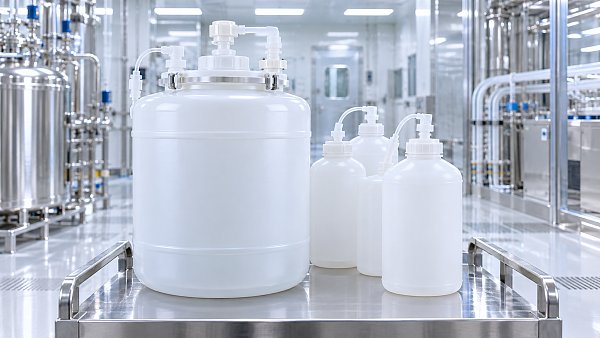
Bulk supply adds contact surfaces and handling steps. Drums, intermediate containers, liners, closures, valves, hoses, and dispensing connections can introduce contamination. Packaging compatibility must cover both chemical resistance and the potential release of particles, metals, or extractable compounds.
Ask where the release sample is taken: before filtration, after filtration, from a holding vessel, or after filling. Testing before final filling leaves packaging and filling operations outside that measurement. Depending on process sensitivity, qualification may need evidence from finished containers as well.
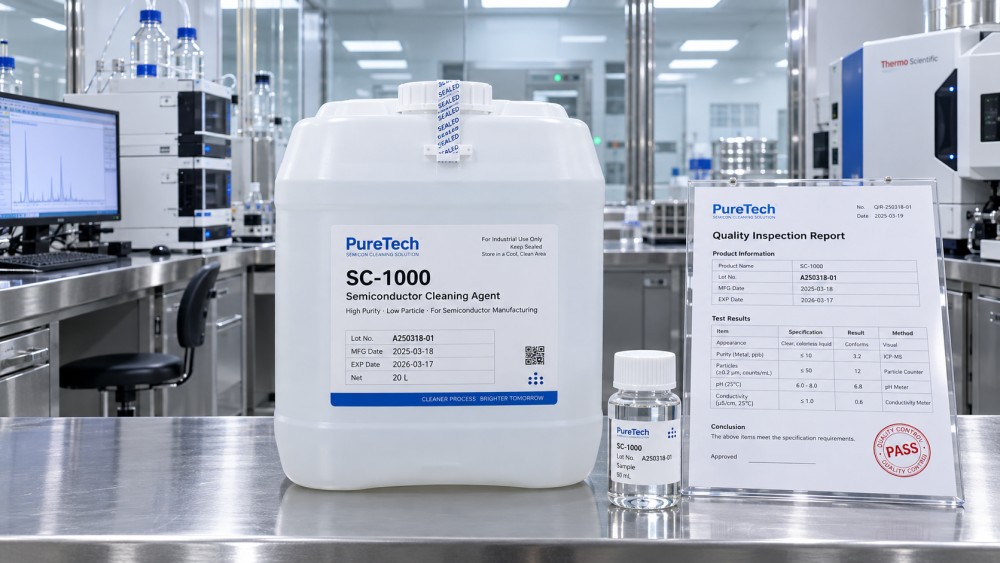
During delivery inspection, connect each container to its lot documentation and check seals, closures, labels, and visible damage. If a shipment contains multiple lots, preserve that distinction during sampling and release. Pooling samples can dilute contamination from a single affected container and obscure its source.
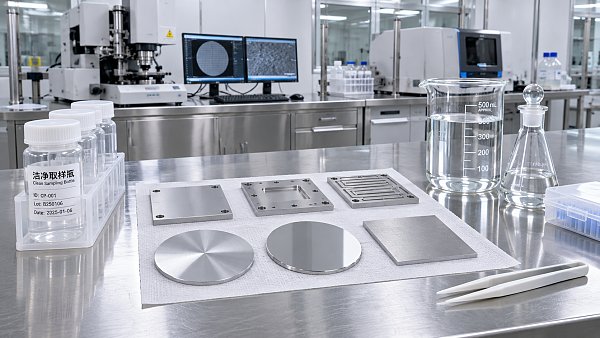
Your own sampling procedure must also protect the sample. Unsuitable bottles, transfer tools, ambient exposure, or handling can create misleading results. Use laboratory-approved containers, a defined sampling location, and handling instructions matched to the chemical and target contaminants.
Use independent testing where it changes the decision
Independent testing is especially useful when qualifying a new source, evaluating a repackager, investigating inconsistent results, or introducing a cleaner into a sensitive process. It can also help determine whether a lower-priced alternative meets the same requirements as an established product.
Choose the laboratory by relevant capability. It should be able to handle the chemical safely, measure the required contaminants in that matrix, and report at limits suitable for your specification. If laboratory accreditation matters to your quality system, examine whether its scope covers the relevant testing; a general accreditation claim does not establish capability for every analysis.
Agree on sampling, methods, units, reporting limits, and acceptance rules before comparing supplier and independent results. Differences between laboratories can arise from sample handling or methods as well as from the material itself. Retained samples with documented storage conditions can support an investigation.
Testing every possible contaminant in every shipment is rarely an efficient purchasing strategy. A more practical approach is broader qualification testing followed by routine checks focused on critical attributes, supported by supplier performance and change control. Increase scrutiny when the source, formulation, packaging, or supply route changes.
Evaluate controls that keep future batches consistent
A compliant batch demonstrates current performance. Repeat purchasing also depends on the supplier’s ability to control variation. Review how raw materials are approved, production equipment is cleaned, filling is controlled, and off-specification material is segregated.
Quality-system certification can support this review, but it does not establish that a particular cleaner meets semiconductor process requirements. Likewise, a safety data sheet provides hazard and handling information; it is not a substitute for trace-contamination data or a batch CoA.
Change notification deserves explicit purchasing terms. Changes to raw-material sources, purification equipment, manufacturing sites, analytical methods, or packaging can affect qualification. Define which changes require advance notification and which require your approval before shipment.
Ask for historical results for critical attributes where available. These help distinguish a process that consistently operates comfortably within limits from one that frequently approaches them. Confirm that the records cover the same grade and relevant production route as your intended supply.
Compare wholesale cost after accounting for release and handling
The lowest price per unit may become expensive if the material requires extensive retesting, additional filtration, rejected deliveries, or repeated qualification. Compare offers against a common specification and include the costs needed to make each supply option usable.
Packaging size affects that calculation. Larger containers may reduce purchase and handling costs per unit, but repeated connections and longer use periods can increase exposure to contamination or moisture. Smaller containers may suit low consumption or sensitive applications, even with a higher unit price.
Evaluate shelf life alongside actual consumption, storage conditions, and any validated period after opening. An unopened shelf-life statement does not automatically establish how long a connected container remains suitable in your dispensing system.
Ask whether the quoted price includes the required batch testing, certificate detail, packaging, and traceability. Two offers are comparable only when they cover equivalent quality obligations. Also define responsibility for investigation, replacement, and disposition when a shipment fails agreed acceptance criteria.
Make the first bulk order conditional on clear release criteria
Before committing to volume, turn the technical discussion into a purchasing specification. It should identify the exact product and grade, critical impurity limits, test methods or agreed equivalents, reporting requirements, approved packaging, and lot-traceability expectations.
Set a practical release sequence: review shipment documentation, inspect containers, perform the agreed incoming checks, and release the material only after acceptance. For a new cleaner or source, analytical purity should be complemented by process qualification covering cleaning effectiveness, material compatibility, and residue after rinsing. Chemically clean material can still perform poorly in a particular application.
Approve wholesale supply when the evidence connects the specification to the delivered lot and the intended use. That connection makes purity verifiable—and gives a lower purchase price a sound basis for becoming a lower operating cost.
Facing technical bottlenecks in manufacturing or looking for more efficient industrial solutions? Leave your details below and let the engineering experts at FCAS solve them for you.
We respect your privacy. Your information is strictly confidential.
Related News
 Ultra-pure Semiconductor CleanersHow to Select Non Ionic Semiconductor SurfactantsSelect non ionic semiconductor surfactants with confidence. Explore purity, rinseability, compatibility, and supplier checks for a reliable cleaning process.MORE+
 Ultra-pure Semiconductor CleanersHow to Choose Electronic Cleaning Chemicals for Corrosion ProtectionElectronic cleaning chemicals corrosion protection starts with the right selection. Discover how to assess compatibility, residues, drying, and safety.MORE+
 Ultra-pure Semiconductor CleanersWhat Affects the Bulk Price of Semiconductor Process Cleaners?Semiconductor process cleaners bulk price depends on purity, packaging, logistics, and more. Discover how to compare quotes and control costs.MORE+
 Ultra-pure Semiconductor CleanersHow to Evaluate Low Ionic Electronic Grade Cleaners for ChipmakingDiscover how to evaluate low ionic electronic grade cleaners for chipmaking, from surface residue and material compatibility to supplier qualification.MORE+
 Ultra-pure Semiconductor CleanersHow to Choose Water-Based Electronic Cleaning Chemicals That Rinse CleanChoose water based electronic cleaning chemicals that rinse clean. Learn how to compare residue removal, material compatibility, and rinse performance for reliable production.MORE+
 Ultra-pure Semiconductor CleanersHow to Select Aqueous Semiconductor Process Cleaners for CopperSelect aqueous semiconductor process cleaners for copper with confidence. Learn how to balance residue removal, corrosion control, and process compatibility for reliable results.MORE+
 Ultra-pure Semiconductor CleanersHow Can You Verify Purity When Buying Semiconductor Cleaners Wholesale?Buying semiconductor cleaners wholesale? Learn how to verify batch purity, assess test methods, and check packaging to reduce contamination risks and buy with confidence.MORE+
 Ultra-pure Semiconductor CleanersHow Are Trace Metals Measured in Low Metal Wafer Cleaning Solutions?How are trace metals measured in low metal wafer cleaning solutions? Explore ICP-MS, contamination controls, and validation essentials for confident batch-release decisions.MORE+
 Ultra-pure Semiconductor CleanersWhat Should You Check Before Buying Ultrapure Cleaning Chemicals?Buying Ultrapure Cleaning Chemicals? Discover key checks for purity, test results, packaging, and supplier reliability to reduce contamination risks and make smarter purchasing decisions.MORE+
 Ultra-pure Semiconductor CleanersHow Ultra-Pure Semiconductor Cleaners Improve Post-CMP Cleaning ResultsSemiconductor cleaners for post CMP cleaning improve residue removal, reduce contamination risk, and protect sensitive wafer surfaces for more reliable yields.MORE+
 Ultra-pure Semiconductor CleanersA Practical Guide to Semiconductor Process Cleaner Purity RequirementsSemiconductor process cleaners purity requirements explained: assess metals, particles, ions, residues, packaging, and batch consistency to protect yield and process reliability.MORE+
 Ultra-pure Semiconductor CleanersHow to Select Semiconductor Process Cleaners for Fab UseSemiconductor process cleaners for fab use: learn how to match chemistry, material compatibility, particle control, rinse performance, and tool requirements to protect yield.MORE+
 Ultra-pure Semiconductor CleanersHow Precision Cleaning Agents Protect Semiconductor Yield and ReliabilityPrecision cleaning agents for semiconductors protect yield and reliability by removing trace contaminants, safeguarding sensitive materials, and improving rinse performance.MORE+
 Ultra-pure Semiconductor CleanersHow to Assess a Semiconductor Wafer Cleaners ExporterSemiconductor wafer cleaners exporter assessment guide: compare purity controls, packaging, documentation, process fit, and supply reliability before sourcing.MORE+
 Ultra-pure Semiconductor CleanersHow to Verify Semiconductor Process Cleaners Purity RequirementsSemiconductor process cleaners purity requirements: learn how to verify trace metals, ions, particles, residues, COAs, and packaging controls for reliable wafer cleaning.MORE+
 Ultra-pure Semiconductor CleanersIs Semiconductor Cleaner Packaging Critical to Shelf Life?Is semiconductor process cleaner packaging critical for shelf life? Discover how packaging controls contamination, stability, and process-ready purity in high-sensitivity applications.MORE+
 Ultra-pure Semiconductor CleanersCan Electronic Cleaning Chemicals Be Used on Sensitive Circuit Boards?Can electronic cleaning chemicals be used on sensitive circuit boards? Discover safe cleaner selection, material compatibility, targeted application, and drying steps for reliable results.MORE+
 Ultra-pure Semiconductor CleanersHow to Verify Residue Control in Semiconductor Process CleanersSemiconductor Process Cleaners: learn how to verify ionic, organic, metal, and particle residue control with risk-based qualification, rinse testing, and ongoing process monitoring.MORE+
 Ultra-pure Semiconductor CleanersSelecting Low Residue Semiconductor Wafer Cleaners for Critical ProcessesLow residue semiconductor wafer cleaners: learn how to select compatible, rinse-ready solutions that protect critical processes, reduce contamination risk, and support reliable yield.MORE+
 Ultra-pure Semiconductor CleanersHow to Evaluate a Semiconductor Cleaners Factory for Ultra-Pure SupplySemiconductor cleaners factory evaluation guide: verify ultra-pure specifications, contamination controls, packaging integrity, and supply resilience before qualification.MORE+
 Ultra-pure Semiconductor CleanersHow to Evaluate an Electronic Grade Cleaners SupplierElectronic grade cleaners supplier evaluation made simple: learn how to assess purity, batch consistency, compatibility, documentation, packaging, and supply resilience.MORE+
 Ultra-pure Semiconductor CleanersIs Higher Purity Worth the Switch for Semiconductor Process Cleaners?Is it worth switching to semiconductor process cleaners with higher purity? Explore contamination control, compatibility, and cost factors to make a confident choice.MORE+
 Ultra-pure Semiconductor CleanersHow Semiconductor Cleaners for Post CMP Cleaning Prevent DefectsSemiconductor cleaners for post CMP cleaning help prevent particle defects, metal contamination, corrosion, and yield loss. Explore smarter qualification strategies.MORE+
 Ultra-pure Semiconductor CleanersHow to Compare Metal Cleaning Chemicals Wholesale OffersMetal cleaning chemicals wholesale: compare true in-use cost, cleaning performance, compatibility, compliance, and supply reliability to choose the best offer.MORE+
 Ultra-pure Semiconductor CleanersHow to Compare Semiconductor Process Cleaners from Different SuppliersHow to compare semiconductor process cleaners from different suppliers? Learn a practical method to assess purity, residue, compatibility, stability, and supplier support for safer qualification.MORE+
 Ultra-pure Semiconductor CleanersChoosing Degreasing Solvents for Electronic Components Without ResidueDegreasing solvents for electronic components: learn how to choose low-residue, compliant, and material-safe cleaners that improve reliability, reduce risk, and support smarter QC decisions.MORE+
 Ultra-pure Semiconductor CleanersHow Bulk Semiconductor Wafer Cleaners Improve Yield and Defect ControlBulk semiconductor wafer cleaners improve yield by reducing particles, residue, and repeatable defect risks. Learn what technical teams should verify before selecting a system.MORE+
 Ultra-pure Semiconductor CleanersHow to Choose Electronic Cleaning Chemicals for Sensitive PCB and Semiconductor LinesElectronic Cleaning Chemicals for sensitive PCB and semiconductor lines demand more than strong cleaning—they need low residue, material compatibility, and stable process control. Learn how to choose the right chemistry for reliable results.MORE+
 Ultra-pure Semiconductor CleanersWhat Semiconductor Process Cleaners Remove Most Effectively in Advanced Fab ProcessesSemiconductor Process Cleaners remove photoresist, etch residues, particles, and metal ions most effectively in advanced fabs—helping protect yield with precise, low-residue cleaning.MORE+