How Are Trace Metals Measured in Low Metal Wafer Cleaning Solutions?
Trace metals in low metal wafer cleaning solutions are measured primarily by inductively coupled plasma mass spectrometry (ICP-MS), using contamination-controlled sampling, preparation suited to the chemical matrix, and calibration verified at the concentrations relevant to the product specification. The instrument measures elemental signals, but the reliability of a batch-release result depends on the entire workflow: collection, transport, preparation, interference control, and data review.
For quality control teams, the first question is whether the laboratory can reliably quantify each specified element in the original cleaning solution. A detection limit demonstrated in clean water does not establish that capability in concentrated acid, alkaline peroxide, or a surfactant-containing formulation. Safety personnel also need to confirm that the preparation method preserves analytical validity without creating uncontrolled chemical reactions or exposing incompatible equipment to hazardous reagents.
Define what the result must represent
Before selecting an analytical method, establish the sampling point and the reporting basis. A result from an unopened supplier container answers a different question from a result collected at the point of use. Distribution lines, mixing vessels, filters, and process equipment can contribute contamination after delivery. A used cleaning bath also contains material removed from wafers, so its metal concentration cannot be interpreted as incoming chemical purity.
The specification should name individual elements and their limits. Sodium, potassium, calcium, iron, copper, nickel, chromium, and zinc are examples of elements that may be included, but the required panel depends on the chemistry and process. A statement such as “total metals below specification” is difficult to evaluate unless the included elements, treatment of nondetects, and calculation rules are defined.
Units deserve equal attention. A mass fraction such as micrograms per kilogram is not automatically interchangeable with a concentration such as micrograms per liter. Density matters when converting between them, especially for concentrated reagents. Reports using “ppb” or “ppt” should explicitly define the basis to prevent misunderstandings between laboratories and purchasing specifications.
The method must also distinguish dissolved metals from a broader recoverable fraction. Filtering a sample before analysis can remove metal-bearing particles and change the quantity being measured. Direct analysis without filtration does not automatically establish total metal content either: particles may settle, enter the instrument inconsistently, or resist complete decomposition. If particulate contamination is within scope, preparation and recovery must address it explicitly.
Why ICP-MS is used—and where the matrix changes the method
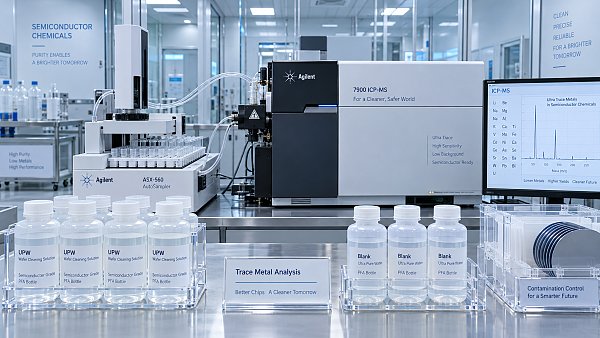
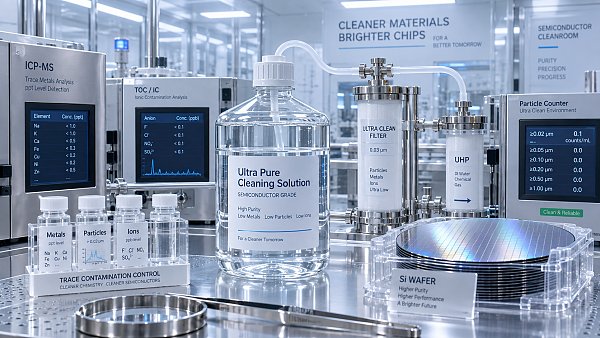
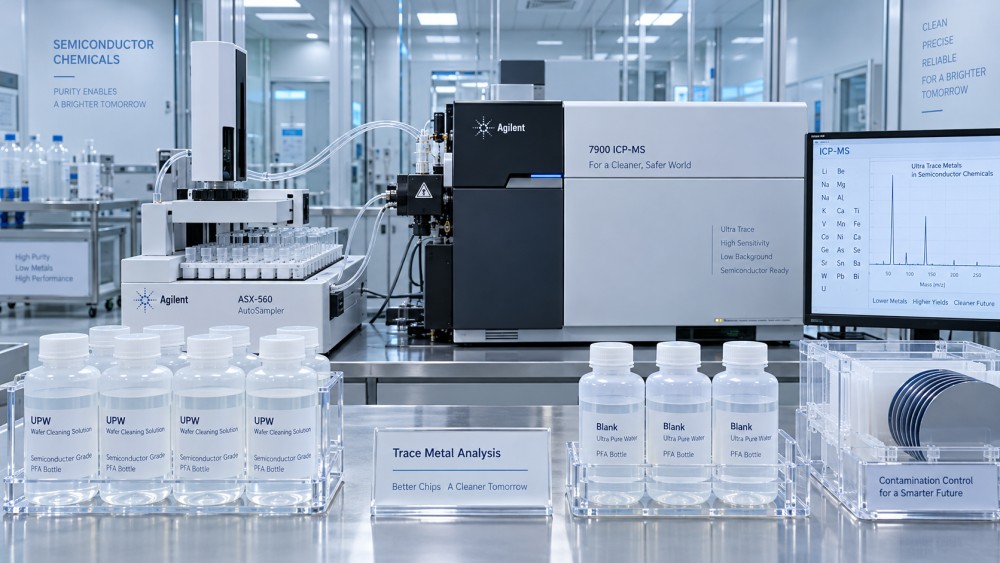
ICP-MS introduces the prepared sample into an argon plasma, where elements are ionized. The mass spectrometer separates ions by mass-to-charge ratio, and calibration relates their signals to concentration. Its sensitivity and ability to measure multiple elements make it well suited to trace-metal control in high-purity process chemicals.
However, the same instrument can perform differently across cleaning matrices. High acid concentration, dissolved solids, organic ingredients, and viscosity can affect sample transport, ion formation, signal stability, and contamination buildup. The laboratory therefore needs a method demonstrated for the particular chemical or a justified matrix family.
Spectral interferences are another concern. Ions formed from the plasma gas and sample components can overlap the mass of an analyte. For example, argon-oxygen species can interfere with iron measurement at mass 56, while argon-chlorine species can interfere with arsenic at mass 75. The significance depends on the analyte, matrix, concentration, and instrument configuration.
Collision-cell, reaction-cell, tandem ICP-MS, or high-resolution approaches can help resolve specific problems. These options require appropriate operating conditions and validation; their presence on an instrument does not guarantee interference-free results. Alternative isotopes can provide useful confirmation when available, although sensitivity and other overlaps must also be considered.
ICP optical emission spectrometry can be appropriate when the required limits are less demanding and matrix performance is adequate. It should not be assumed equivalent to ICP-MS for an ultratrace specification. Method selection should follow the required reporting limit and demonstrated performance for each element.
Control contamination before the sample reaches the instrument
At very low concentrations, the sample container, transfer equipment, preparation reagents, and laboratory environment can contribute a meaningful share of the measured metal. Better instrumental sensitivity cannot compensate for an uncontrolled blank.
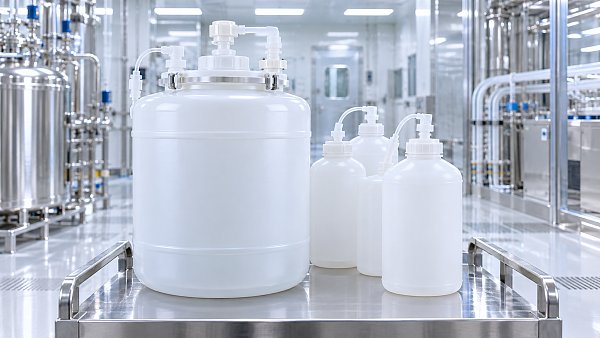
Sampling containers should be qualified for both chemical compatibility and elemental background. Suitable fluoropolymers and selected high-purity plastics may be used, depending on the chemistry. Material names alone are insufficient: manufacturing residues, cleaning history, closures, and storage conditions can affect performance. Glass can contribute certain elements and is unsuitable for hydrofluoric-acid service.
A defensible collection procedure specifies the sampling location, handling conditions, container preparation, and any justified line-flushing practice. Operators should avoid contact between wetted surfaces and metallic tools or unqualified accessories. Clean gloves and controlled handling reduce contamination, but they do not establish that a bottle or sampling assembly is clean enough; blanks provide that evidence.
Different blanks answer different questions. A reagent blank assesses preparation reagents. A method blank passes through the preparation sequence. A container blank investigates the vessel, while an appropriately designed field blank can reveal contamination introduced during collection and handling. Blank results should be evaluated against predefined criteria and the decision limit for the sample.
When the blank approaches the product limit, subtracting its value from the sample is not an adequate stand-alone correction. Variable contamination can make that subtraction unreliable. The source needs investigation, followed by preparation or collection under controlled conditions.
Prepare the chemistry without losing analytical sensitivity
Dilution is often the simplest way to reduce matrix loading and improve instrument stability. Its cost is a higher reporting limit in the original product. If a laboratory dilutes a sample extensively, it must still demonstrate that the resulting method can resolve concentrations below the release limit.
For illustration, a final-solution quantification limit of 0.01 micrograms per liter becomes 1 microgram per liter on an original-sample volume basis after a 100-fold dilution, assuming no other preparation factors. This is an arithmetic example, not a performance claim. Mass-based specifications require the corresponding mass-based calculation and, where applicable, density conversion.
Preparation choices depend on the formulation:
- Strong acids: Dilution, calibration composition, and sample-introduction materials must accommodate acid concentration and composition. Hydrofluoric acid requires compatible wetted components and an appropriately validated introduction system.
- Alkaline and peroxide-containing solutions: Changes in pH can alter metal solubility, while peroxide can decompose and evolve gas. Any stabilization or acidification step needs evidence that it retains the target elements and controls the reaction.
- Organic or surfactant-containing cleaners: Organic loading can affect transport, plasma behavior, and background signals. Dilution or validated decomposition may be necessary, depending on the formulation and analytical objective.
Evaporation, preconcentration, and matrix removal can improve access to lower concentrations, but introduce additional surfaces, reagents, and opportunities for contamination or analyte loss. They are justified only when recovery, blanks, and reproducibility support the intended measurement. More preparation does not inherently produce a more complete result.
Sample stability also needs validation. Metals may adsorb onto container walls, precipitate, or redistribute between liquid and particles during storage. A holding time established for one matrix should not be transferred automatically to another. Collection-to-analysis time and preservation conditions should reflect demonstrated stability for the elements being reported.
Demonstrate that the measurement works near the specification
Calibration establishes the relationship between signal and concentration, but calibration alone does not prove that the sample result is accurate. Standards should be traceable, suitable for the analytes, and prepared in a composition appropriate to the method. Independent calibration verification helps detect errors in standard preparation or calibration assignment.
Internal standards help track changes in sample introduction, ionization, and instrument response. Their behavior must be monitored against acceptance criteria. They cannot fully correct every matrix effect, and they do not necessarily reveal analyte loss that occurred before they were added.
Matrix spikes provide complementary evidence. Adding a known amount of an element to the sample tests recovery under the selected conditions. A spike added before preparation evaluates more of the workflow than one added afterward. However, a soluble spike may not mimic a metal trapped in a particle or a strongly bound species, so acceptable recovery does not by itself prove complete extraction.
Spike concentration matters as well. Recovery demonstrated far above the product limit provides limited evidence about performance close to that limit. Validation should include concentrations relevant to the release decision, together with suitable replication. Duplicate preparations assess preparation variability; repeated readings from one vial mainly assess instrumental repeatability.
A practical analytical batch includes method blanks, calibration verification, appropriate recovery checks, and monitoring of carryover. The sequence should account for samples with higher metal content, because residual material in the introduction system can affect subsequent samples. Unexpected elevations following a concentrated sample warrant review of rinse performance and sequence history.
The laboratory should distinguish three concepts:
- Instrument detection limit: Sensitivity demonstrated under specified instrumental conditions.
- Method detection limit: Detection capability that reflects the relevant preparation and measurement process.
- Quantification or reporting limit: The level at which a numerical result can be reported under defined performance criteria.
For batch release, the relevant capability is the reporting limit expressed on the original-product basis. “Not detected” does not mean zero metal. A result reported below a reporting limit that exceeds the specification cannot establish compliance.
Apply standards and safety controls to the actual workflow
Where a customer specification or applicable SEMI chemical standard is invoked, the laboratory should identify the exact document, revision, product grade, elemental limits, and analytical requirements that apply. There is no single universal metal limit covering every wafer-cleaning chemistry and process. A method developed for an environmental sample should not be assumed suitable for a high-purity chemical without demonstrating the required performance.
ISO/IEC 17025 accreditation provides a framework for laboratory competence, but the scope matters. An accredited laboratory may not have the particular chemical matrix, preparation procedure, or required reporting range within its accredited activities. Qualification should examine the method’s scope and validation evidence alongside the accreditation certificate.
Safety review must cover the preparation sequence as well as the original chemical. Dilution and acidification can release heat; peroxide-containing mixtures can generate gas; incompatible combinations can create hazardous reactions. Hydrofluoric acid requires dedicated handling controls, compatible equipment, trained personnel, and an established emergency response. Preparation should follow an approved chemical-specific procedure, with ventilation, protective equipment, and waste handling suited to the hazards.
Use the result to make a defensible release decision
A release report should identify the sample and sampling point, preparation method, dilution factors, reporting units, element-specific reporting limits, and any qualification affecting interpretation. Quality reviewers need access to the associated blank, recovery, and calibration-control results. A bare table of concentrations leaves too much uncertainty about how those numbers were produced.
Results close to a limit require an agreed decision rule that accounts for measurement uncertainty and the consequences of an incorrect acceptance. The rule should be established before testing. Repeated analysis until a passing value appears can obscure the original finding; an investigation should distinguish instrument behavior, preparation contamination, sampling variability, and actual batch contamination.
Finally, a solution measurement describes the sampled chemical. It does not directly quantify metal deposited on a wafer after cleaning, where surface condition, chemistry, rinsing, and subsequent handling also influence the outcome. When process performance is the concern, solution testing may need to be paired with appropriate wafer-surface analysis. For chemical release, the immediate requirement remains precise: demonstrate that the complete method can quantify the specified elements in the supplied matrix, below the decision limits, with controlled contamination and documented recovery.
Facing technical bottlenecks in manufacturing or looking for more efficient industrial solutions? Leave your details below and let the engineering experts at FCAS solve them for you.
We respect your privacy. Your information is strictly confidential.
Related News
 Ultra-pure Semiconductor CleanersHow to Select Non Ionic Semiconductor SurfactantsSelect non ionic semiconductor surfactants with confidence. Explore purity, rinseability, compatibility, and supplier checks for a reliable cleaning process.MORE+
 Ultra-pure Semiconductor CleanersHow to Choose Electronic Cleaning Chemicals for Corrosion ProtectionElectronic cleaning chemicals corrosion protection starts with the right selection. Discover how to assess compatibility, residues, drying, and safety.MORE+
 Ultra-pure Semiconductor CleanersWhat Affects the Bulk Price of Semiconductor Process Cleaners?Semiconductor process cleaners bulk price depends on purity, packaging, logistics, and more. Discover how to compare quotes and control costs.MORE+
 Ultra-pure Semiconductor CleanersHow to Evaluate Low Ionic Electronic Grade Cleaners for ChipmakingDiscover how to evaluate low ionic electronic grade cleaners for chipmaking, from surface residue and material compatibility to supplier qualification.MORE+
 Ultra-pure Semiconductor CleanersHow to Choose Water-Based Electronic Cleaning Chemicals That Rinse CleanChoose water based electronic cleaning chemicals that rinse clean. Learn how to compare residue removal, material compatibility, and rinse performance for reliable production.MORE+
 Ultra-pure Semiconductor CleanersHow to Select Aqueous Semiconductor Process Cleaners for CopperSelect aqueous semiconductor process cleaners for copper with confidence. Learn how to balance residue removal, corrosion control, and process compatibility for reliable results.MORE+
 Ultra-pure Semiconductor CleanersHow Can You Verify Purity When Buying Semiconductor Cleaners Wholesale?Buying semiconductor cleaners wholesale? Learn how to verify batch purity, assess test methods, and check packaging to reduce contamination risks and buy with confidence.MORE+
 Ultra-pure Semiconductor CleanersHow Are Trace Metals Measured in Low Metal Wafer Cleaning Solutions?How are trace metals measured in low metal wafer cleaning solutions? Explore ICP-MS, contamination controls, and validation essentials for confident batch-release decisions.MORE+
 Ultra-pure Semiconductor CleanersWhat Should You Check Before Buying Ultrapure Cleaning Chemicals?Buying Ultrapure Cleaning Chemicals? Discover key checks for purity, test results, packaging, and supplier reliability to reduce contamination risks and make smarter purchasing decisions.MORE+
 Ultra-pure Semiconductor CleanersHow Ultra-Pure Semiconductor Cleaners Improve Post-CMP Cleaning ResultsSemiconductor cleaners for post CMP cleaning improve residue removal, reduce contamination risk, and protect sensitive wafer surfaces for more reliable yields.MORE+
 Ultra-pure Semiconductor CleanersA Practical Guide to Semiconductor Process Cleaner Purity RequirementsSemiconductor process cleaners purity requirements explained: assess metals, particles, ions, residues, packaging, and batch consistency to protect yield and process reliability.MORE+
 Ultra-pure Semiconductor CleanersHow to Select Semiconductor Process Cleaners for Fab UseSemiconductor process cleaners for fab use: learn how to match chemistry, material compatibility, particle control, rinse performance, and tool requirements to protect yield.MORE+
 Ultra-pure Semiconductor CleanersHow Precision Cleaning Agents Protect Semiconductor Yield and ReliabilityPrecision cleaning agents for semiconductors protect yield and reliability by removing trace contaminants, safeguarding sensitive materials, and improving rinse performance.MORE+
 Ultra-pure Semiconductor CleanersHow to Assess a Semiconductor Wafer Cleaners ExporterSemiconductor wafer cleaners exporter assessment guide: compare purity controls, packaging, documentation, process fit, and supply reliability before sourcing.MORE+
 Ultra-pure Semiconductor CleanersHow to Verify Semiconductor Process Cleaners Purity RequirementsSemiconductor process cleaners purity requirements: learn how to verify trace metals, ions, particles, residues, COAs, and packaging controls for reliable wafer cleaning.MORE+
 Ultra-pure Semiconductor CleanersIs Semiconductor Cleaner Packaging Critical to Shelf Life?Is semiconductor process cleaner packaging critical for shelf life? Discover how packaging controls contamination, stability, and process-ready purity in high-sensitivity applications.MORE+
 Ultra-pure Semiconductor CleanersCan Electronic Cleaning Chemicals Be Used on Sensitive Circuit Boards?Can electronic cleaning chemicals be used on sensitive circuit boards? Discover safe cleaner selection, material compatibility, targeted application, and drying steps for reliable results.MORE+
 Ultra-pure Semiconductor CleanersHow to Verify Residue Control in Semiconductor Process CleanersSemiconductor Process Cleaners: learn how to verify ionic, organic, metal, and particle residue control with risk-based qualification, rinse testing, and ongoing process monitoring.MORE+
 Ultra-pure Semiconductor CleanersSelecting Low Residue Semiconductor Wafer Cleaners for Critical ProcessesLow residue semiconductor wafer cleaners: learn how to select compatible, rinse-ready solutions that protect critical processes, reduce contamination risk, and support reliable yield.MORE+
 Ultra-pure Semiconductor CleanersHow to Evaluate a Semiconductor Cleaners Factory for Ultra-Pure SupplySemiconductor cleaners factory evaluation guide: verify ultra-pure specifications, contamination controls, packaging integrity, and supply resilience before qualification.MORE+
 Ultra-pure Semiconductor CleanersHow to Evaluate an Electronic Grade Cleaners SupplierElectronic grade cleaners supplier evaluation made simple: learn how to assess purity, batch consistency, compatibility, documentation, packaging, and supply resilience.MORE+
 Ultra-pure Semiconductor CleanersIs Higher Purity Worth the Switch for Semiconductor Process Cleaners?Is it worth switching to semiconductor process cleaners with higher purity? Explore contamination control, compatibility, and cost factors to make a confident choice.MORE+
 Ultra-pure Semiconductor CleanersHow Semiconductor Cleaners for Post CMP Cleaning Prevent DefectsSemiconductor cleaners for post CMP cleaning help prevent particle defects, metal contamination, corrosion, and yield loss. Explore smarter qualification strategies.MORE+
 Ultra-pure Semiconductor CleanersHow to Compare Metal Cleaning Chemicals Wholesale OffersMetal cleaning chemicals wholesale: compare true in-use cost, cleaning performance, compatibility, compliance, and supply reliability to choose the best offer.MORE+
 Ultra-pure Semiconductor CleanersHow to Compare Semiconductor Process Cleaners from Different SuppliersHow to compare semiconductor process cleaners from different suppliers? Learn a practical method to assess purity, residue, compatibility, stability, and supplier support for safer qualification.MORE+
 Ultra-pure Semiconductor CleanersChoosing Degreasing Solvents for Electronic Components Without ResidueDegreasing solvents for electronic components: learn how to choose low-residue, compliant, and material-safe cleaners that improve reliability, reduce risk, and support smarter QC decisions.MORE+
 Ultra-pure Semiconductor CleanersHow Bulk Semiconductor Wafer Cleaners Improve Yield and Defect ControlBulk semiconductor wafer cleaners improve yield by reducing particles, residue, and repeatable defect risks. Learn what technical teams should verify before selecting a system.MORE+
 Ultra-pure Semiconductor CleanersHow to Choose Electronic Cleaning Chemicals for Sensitive PCB and Semiconductor LinesElectronic Cleaning Chemicals for sensitive PCB and semiconductor lines demand more than strong cleaning—they need low residue, material compatibility, and stable process control. Learn how to choose the right chemistry for reliable results.MORE+
 Ultra-pure Semiconductor CleanersWhat Semiconductor Process Cleaners Remove Most Effectively in Advanced Fab ProcessesSemiconductor Process Cleaners remove photoresist, etch residues, particles, and metal ions most effectively in advanced fabs—helping protect yield with precise, low-residue cleaning.MORE+