Can Electronic Cleaning Chemicals Be Used on Sensitive Circuit Boards?
A circuit board can look clean and still carry residues that cause leakage current, intermittent signals, poor connector contact, corrosion, or unreliable testing. This is why the question “Can electronic cleaning chemicals be used on sensitive circuit boards?” cannot be answered with a simple yes or no. They can be used safely, but only when the cleaner, the board materials, the contamination, and the drying process are matched correctly.
A high-purity electronic cleaner may remove flux residues, handling oils, dust, silicone films, conductive debris, and light oxidation without harming the assembly. The wrong product, however, can soften conformal coatings, craze clear plastics, trap moisture under components, leave ionic residue, or drive contamination farther beneath fine-pitch packages. Sensitive boards require a controlled cleaning decision rather than a general-purpose spray-and-wipe approach.
Start with the board condition, not the cleaner label
Before selecting a chemical, identify why the board needs cleaning. A board removed from a dusty enclosure requires a different process from one that has failed after liquid exposure. Likewise, flux residue around solder joints, fingerprint oils on a connector, and thermal grease near a power device do not respond equally well to the same solvent.
The first inspection should look for the location and character of the contamination:
- Localized flux or soldering residue: often found around reworked joints, component leads, and fine-pitch pads.
- Oils and fingerprints: usually appear on connector contacts, shielding covers, heat sinks, or board edges.
- Dust and loose particles: may be dry, fibrous, abrasive, or mixed with oily deposits.
- White, green, or dark corrosion: can indicate moisture exposure, electrolyte contamination, or galvanic activity.
- Sticky films: may come from adhesive residues, flux activators, smoke, lubricants, or degraded coatings.
- Unknown liquid damage: presents the highest uncertainty because residues may exist under components and inside connectors.
Cleaning a board with visible corrosion is not only about appearance. Corrosion products can remain conductive or hygroscopic, meaning they attract moisture from the environment. In that situation, a quick solvent wipe may make the surface look better while leaving active contamination beneath component bodies or connector housings.
Which electronic cleaning chemicals are usually suitable?
Products formulated for electronics are generally designed to evaporate cleanly, carry low levels of nonvolatile residue, and avoid common compatibility problems. Even so, “electronics-safe” does not mean universally safe for every assembled board. Modern boards may include acrylic, silicone, urethane, or epoxy conformal coatings; elastomer seals; polycarbonate light pipes; labels; adhesives; display films; foam gaskets; and delicate connector plastics.
Isopropyl alcohol is frequently used because it is accessible and useful for light contamination, but it should not automatically become the default answer. Lower-purity grades can introduce water or dissolved impurities. Alcohol can also redistribute certain residues instead of fully lifting them, especially when a dirty swab is used repeatedly. For boards with dense packages, fine-pitch leads, or residue-sensitive circuits, a cleaner should be chosen based on residue performance and compatibility data rather than familiarity alone.
Materials that deserve extra caution
The bare laminate and solder mask are often more chemically resistant than the components mounted on them. The risk usually lies in what surrounds the circuit: transparent plastics, rubberized buttons, optical sensors, display assemblies, connector inserts, coatings, and adhesives.
Conformal coating is a frequent source of confusion. A coating may protect the board from moisture and contamination, but some solvents can dull, soften, swell, crack, or partially dissolve it. Damage may not be obvious immediately. A softened coating can later lose adhesion or expose areas that were supposed to remain insulated. If the board is coated, determine the coating family if possible and test the chemical on an inconspicuous coated area or a representative sample before cleaning the full assembly.
Connector systems require similar care. Solvent may clean exposed metal contacts effectively, yet pool inside housings, dissolve lubricant, affect retention features, or carry contamination deeper into the mating interface. Apply only enough product to wet the affected zone, allow contaminants to drain away, and ensure full evaporation before reconnecting power or signal cables.
A practical process for cleaning a sensitive assembly
A reliable process reduces the chance of introducing a new failure while trying to remove an old one. The following sequence works better than treating cleaning as a single action.
- Disconnect all power sources. Remove external power, batteries, backup cells where appropriate, and connected cables. A board should never be cleaned while energized.
- Document the original condition. Note residue locations, corrosion patterns, discoloration, loose parts, damaged coatings, and connector orientation. This helps distinguish existing damage from changes observed after cleaning.
- Remove loose debris first. Use clean, dry air suitable for electronics or a soft antistatic brush where appropriate. Avoid pushing particles underneath packages or into open connectors.
- Choose a small test area. Apply the intended cleaner to a noncritical area containing similar coating, plastic, marking, or adhesive materials. Look for clouding, color transfer, softening, swelling, or changes in surface finish.
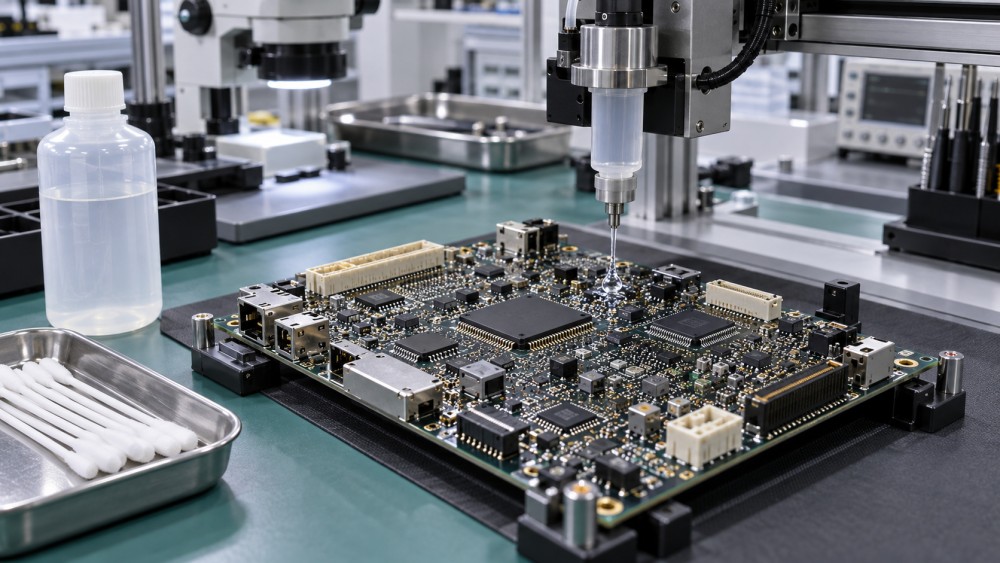
- Use the least aggressive application method. A lint-free swab, controlled dispenser, or low-pressure spray is usually safer than flooding the whole board. Work from cleaner areas toward more contaminated ones.
- Lift contamination instead of spreading it. Replace wipes and swabs often. A dirty applicator can move dissolved flux, oil, or salts across neighboring pads and under component edges.
- Allow adequate drainage and evaporation. Tilt the assembly so liquid does not collect under connectors, shields, sockets, or large packages. Use only drying methods that are compatible with the board and components.
- Inspect before returning the board to service. Check for remaining film, trapped droplets, fibers, altered coatings, damaged markings, or signs that components were disturbed during handling.
For boards cleaned after solder rework, inspection should include the spaces between fine-pitch leads and nearby passive components. Residue trapped in these areas can be difficult to see without magnification. A clean-looking surface around the outside of an integrated circuit does not prove that the underside of the package is dry or residue-free.
Drying is part of the cleaning process
Evaporation speed matters, but fast evaporation is not always enough. A solvent can disappear from exposed copper and solder joints while remaining trapped in narrow gaps, connector cavities, under shielding, or beneath large components. This is particularly relevant for assemblies with bottom-terminated components, board-to-board connectors, switches, coils, and densely packed mechanical housings.
Do not power the board based only on a dry surface appearance. Give the assembly time to drain and evaporate in a clean environment. Where the process permits, controlled warm-air drying may help, but excessive heat can warp plastics, affect adhesives, stress components, or change the properties of coatings. The acceptable temperature and drying time depend on the specific assembly rather than the cleaner alone.
Aqueous cleaning needs stricter drying control. Water-based systems can be effective for certain production processes, especially where the assembly and components are designed for washing. But they rely on proper rinse quality and complete removal of moisture. Inadequate rinsing can leave dissolved ionic contamination behind; inadequate drying can create corrosion risk or electrical leakage. This method should be used only when the assembly’s washability and drying route have been verified.
Warning signs that the cleaner or method is unsuitable
Stop and reassess the process when any of the following appears during or after cleaning:
- Plastic housings become cloudy, brittle, tacky, or visibly swollen.
- Printed legends, labels, barcode markings, or inspection dots begin to smear.
- A conformal coating changes gloss, wrinkles, lifts at the edge, or feels soft.
- White haze or streaking appears after the solvent dries.
- Connector action becomes stiff, loose, noisy, or inconsistent.
- A strong residual odor remains in enclosed sections after the expected drying period.
- The board shows new functional faults after cleaning despite no visible physical damage.
A white film does not always mean the cleaner itself left residue. It may be dissolved flux solids, salts, or oils redeposited as the solvent evaporated. The correction is often to use a cleaner better suited to the soil, improve wiping or rinsing technique, and prevent the dissolved material from drying back onto the board.
When spot cleaning is safer than full-board cleaning
Full-board cleaning is not automatically more thorough. On a board with one reworked connector or a small flux-contaminated area, targeted cleaning can reduce exposure to plastics, coatings, labels, and components that do not need treatment. It also lowers the chance that liquid will enter hidden spaces.
Broad cleaning is more appropriate when contamination is widespread and the board construction is known to tolerate the chosen process. Production cleaning, for example, may be validated around a specific solder paste, flux chemistry, board finish, component population, rinse method, and drying profile. That controlled process cannot be assumed to apply to an unknown field-return board or a mixed assembly that has been modified over time.
Do not use household substitutes on circuit boards
Household cleaners, glass cleaners, degreasers, lubricants, acetone-containing mixtures, and fragranced wipes are poor substitutes for electronic cleaning chemicals. They may leave surfactants, perfumes, oils, salts, corrosion inhibitors, or water behind. Some can rapidly damage plastics and coatings. Even compressed-air products should be selected carefully, since certain products may release propellant or leave cold-induced condensation when used improperly.
For high-impedance, high-frequency, safety-related, optical, medical, or precision control assemblies, the cleanliness requirement may be more demanding than visual inspection suggests. Ionic contamination, moisture retention, and residue under components can affect performance even when solder joints appear intact. In these cases, cleaner selection, application volume, residue testing, and drying conditions may need to be confirmed against the assembly specification.
Questions that often arise during board cleaning
Can a circuit board be cleaned with alcohol and powered on immediately?
No. Even when using a high-purity alcohol-based cleaner, wait until the board is fully dry, including connectors, shielded areas, and spaces beneath components. Surface dryness is not a reliable indication that all trapped liquid has evaporated.
Will a no-residue cleaner remove every type of flux?
Not necessarily. Flux chemistry varies, and some residues require a specifically matched solvent system or a controlled aqueous process. A no-residue label describes the intended evaporation behavior of the cleaner, not guaranteed removal of every contaminant.
Should corrosion be scrubbed off aggressively?
Aggressive abrasion can remove protective finishes, damage solder mask, lift pads, or break fine component leads. First determine whether the corrosion is superficial or whether it has already affected copper traces, plated holes, component terminals, or connector contacts. Severe corrosion may require repair work in addition to cleaning.
Related News
 Antioxidants & Natural PreservativesWhat Quality Checks Matter When Sourcing Butylparaben for Personal CareButylparaben for personal care sourcing guide: compare assay, impurities, physical performance, documentation, traceability, and supplier quality to reduce formulation risk.MORE+
 Nano-microcapsule FormulationsHow Encapsulated Flavors Protect Taste During Processing and StorageEncapsulated Flavors protect taste from heat, oxygen, moisture, and storage loss. Explore smarter release, carrier selection, and processing strategies.MORE+
 Chelated Trace Element FertilizersHow Greenhouse Fertigation Systems Reduce Water and Fertilizer WasteGreenhouse fertigation systems reduce water and fertilizer waste with precise dosing, uniform irrigation, drainage monitoring, and smarter crop-zone control. Learn practical strategies.MORE+
 Supercritical CO2 Essential OilsHow Natural Essential Oil Blends Improve Consistent Product FragranceNatural essential oil blends help brands achieve consistent, appealing fragrance across batches. Explore smart blend design, stability testing, and product compatibility strategies.MORE+
 Non-ionic Surfactants & DefoamersHow to Choose Non Ionic Low Foaming Surfactants for CIP CleaningNon ionic low foaming surfactants for CIP cleaning: learn how to balance wetting, foam control, compatibility, and rinseability for reliable cleaning performance.MORE+
 Nano-microcapsule FormulationsHow Food Grade Cyclodextrin Complexes Protect Sensitive FlavorsFood grade cyclodextrin inclusion complexes help protect sensitive flavors from oxidation, evaporation, and processing loss while supporting controlled release and consistent sensory quality.MORE+
 Polymer-Coated Water Soluble NPKHow Fertilizer Coating Polymers Improve NPK Granule ReleaseFertilizer coating polymers for NPK granules improve controlled nutrient release, reduce loss risks, and enhance product consistency. Discover key selection and process insights.MORE+
 Chelated Trace Element FertilizersWhat Diammonium Phosphate Means for Crop Nutrition PlanningDiammonium Phosphate: learn how DAP supports early phosphorus access, nitrogen budgeting, smart placement, and balanced crop nutrition planning.MORE+
 Maillard Reaction Savory FlavorsHow to Assess a Flavor Bases Supplier List for Reliable SourcingGlobal Fine Chemicals & Agrochemical Intelligence Network flavor bases supplier list: assess specs, samples, supply risk, and true cost to source with confidence.MORE+
 Hydrocolloids & EmulsifiersHow Konjac Gum Powder Improves Texture in Low-Calorie FoodsKonjac gum powder improves body, stability, and mouthfeel in low-calorie foods. Discover practical tips for smoother sauces, beverages, and reduced-fat formulations.MORE+
 Supercritical CO2 Essential OilsWhat to Check Before Choosing a Botanical Essential Oils ManufacturerChoose a botanical essential oils manufacturer with confidence. Explore key checks for purity, traceability, compliance, batch consistency, and reliable supply.MORE+
 Microencapsulated FragrancesHow Fragrance Carriers for Detergents Improve Scent PerformanceFragrance carriers for detergents improve stability, fabric deposition, and long-lasting scent. Explore practical solutions for better wash-to-wear fragrance performance.MORE+
 Antioxidants & Natural PreservativesWhen Propyl Gallate Antioxidant Is the Right Choice for Oil StabilityPropyl gallate antioxidant: learn when it is the right choice for oil stability, shelf-life protection, processing compatibility, and smarter formulation decisions.MORE+
 Antioxidants & Natural PreservativesHow Potassium Sorbate Extends Shelf Life in Food and Beverage ProductsPotassium Sorbate helps food and beverage brands control yeast and mold spoilage. Explore pH, dosage, processing, and packaging strategies for reliable shelf life.MORE+
 Antioxidants & Natural PreservativesHow to Source Bulk Herbal Extracts With Reliable Quality ControlBulk herbal extracts sourcing guide: compare suppliers, verify traceability, review CoAs, and build reliable quality controls for safer, consistent purchasing.MORE+
 Antioxidants & Natural PreservativesWhat to Check Before Sourcing Butylparaben for Personal Care FormulasButylparaben for personal care sourcing guide: check market eligibility, purity, supplier controls, formula compatibility, packaging, and total risk before buying.MORE+
 Targeted Bio-pesticides & APIsChoosing Microbial Fungicides for Foliar Diseases in Integrated Crop ProgramsMicrobial fungicides for foliar diseases: learn how to match biology, formulation, tank compatibility, and timing for stronger integrated crop protection.MORE+
 Targeted Bio-pesticides & APIsHow Microbial Insecticides Control Caterpillars With Lower Crop Residue RiskMicrobial insecticides for caterpillars help protect crops with targeted early-larval control and lower residue-management pressure. Learn timing, coverage, compliance, and scouting essentials.MORE+
 Microencapsulated FragrancesHow to Add Encapsulated Laundry Fragrances Without Weakening Wash ResultsEncapsulated laundry fragrances: learn how to boost long-lasting scent while protecting cleaning power, stability, foam control, and fabric care.MORE+
 Supercritical CO2 Essential OilsHow Aroma Ingredients Shape Lasting and Skin-Safe Personal Care ProductsAroma ingredients for personal care: discover how to achieve lasting scent, formulation stability, skin safety, and confident product performance.MORE+
 Targeted Bio-pesticides & APIsInsecticides Explained Through Labels, Active Ingredients, and SafetyInsecticides explained through labels, active ingredients, formulations, and safety. Learn how to compare products, manage risk, and make informed crop protection decisions.MORE+
 Heavy-duty Industrial DegreasersHow to Select Parts Wash Cleaners for Automotive ComponentsParts wash cleaners for automotive components: learn how to match chemistry, materials, rinsing, safety, and waste controls for reliable cleaning results.MORE+
 Chelated Trace Element FertilizersHow Precision Fertigation Systems Improve Water and Nutrient ControlPrecision fertigation systems improve water and nutrient control with accurate dosing, uniform irrigation, smart monitoring, and reduced waste. Discover how to optimize crop performance.MORE+
 Hydrocolloids & EmulsifiersHow Bulk Price Factors Affect Hydrocolloid Stabilizer Blend SourcingHydrocolloid stabilizer blends bulk price: compare dosage efficiency, quality consistency, logistics, and documentation to reduce total sourcing costs.MORE+
 Zero-Calorie Sweeteners & AcidulantsHow to Choose a Natural Sweeteners Supplier for Clean-Label ProductsNatural sweeteners supplier selection guide for clean-label products: compare formulation fit, traceability, documentation, and supply reliability.MORE+
 Non-ionic Surfactants & DefoamersWhat Cationic Surfactants Do and Where They Are UsedCationic Surfactants deliver antimicrobial action, conditioning, antistatic control, and surface treatment benefits. Explore key uses, compatibility, and safe selection tips.MORE+
 Targeted Bio-pesticides & APIsHow to Evaluate Pesticide Suspension Concentrates for Field StabilityPesticide Suspension Concentrates: learn how to evaluate field stability, redispersibility, dilution, tank-mix compatibility, and spray safety for reliable performance.MORE+
 Hydrocolloids & EmulsifiersHow Hydrocolloid Systems for Meat Products Improve Texture and YieldHydrocolloid systems for meat products improve yield, texture, water retention, and slicing quality. Explore practical formulation strategies for stable, high-performing meat products.MORE+
 Microencapsulated FragrancesHow Laundry Fragrances for Liquid Detergents Improve Scent LongevityLaundry fragrances for liquid detergents: discover how fragrance design, deposition, and encapsulation create lasting fabric freshness and stronger product appeal.MORE+
 Nano-microcapsule FormulationsChoosing Fragrance Preparations That Perform Well in Personal WashFragrance preparations for personal wash: learn how to select options that protect clarity, stability, foam, scent performance, and packaging compatibility.MORE+
 Controlled-Release ThermodynamicsModified Cyclodextrins Explained for Controlled Fragrance ReleaseModified cyclodextrins enable controlled fragrance release, odor control, and volatile-note protection. Explore how they optimize performance in detergents, fabric care, and more.MORE+
 Microencapsulated FragrancesHow Fragrance Delivery Systems Improve Fabric Softener LongevityFragrance delivery systems for fabric softeners improve scent longevity through smart protection, reliable deposition, and controlled release for lasting freshness.MORE+
 Supercritical CO2 Essential OilsHow to Evaluate a Natural Cardamom Oil Supplier for Reliable SupplyNatural cardamom oil supplier evaluation guide: verify botanical origin, purity, batch consistency, documentation, packaging, and delivery reliability for confident sourcing.MORE+
 Maillard Reaction Savory FlavorsHow Ethyl Maltol Purity Testing Supports Flavor Safety ComplianceEthyl Maltol purity testing strengthens flavor safety compliance through identity checks, impurity profiling, supplier verification, and audit-ready documentation.MORE+
 Microencapsulated FragrancesEssential Oil Extracts Compared for Fragrance and Wellness UsesEssential Oil Extracts compared for fragrance and wellness: explore scent profiles, extraction methods, stability, safety, and sourcing insights for smarter formulation choices.MORE+
 Zero-Calorie Sweeteners & AcidulantsWhat Drives Zero Calorie Sweeteners Bulk Price in 2026Zero calorie sweeteners bulk price in 2026: compare specifications, dosage, quality, freight, and supply risk to make smarter sourcing decisions.MORE+
 EPA FIFRA & FDA GRAS RegsSynthetic Food Preservatives Rules That Support Safer FormulasSynthetic Food Preservatives: learn the rules for safer formulas, compliant use levels, validated shelf life, labeling, and reliable microbial control.MORE+
 Micelle Fluidics & ChelationHow Anionic Industrial Dispersants Improve Coating StabilityAnionic industrial dispersants improve coating stability, pigment wetting, viscosity control, gloss, and storage performance. Learn how to select and test the right solution.MORE+
 Supercritical CO2 Essential OilsHow to Choose Eucalyptus Oil Grades for Clean, Consistent ProductsChoose the right Eucalyptus Oil grade with confidence. Compare cineole content, purity, origin, processing, documentation, and application fit for consistent products.MORE+
 Micelle Fluidics & ChelationWhat Are Cationic Surfactants and Where Are They Commonly Used?Cationic Surfactants deliver powerful surface affinity for disinfection, fabric softening, hair conditioning, antistatic control, and industrial treatments. Explore key uses and selection factors.MORE+