
Why Mild Cocamidopropyl Betaine Matters in Gentle Cleansing Formulas
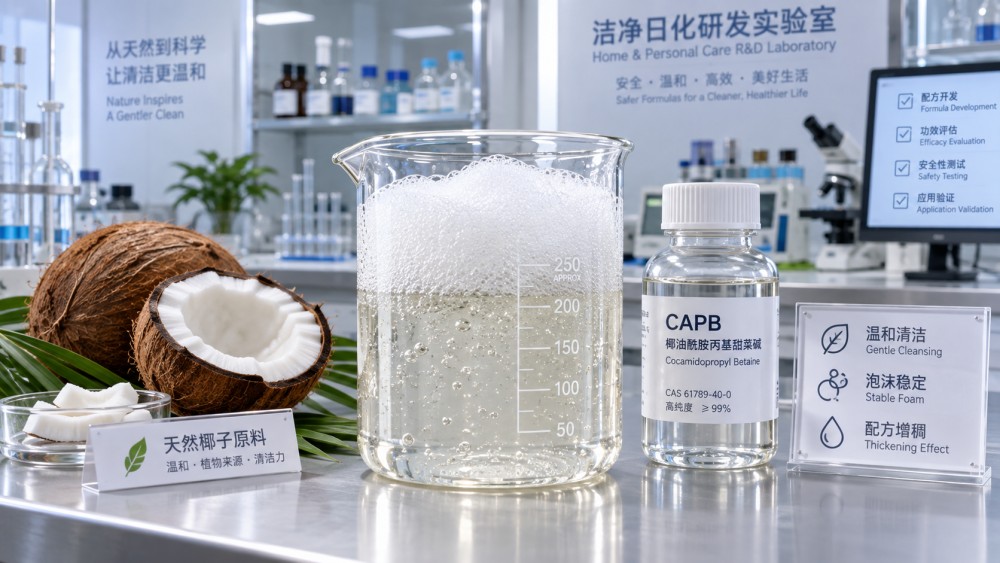
Mild cocamidopropyl betaine matters because “gentle cleansing” is not achieved by simply choosing a surfactant with a mild reputation. A cleanser must still wet the skin or substrate, lift sebum and particulate soil, maintain an acceptable foam profile, remain stable through storage, and rinse without an undesirable residue. Cocamidopropyl betaine (CAPB) is frequently used because it helps balance these competing requirements, particularly when paired with stronger primary surfactants.
Its value lies less in being a universal stand-alone cleanser than in functioning as a formulation moderator. In shampoo, facial wash, body wash, hand soap, baby cleansing products, and selected household cleaning systems, CAPB can improve foam quality, support viscosity development, broaden compatibility, and reduce the harshness associated with some anionic surfactant systems. These benefits depend on grade quality, surfactant ratio, pH, electrolyte level, preservatives, fragrance, and the intended use pattern.
An amphoteric surfactant with a practical formulation role
Cocamidopropyl betaine is an amphoteric surfactant produced from fatty acids derived from coconut feedstocks and a betaine-type hydrophilic group. Commercial CAPB is generally supplied as an aqueous solution rather than as a pure, single chemical substance. Its hydrocarbon chains provide oil-affinity and soil-lifting capacity, while its charged polar group supports dispersion in water and interaction with other surfactants.
The term “amphoteric” is important, but it can be misunderstood. CAPB has both positively and negatively charged functionalities within its molecular structure. Its behavior in a formula is influenced by pH and by the other surfactants present. In common personal-care cleansing ranges, it behaves as a zwitterionic co-surfactant and works particularly effectively beside anionic materials such as sodium laureth sulfate, sodium lauroyl sarcosinate, sodium cocoyl glutamate, or sodium methyl cocoyl taurate.
That interaction changes the surfactant system rather than merely adding another cleaning agent. When anionic and amphoteric surfactants associate in solution, they can form mixed micelles. These structures may lower the concentration of freely available anionic surfactant molecules that interact aggressively with skin proteins and lipids. This is one reason CAPB is commonly associated with improved mildness, although it does not make an otherwise poorly designed formula inherently non-irritating.
The practical point is that mildness is a property of the finished system: total surfactant active matter, surfactant blend, pH, contact time, rinse-off behavior, preservatives, fragrance allergens, chelators, solvents, and product use all matter. CAPB contributes to the outcome, but it is not the outcome by itself.
Why foam quality matters more than foam volume
Consumers often associate abundant foam with cleaning performance, while formulators know that foam volume alone says little about detergency, rinse quality, or skin compatibility. CAPB is valued because it can improve foam texture and persistence in systems where the primary anionic surfactant produces foam that is fast but airy, unstable, or weakened by oils and soil.
In a shampoo, for example, foam must develop under dilution, distribute through wet hair, tolerate sebum and styling residues, and rinse without leaving hair difficult to manage. In a hand wash, foam must appear quickly under short wash conditions yet not create an excessively high-defatting wash profile. CAPB can support a denser, creamier foam sensation in both cases. This sensory contribution is commercially relevant because it helps a milder surfactant system remain convincing in actual use.
However, “more CAPB” is not a universal route to better foam. At high inclusion levels, it may alter the foam character in ways that no longer suit the intended product. Formula performance also shifts with fragrance oil load, polymers, pearlizers, oils, conditioning agents, and water hardness. The useful question is not whether CAPB boosts foam in isolation, but whether it delivers the desired foam under the product’s real dilution, soil, and application conditions.
Mildness is linked to surfactant interactions, not a marketing claim
The mildness case for CAPB is strongest when it is discussed in relation to a complete surfactant blend. Primary anionic surfactants are efficient cleansers and often economical building blocks, but their skin interaction can be more pronounced when used alone or at a high active level. Introducing an amphoteric co-surfactant can modify micellar structure and reduce the harsh sensory profile of the blend.
This can be useful in products intended for frequent use, such as daily shampoo, shower gel, facial cleanser, and hand wash. It is also relevant where a formula must remove soils efficiently but avoid an overly “stripped” after-feel. A squeaky-clean sensation is not always evidence of superior cleansing; it may reflect excessive removal of surface lipids or a surfactant system that is poorly balanced for the use case.
There are clear limits. A formula with a high total active surfactant content, strongly alkaline pH, high fragrance burden, or unsuitable preservative system can still cause discomfort even when it contains CAPB. Conversely, a carefully designed low-active system based on mild anionic or nonionic surfactants may not require a large CAPB contribution. The ingredient is best understood as a flexible tool for tuning cleansing behavior rather than as a shortcut to a “sensitive skin” claim.
Viscosity building: useful, but not automatic
One of the most commercially useful properties of cocamidopropyl betaine is its role in viscosity adjustment. Many anionic/amphoteric surfactant blends respond to sodium chloride or other electrolytes by becoming thicker over a specific concentration range. This allows formulators to build a pourable gel texture without relying exclusively on polymeric thickeners.
The relationship is often described as a salt curve. At low salt concentration, viscosity may be modest. As salt is added, the micelles can change shape and the product thickens. Beyond an optimum point, additional salt can cause viscosity to fall. This means salt addition is a controlled formulation step, not a simple “add until thick” procedure.
CAPB can make this electrolyte-thickening behavior more workable in conventional sulfate-containing systems, but the response is highly formula-specific. A blend based on sodium laureth sulfate and CAPB may thicken readily, while a sulfate-free system based on glutamates, taurates, isethionates, glucosides, or amino-acid surfactants may require a different rheology strategy. Polymer thickeners, associative thickeners, cellulose derivatives, gums, or specialized surfactant blends may be more appropriate in those cases.
This distinction matters during ingredient evaluation. A supplier’s typical viscosity result obtained from a simple model formula cannot be treated as a guarantee for a finished cleanser containing fragrance, actives, botanical extracts, conditioning polymers, opacifiers, and a particular preservative package.
Compatibility supports formulation flexibility
CAPB is used across many rinse-off formats partly because it is compatible with a broad range of surfactants. It can work with anionic surfactants to improve mildness and foam, with nonionic surfactants to help manage solubilization and cleansing balance, and with certain cationic components under carefully controlled conditions. Its compatibility profile is useful when a product needs more than basic washing performance.
In shampoos, the surfactant base must coexist with conditioning polymers, silicones, deposition aids, fragrances, preservatives, and often anti-dandruff or scalp-care actives. In body wash, oils, emollients, pearlizing agents, and fragrance may significantly affect clarity and viscosity. In facial cleansers, formulators may need to accommodate humectants, soothing agents, exfoliating acids, or low-pH positioning. CAPB does not solve all compatibility issues, but it gives more room to design a balanced system.
It also has relevance beyond personal care. In household cleaning products, amphoteric surfactants can support wetting and foam in products where surface friendliness or foam character is important. Yet the mildness logic should not be transferred automatically from skin cleansing to hard-surface cleaning. A kitchen cleaner, dishwashing liquid, or institutional cleaning product is evaluated primarily by soil removal, rinse behavior, material compatibility, foam control, and exposure conditions. The appropriate CAPB level may therefore differ substantially from that in a body wash.
Grade quality can affect both performance and risk assessment
“Cocamidopropyl betaine” does not describe every commercially available material with enough precision for technical comparison. Products can differ in active matter, sodium chloride content, pH, color, odor, microbial control system, viscosity, coconut-chain distribution, and impurity profile. These differences can influence processing, finished-product appearance, batch repeatability, and safety evaluation.
Two residual substances receive particular attention in discussions of CAPB sensitivity: amidoamine and 3-dimethylaminopropylamine (DMAPA). They can arise from the manufacturing route and may be present at low residual levels depending on process control and purification. Reports of allergic contact dermatitis associated with CAPB-containing products have led formulators and safety assessors to examine these residuals carefully rather than treating the label name alone as the complete exposure picture.
This does not mean CAPB should be classified as unsuitable for gentle cleansing. It means the choice of grade and the supporting documentation matter. For products intended for sensitive-use positioning, a technical review should consider impurity specifications, supplier analytical controls, lot consistency, and the finished formula’s irritation and compatibility assessment. A low-odor or light-color grade may be useful for aesthetics, but those properties do not by themselves establish a favorable impurity profile.
Common formulation assumptions that create avoidable problems
A frequent mistake is to assume that CAPB can replace a primary surfactant without changing cleaning performance. In many formulas, it is a co-surfactant rather than the principal detergent. Replacing a high-detergency anionic surfactant with CAPB may reduce cleaning power, change viscosity response, alter foam under soil load, and affect cost structure. Whether that trade-off is desirable depends on the product’s purpose.
Another mistake is to judge mildness only through the ingredient list. A cleanser containing several materials perceived as mild can still be unpleasant if the combined active level is too high, the pH is unsuitable, the rinse profile is poor, or the formula contains sensitizing fragrance components. Finished-product testing and use-relevant assessment remain more informative than a simple ingredient-counting approach.
Clarity is also often overestimated as a sign of formulation quality. CAPB can be used in clear systems, but a transparent appearance may be destabilized by fragrance, oils, salts, temperature cycling, or botanical additions. A formula may need a solubilizer, a different perfume composition, an opacity strategy, or a revised surfactant ratio. Forcing a clear appearance through excessive processing or incompatible additives can compromise the formula more than accepting a naturally pearlescent or opaque format.
How to evaluate CAPB for a gentle cleanser
A useful evaluation begins with the finished-product brief rather than the raw material name. The intended cleansing task should be clear: removal of light daily soil, heavy sebum, makeup residues, occupational grime, or hard-surface grease each demands a different surfactant balance. The expected frequency of use, contact time, target pH, desired foam character, and packaging format also influence the choice.
Technical documents should be reviewed for active matter, pH, sodium chloride level, appearance, odor, microbiological specification, preservative system where applicable, and impurity limits relevant to the intended application. Certificates of analysis are important for verifying delivered lots, but they should be read alongside the supplier’s specification and change-control approach. A raw material that performs well in a pilot batch but varies in salt content or active content across supply lots can create recurring viscosity and appearance issues at production scale.
Laboratory screening should assess more than initial viscosity. Storage at relevant temperatures, freeze-thaw exposure where distribution conditions warrant it, centrifugation or other stability checks, odor development, color stability, foam under dilution, and compatibility with packaging all provide useful evidence. For personal-care products, irritation potential and claim support require appropriate safety assessment methods consistent with the intended market and product category.
The reason mild cocamidopropyl betaine remains important is straightforward: it helps formulators make effective cleansing systems behave more gently and feel more refined. Its contribution is real, but conditional. The strongest formulas use CAPB with a clear understanding of mixed-surfactant behavior, electrolyte response, impurity control, and the difference between an ingredient’s reputation and a finished product’s actual performance.
Related News
 Antioxidants & Natural PreservativesWhat Quality Checks Matter When Sourcing Butylparaben for Personal CareButylparaben for personal care sourcing guide: compare assay, impurities, physical performance, documentation, traceability, and supplier quality to reduce formulation risk.MORE+
 Nano-microcapsule FormulationsHow Encapsulated Flavors Protect Taste During Processing and StorageEncapsulated Flavors protect taste from heat, oxygen, moisture, and storage loss. Explore smarter release, carrier selection, and processing strategies.MORE+
 Chelated Trace Element FertilizersHow Greenhouse Fertigation Systems Reduce Water and Fertilizer WasteGreenhouse fertigation systems reduce water and fertilizer waste with precise dosing, uniform irrigation, drainage monitoring, and smarter crop-zone control. Learn practical strategies.MORE+
 Supercritical CO2 Essential OilsHow Natural Essential Oil Blends Improve Consistent Product FragranceNatural essential oil blends help brands achieve consistent, appealing fragrance across batches. Explore smart blend design, stability testing, and product compatibility strategies.MORE+
 Non-ionic Surfactants & DefoamersHow to Choose Non Ionic Low Foaming Surfactants for CIP CleaningNon ionic low foaming surfactants for CIP cleaning: learn how to balance wetting, foam control, compatibility, and rinseability for reliable cleaning performance.MORE+
 Nano-microcapsule FormulationsHow Food Grade Cyclodextrin Complexes Protect Sensitive FlavorsFood grade cyclodextrin inclusion complexes help protect sensitive flavors from oxidation, evaporation, and processing loss while supporting controlled release and consistent sensory quality.MORE+
 Polymer-Coated Water Soluble NPKHow Fertilizer Coating Polymers Improve NPK Granule ReleaseFertilizer coating polymers for NPK granules improve controlled nutrient release, reduce loss risks, and enhance product consistency. Discover key selection and process insights.MORE+
 Chelated Trace Element FertilizersWhat Diammonium Phosphate Means for Crop Nutrition PlanningDiammonium Phosphate: learn how DAP supports early phosphorus access, nitrogen budgeting, smart placement, and balanced crop nutrition planning.MORE+
 Maillard Reaction Savory FlavorsHow to Assess a Flavor Bases Supplier List for Reliable SourcingGlobal Fine Chemicals & Agrochemical Intelligence Network flavor bases supplier list: assess specs, samples, supply risk, and true cost to source with confidence.MORE+
 Hydrocolloids & EmulsifiersHow Konjac Gum Powder Improves Texture in Low-Calorie FoodsKonjac gum powder improves body, stability, and mouthfeel in low-calorie foods. Discover practical tips for smoother sauces, beverages, and reduced-fat formulations.MORE+
 Supercritical CO2 Essential OilsWhat to Check Before Choosing a Botanical Essential Oils ManufacturerChoose a botanical essential oils manufacturer with confidence. Explore key checks for purity, traceability, compliance, batch consistency, and reliable supply.MORE+
 Microencapsulated FragrancesHow Fragrance Carriers for Detergents Improve Scent PerformanceFragrance carriers for detergents improve stability, fabric deposition, and long-lasting scent. Explore practical solutions for better wash-to-wear fragrance performance.MORE+
 Antioxidants & Natural PreservativesWhen Propyl Gallate Antioxidant Is the Right Choice for Oil StabilityPropyl gallate antioxidant: learn when it is the right choice for oil stability, shelf-life protection, processing compatibility, and smarter formulation decisions.MORE+
 Antioxidants & Natural PreservativesHow Potassium Sorbate Extends Shelf Life in Food and Beverage ProductsPotassium Sorbate helps food and beverage brands control yeast and mold spoilage. Explore pH, dosage, processing, and packaging strategies for reliable shelf life.MORE+
 Antioxidants & Natural PreservativesHow to Source Bulk Herbal Extracts With Reliable Quality ControlBulk herbal extracts sourcing guide: compare suppliers, verify traceability, review CoAs, and build reliable quality controls for safer, consistent purchasing.MORE+
 Antioxidants & Natural PreservativesWhat to Check Before Sourcing Butylparaben for Personal Care FormulasButylparaben for personal care sourcing guide: check market eligibility, purity, supplier controls, formula compatibility, packaging, and total risk before buying.MORE+
 Targeted Bio-pesticides & APIsChoosing Microbial Fungicides for Foliar Diseases in Integrated Crop ProgramsMicrobial fungicides for foliar diseases: learn how to match biology, formulation, tank compatibility, and timing for stronger integrated crop protection.MORE+
 Targeted Bio-pesticides & APIsHow Microbial Insecticides Control Caterpillars With Lower Crop Residue RiskMicrobial insecticides for caterpillars help protect crops with targeted early-larval control and lower residue-management pressure. Learn timing, coverage, compliance, and scouting essentials.MORE+
 Microencapsulated FragrancesHow to Add Encapsulated Laundry Fragrances Without Weakening Wash ResultsEncapsulated laundry fragrances: learn how to boost long-lasting scent while protecting cleaning power, stability, foam control, and fabric care.MORE+
 Supercritical CO2 Essential OilsHow Aroma Ingredients Shape Lasting and Skin-Safe Personal Care ProductsAroma ingredients for personal care: discover how to achieve lasting scent, formulation stability, skin safety, and confident product performance.MORE+
 Targeted Bio-pesticides & APIsInsecticides Explained Through Labels, Active Ingredients, and SafetyInsecticides explained through labels, active ingredients, formulations, and safety. Learn how to compare products, manage risk, and make informed crop protection decisions.MORE+
 Heavy-duty Industrial DegreasersHow to Select Parts Wash Cleaners for Automotive ComponentsParts wash cleaners for automotive components: learn how to match chemistry, materials, rinsing, safety, and waste controls for reliable cleaning results.MORE+
 Chelated Trace Element FertilizersHow Precision Fertigation Systems Improve Water and Nutrient ControlPrecision fertigation systems improve water and nutrient control with accurate dosing, uniform irrigation, smart monitoring, and reduced waste. Discover how to optimize crop performance.MORE+
 Hydrocolloids & EmulsifiersHow Bulk Price Factors Affect Hydrocolloid Stabilizer Blend SourcingHydrocolloid stabilizer blends bulk price: compare dosage efficiency, quality consistency, logistics, and documentation to reduce total sourcing costs.MORE+
 Zero-Calorie Sweeteners & AcidulantsHow to Choose a Natural Sweeteners Supplier for Clean-Label ProductsNatural sweeteners supplier selection guide for clean-label products: compare formulation fit, traceability, documentation, and supply reliability.MORE+
 Non-ionic Surfactants & DefoamersWhat Cationic Surfactants Do and Where They Are UsedCationic Surfactants deliver antimicrobial action, conditioning, antistatic control, and surface treatment benefits. Explore key uses, compatibility, and safe selection tips.MORE+
 Targeted Bio-pesticides & APIsHow to Evaluate Pesticide Suspension Concentrates for Field StabilityPesticide Suspension Concentrates: learn how to evaluate field stability, redispersibility, dilution, tank-mix compatibility, and spray safety for reliable performance.MORE+
 Hydrocolloids & EmulsifiersHow Hydrocolloid Systems for Meat Products Improve Texture and YieldHydrocolloid systems for meat products improve yield, texture, water retention, and slicing quality. Explore practical formulation strategies for stable, high-performing meat products.MORE+
 Microencapsulated FragrancesHow Laundry Fragrances for Liquid Detergents Improve Scent LongevityLaundry fragrances for liquid detergents: discover how fragrance design, deposition, and encapsulation create lasting fabric freshness and stronger product appeal.MORE+
 Nano-microcapsule FormulationsChoosing Fragrance Preparations That Perform Well in Personal WashFragrance preparations for personal wash: learn how to select options that protect clarity, stability, foam, scent performance, and packaging compatibility.MORE+
 Controlled-Release ThermodynamicsModified Cyclodextrins Explained for Controlled Fragrance ReleaseModified cyclodextrins enable controlled fragrance release, odor control, and volatile-note protection. Explore how they optimize performance in detergents, fabric care, and more.MORE+
 Microencapsulated FragrancesHow Fragrance Delivery Systems Improve Fabric Softener LongevityFragrance delivery systems for fabric softeners improve scent longevity through smart protection, reliable deposition, and controlled release for lasting freshness.MORE+
 Supercritical CO2 Essential OilsHow to Evaluate a Natural Cardamom Oil Supplier for Reliable SupplyNatural cardamom oil supplier evaluation guide: verify botanical origin, purity, batch consistency, documentation, packaging, and delivery reliability for confident sourcing.MORE+
 Maillard Reaction Savory FlavorsHow Ethyl Maltol Purity Testing Supports Flavor Safety ComplianceEthyl Maltol purity testing strengthens flavor safety compliance through identity checks, impurity profiling, supplier verification, and audit-ready documentation.MORE+
 Microencapsulated FragrancesEssential Oil Extracts Compared for Fragrance and Wellness UsesEssential Oil Extracts compared for fragrance and wellness: explore scent profiles, extraction methods, stability, safety, and sourcing insights for smarter formulation choices.MORE+
 Zero-Calorie Sweeteners & AcidulantsWhat Drives Zero Calorie Sweeteners Bulk Price in 2026Zero calorie sweeteners bulk price in 2026: compare specifications, dosage, quality, freight, and supply risk to make smarter sourcing decisions.MORE+
 EPA FIFRA & FDA GRAS RegsSynthetic Food Preservatives Rules That Support Safer FormulasSynthetic Food Preservatives: learn the rules for safer formulas, compliant use levels, validated shelf life, labeling, and reliable microbial control.MORE+
 Micelle Fluidics & ChelationHow Anionic Industrial Dispersants Improve Coating StabilityAnionic industrial dispersants improve coating stability, pigment wetting, viscosity control, gloss, and storage performance. Learn how to select and test the right solution.MORE+
 Supercritical CO2 Essential OilsHow to Choose Eucalyptus Oil Grades for Clean, Consistent ProductsChoose the right Eucalyptus Oil grade with confidence. Compare cineole content, purity, origin, processing, documentation, and application fit for consistent products.MORE+
 Micelle Fluidics & ChelationWhat Are Cationic Surfactants and Where Are They Commonly Used?Cationic Surfactants deliver powerful surface affinity for disinfection, fabric softening, hair conditioning, antistatic control, and industrial treatments. Explore key uses and selection factors.MORE+







































