Do industrial wetting agents improve pesticide spray coverage? They can when poor leaf wetting limits deposition, but lower surface tension alone does not guarantee better performance.
For technical evaluators, the key is whether an agriculturally suitable wetting agent improves droplet spreading and retention without increasing runoff, crop injury, or formulation instability.
This article examines how leaf surface properties, surfactant chemistry, spray conditions, and pesticide compatibility influence results, alongside tests that distinguish useful coverage from excessive spreading.
Any candidate must meet applicable regulatory requirements and pesticide label directions. An industrial product’s wetting performance does not establish its suitability for agricultural spray applications.
The strongest justification for adding a wetting agent is a demonstrated limitation: droplets fail to wet the target, and correcting that failure improves pesticide delivery.
Does poor wetting actually limit your spray coverage?

Wetting agents are surfactants that change liquid interactions with surfaces. In pesticide sprays, they can help deposited droplets spread over leaves that otherwise resist wetting.
Waxy foliage often produces rounded droplets with small contact areas. Some droplets rebound or roll away, leaving less spray on the intended plant surface.
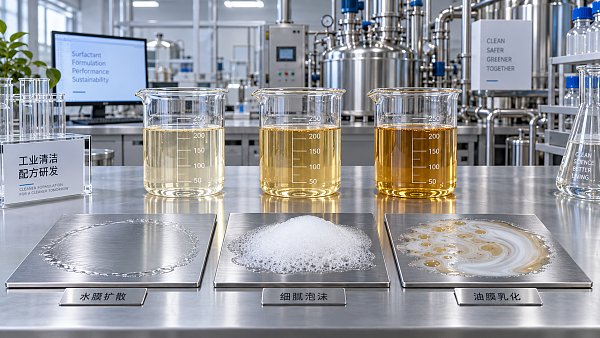
A suitable surfactant can reduce contact angle and increase the area contacted by retained droplets. The practical benefit depends on what happens after impact.
Leaf hairs, surface roughness, wax composition, growth stage, and leaf orientation complicate this response. Performance on one crop cannot reliably predict performance on another crop.
Wetting improvements are most relevant when untreated spray visibly beads, deposition is patchy, or a contact pesticide requires more uniform treatment of exposed target surfaces.
However, sparse coverage caused by poor nozzle placement or inadequate canopy penetration requires application changes. A wetting agent cannot reliably compensate for droplets missing their target.
Before screening products, identify whether the primary limitation is spray delivery, droplet retention, spreading, or active ingredient uptake. Each problem requires a different performance assessment.
What counts as a useful improvement in coverage?
Coverage describes the proportion of a target surface contacted by spray. Deposition describes the amount delivered, while retention describes how much remains after impact and drainage.
These measurements are related but cannot substitute for one another. A large wetted area may contain little active ingredient if spreading produces a very thin deposit.
Likewise, a treatment can produce impressive photographs while losing more spray through runoff. Visual spreading alone provides insufficient evidence for a formulation or purchasing decision.
Contact pesticides often benefit from more uniform deposits, although biological performance still depends on dose, target susceptibility, persistence, and access to the relevant plant surface.
Systemic pesticides may benefit from improved contact or absorption, but greater spreading does not automatically increase uptake. Some combinations can redistribute deposits without improving control.
Technical evaluators should therefore define success using several connected endpoints: target coverage, retained spray mass, deposit distribution, crop safety, and the required biological response together.
Which wetting agent properties deserve technical scrutiny?
Nonionic surfactants are widely used in agricultural adjuvants because they can provide useful wetting across varied formulations. However, individual chemistries differ substantially in practical performance.
Some organosilicone surfactants produce extensive spreading on suitable surfaces. That behavior can be valuable, but may also increase drainage or alter uptake under particular conditions.
Anionic surfactants can contribute wetting and dispersion, while cationic products may create compatibility or crop safety concerns. Charge category alone cannot establish suitability for use.
Commercial products often contain surfactant blends, solvents, and other ingredients. Evaluating only the named surfactant overlooks components that may affect injury, foam, stability, or residues.
Request the active surfactant content, recommended agricultural uses, relevant specifications, safety documentation, and supporting performance data. Compare products at clearly defined concentrations and application conditions.
Static surface tension describes a liquid after its surface approaches equilibrium. Spray droplets form and encounter leaves quickly, making dynamic surface tension particularly relevant during evaluation.
Surfactants need time to populate newly created liquid surfaces. Consequently, products with similar equilibrium measurements may behave differently during atomization, flight, and droplet impact events.
Contact angle measurements on representative leaves add useful information, but neither contact angle nor surface tension alone captures rebound, runoff, deposit chemistry, or biological efficacy.
When can more wetting reduce application performance?
Excessive spreading can connect neighboring droplets into films that drain from inclined leaves. This risk becomes especially relevant at high spray volumes or near runoff.
Under those conditions, increasing surfactant concentration may enlarge the visible wetted area while reducing retained pesticide. Measuring both outcomes prevents a misleading interpretation of performance.
Surfactants can also change spray breakup and droplet size distribution. The direction and magnitude depend on formulation, concentration, nozzle design, pressure, and other operating conditions.
A finer spray may increase apparent coverage while increasing drift potential. Wetting agents should therefore never be assumed to function as drift control products automatically.
Hot conditions, drought stress, tender growth, and certain pesticide combinations may increase crop injury risk. Greater penetration can also increase exposure to phytotoxic formulation components.
Existing surfactants within a pesticide formulation may already provide sufficient wetting. Additional adjuvant can produce little benefit, disrupt stability, or exceed permitted label directions unnecessarily.
Rainfastness also requires separate assessment when relevant. Faster spreading does not prove that deposits resist rainfall or that sufficient active ingredient enters the plant beforehand.
How should you test a candidate before recommending it?
Begin with the intended pesticide, crop, application equipment, water source, and permitted adjuvant use. Establish acceptance criteria before screening candidates to avoid selecting attractive but irrelevant results.
Use the pesticide spray without added wetting agent as the baseline. Where appropriate, include an established agricultural adjuvant as a practical reference for comparative performance.
Screen several permitted concentrations rather than assuming the highest concentration performs best. Keep pesticide dose, carrier volume, nozzle settings, and environmental conditions consistent across comparisons.
First, check mixture compatibility using representative water and label mixing instructions. Observe separation, flocculation, sedimentation, excessive foam, and changes during the expected spray holding period.
A jar test can identify obvious incompatibilities, but it does not establish crop safety, field efficacy, or acceptable behavior through pumps, filters, and spray nozzles.
Next, assess droplets on representative leaves under controlled conditions. Include relevant growth stages and leaf surfaces, since upper and lower surfaces may respond differently to treatment.
Record spreading over time, retained liquid, rebound, and drainage where feasible. A tracer can support deposit measurements when its compatibility and measurement response are validated.
Water sensitive cards help compare spray distribution, but their surfaces differ from leaves. Surfactants can change stain spreading, so card results need careful interpretation alongside leaf measurements.
Follow laboratory screening with replicated crop trials that measure coverage, crop injury, and biological outcomes. Use representative untreated controls and predefined assessment timings appropriate to the pesticide.
For retention comparisons, express deposits against a defined leaf area or target unit. Report variability, since inconsistent coverage can undermine a favorable average result across samples.
Set practical decision thresholds around the application objective. A statistically detectable spreading difference may have little commercial value if control, reliability, or crop safety remains unchanged.
Which spray conditions must stay in the evaluation?
Water chemistry can change pesticide and adjuvant behavior. Record hardness, pH, and relevant dissolved salts instead of assuming results obtained with laboratory water will transfer.
A wetting agent does not necessarily correct hard water antagonism or unsuitable pH. Water conditioners and buffers serve different functions and require their own compatibility assessment.
Carrier volume determines how much liquid reaches the target and how close foliage approaches runoff. Evaluate candidate products at realistic volumes for the intended application.
Nozzle type, pressure, travel speed, and boom position influence droplet delivery. Keep these variables documented so any observed benefit can be attributed and reproduced with confidence.
Dense canopies create additional barriers to deposition. Better spreading on exterior leaves does not demonstrate that sufficient spray reaches lower foliage or concealed pest habitats.
Temperature and humidity influence evaporation and drying time. Short drying periods can change deposit formation, while prolonged wetness can affect drainage and potential crop exposure.
Record these conditions during trials and define the operating range supported by evidence. Claims covering substantially different conditions require additional validation before broader commercial recommendation.
What should procurement and regulatory teams verify?
The term industrial wetting agent describes a broad market category, not agricultural authorization. A cleaning or coating surfactant may lack documentation needed for pesticide applications.
Confirm whether the intended use is incorporation into a pesticide formulation or addition to a spray tank. Regulatory obligations and supporting documentation may differ substantially.
Check applicable local requirements, pesticide label instructions, crop restrictions, and any required adjuvant approvals. Requirements vary by jurisdiction, so a general supplier statement is insufficient.
Request batch specifications, impurity controls, traceability, storage guidance, and change notification procedures. Consistent surfactant composition matters when application performance depends on a narrow concentration range.
A safety data sheet supports hazard communication but does not establish crop suitability or regulatory acceptance. Technical decisions require evidence addressing the actual proposed use.
Compare cost at the effective application rate rather than price per kilogram alone. Include handling, foam management, compatibility work, and any additional application constraints involved.
When is a wetting agent worth selecting?
Select a wetting agent when evidence shows that poor wetting limits pesticide delivery and the candidate improves useful target coverage under the intended operating conditions.
The strongest candidates maintain adequate retention, preserve formulation compatibility, and deliver the required biological performance without unacceptable crop injury or application problems at permitted rates.
If coverage gains disappear under realistic spraying conditions, or arrive with runoff and injury, the candidate has not demonstrated value for that specific proposed use.
For technical evaluators, the decision rests on a clear chain of evidence: identified wetting limitation, reproducible deposition improvement, acceptable crop response, and compliant application conditions.