
What to Check Before Choosing an Electronic Cleaning Chemicals Factory
Choosing an electronic cleaning chemicals factory is rarely a simple “specification versus price” exercise. A product may look acceptable on a quotation, arrive with a standard safety data sheet, and still create problems once it reaches a cleaning line: slow drying, visible residue, corrosion on sensitive alloys, seal swelling, unstable bath performance, or inconsistent results from one delivery to the next.
For procurement teams, the real cost is not just the price per drum or kilogram. It includes production interruptions, rejected boards or components, additional rinsing, waste treatment, qualification work, emergency replacement orders, and the time technical teams spend tracing an unexpected contamination issue. Before selecting an electronic cleaning chemicals factory, buyers need to understand what the chemical must do in the actual process—and what it must not do.
Start with the contamination and the cleaning process
“Electronic cleaning chemical” is a broad purchasing category. It can refer to a solvent for flux residue, a water-based cleaner for stamped metal parts, a precision cleaner for optical components, a degreaser for connectors, or a high-purity material used near semiconductor-related processes. These are not interchangeable applications, even when the products are described with similar marketing language.
A useful supplier discussion begins with the soil, not the product name. Is the residue rosin-based flux, no-clean flux, machining oil, fingerprints, polishing compound, silicone contamination, fine dust, adhesive residue, or a mixed industrial soil? The chemical approach changes depending on whether the soil is polar, non-polar, baked on by heat, or trapped under low-clearance components.
The cleaning method matters just as much. Spray-in-air systems, immersion tanks, ultrasonic equipment, vapor cleaning, manual wiping, and automated inline processes put very different demands on foam behavior, wetting, evaporation, filtration, and rinseability. A highly effective cleaner in a beaker test can perform poorly in a spray washer if it foams excessively or loses activity as dissolved soils accumulate.
Before requesting quotations, prepare a short process brief covering the substrate, contaminants, cleaning equipment, temperature window, rinse method, drying method, target throughput, and acceptable residue level. This gives factories enough context to recommend a formulation rather than simply offering their lowest-priced general-purpose cleaner.
Purity is necessary, but impurity control needs a closer look
Procurement documents often ask for “high purity,” but this phrase alone is too vague for sensitive electronic applications. What matters is which impurities are controlled, how they are measured, and whether the controls are relevant to the intended cleaning stage.
For example, a cleaner may need low non-volatile residue to avoid films on connectors, sensor surfaces, or printed circuit assemblies. Ionic residues may matter where electrical reliability is sensitive to corrosion or leakage paths. Water content can be important for moisture-sensitive processes, while particulate control becomes more critical as feature sizes become smaller or when cleaning high-purity assemblies. A supplier should be able to explain the specification in practical terms, not merely show a purity percentage on a certificate of analysis.
Ask for a current technical data sheet, a representative certificate of analysis format, and the test methods used for the properties that affect your process. If the factory cannot clarify whether a reported value is a routine release test, a typical value, or an occasional laboratory check, that is worth noting. The issue is not necessarily that the product is unsuitable; it is that the buyer does not yet have enough evidence to manage quality risk.
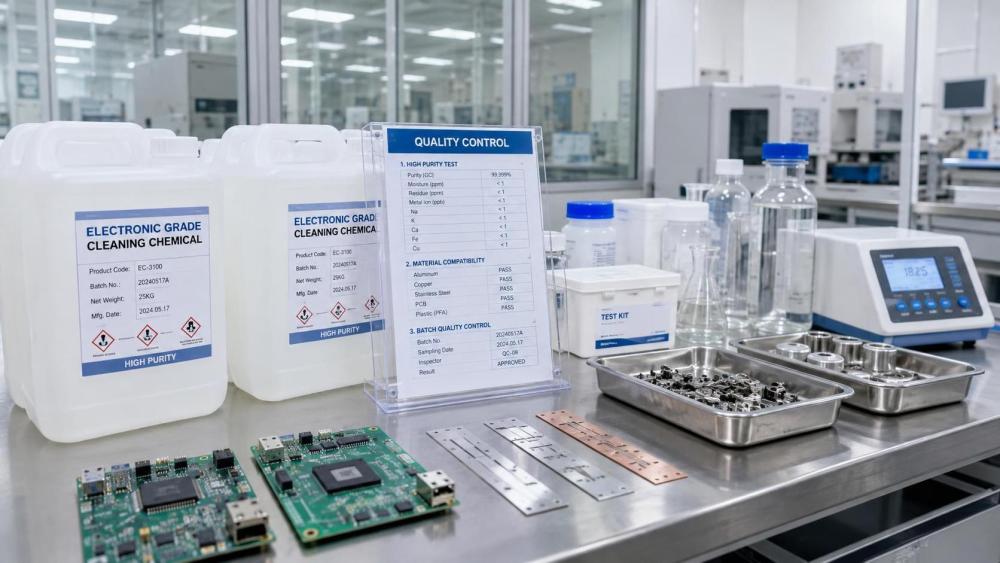
Material compatibility is where many low-cost choices become expensive
Electronic assemblies can combine copper, aluminum, nickel, stainless steel, solder alloys, plated surfaces, polymers, elastomers, conformal coatings, inks, adhesives, ceramic materials, and glass in one product. A cleaning chemical that removes contamination quickly may also attack an exposed metal, haze a plastic cover, weaken an adhesive bond, or affect a seal after repeated exposure.
Compatibility cannot be assumed from a product’s chemistry class. Even formulations that appear similar can differ in solvent balance, surfactant package, alkalinity, corrosion inhibition, additives, and drying behavior. A factory should be willing to review the materials involved and identify likely areas for validation. For water-based systems, buyers should also ask whether the product has a defined operating concentration and whether corrosion protection is retained after dilution, heating, or prolonged bath use.
The practical test is not a quick visual dip test alone. Where the component is valuable or difficult to replace, qualification should reflect real contact time, temperature, mechanical action, rinse conditions, and drying conditions. Appearance is only one outcome. Electrical performance, surface adhesion, solderability, coating integrity, and later-stage reliability may need review by the relevant technical team.
Check residue removal and rinse performance together
A cleaner can remove a visible soil and still leave behind its own residues. This is a common blind spot in sourcing discussions. Surfactants, corrosion inhibitors, dissolved oils, salts, and degraded bath components can remain on a part if the rinse sequence is inadequate or if the formulation is not designed for the process.
For many electronic applications, the important question is not “Does it clean?” but “What remains after cleaning, rinsing, and drying?” Ask the factory how it evaluates rinseability, whether the product is intended for deionized-water rinsing, and how bath loading affects performance. If a supplier recommends a cleaner that needs multiple rinse stages, the water use, wastewater profile, and equipment capacity must be included in the cost review.
This is also where formulation knowledge matters. Industrial surfactants, wetting agents, dispersants, defoamers, and specialty solvents each influence soil removal and rinsing in different ways. A supplier with experience in specialty chemical formulation should be able to discuss foam control, surface wetting, emulsion stability, redeposition risk, and drying behavior without reducing the answer to “our product is suitable for electronics.”
Evaluate the factory’s consistency, not only the sample
A laboratory sample is a starting point, not proof of long-term supply capability. Small differences in raw-material quality, blending sequence, water quality, filtration, storage time, or packaging practice can affect a cleaning formulation. The risk is higher when the product contains multiple surfactants, solvents, corrosion inhibitors, or additives that must remain stable during transport and storage.
During supplier assessment, look for evidence that the factory controls incoming materials, batch mixing, in-process checks, finished-goods testing, and retained samples. The exact quality system will differ by product and market, but the supplier should have a clear answer when asked how it handles an out-of-specification batch, a customer complaint, or a change in a key raw material.
It is reasonable to ask whether formulation changes require customer notification, especially if the cleaner has been qualified for a sensitive process. Procurement teams do not need access to proprietary formulas, but they do need a dependable change-control arrangement. An unannounced adjustment to a solvent source or surfactant package can disrupt a carefully balanced cleaning process.
Documentation should support operations, safety, and market access
A competent electronic cleaning chemicals factory should provide documents that are usable by purchasing, EHS, quality, logistics, and production teams. At a minimum, buyers commonly need an up-to-date safety data sheet, technical data sheet, certificate of analysis where applicable, transport information, storage guidance, and basic emergency handling details.
For cross-border procurement, verify whether the classification, labeling, and shipping documentation match the destination market and transportation mode. A product that is commercially attractive may be less attractive once hazardous-goods freight, special storage, local inventory limits, or disposal obligations are considered. Regulations vary by jurisdiction, so the factory’s documents should be reviewed against the requirements of the importing country and the buyer’s internal compliance process.
Do not treat documentation as a paperwork issue separate from performance. In chemical sourcing, incomplete or inconsistent documents often indicate that the supplier may also be weak in change management, traceability, or technical communication.
Compare total process cost, not the invoice price
The lowest unit price can be misleading. A concentrated water-based cleaner may cost more per kilogram but operate at a lower use concentration. A faster-drying solvent may reduce cycle time but create higher ventilation or handling requirements. A product with stronger bath life may lower change-out frequency, yet require more complex wastewater treatment. None of these trade-offs can be judged from a drum price alone.
A better comparison uses cost per cleaned part, per cleaned area, or per operating hour where process data are available. That approach is less convenient than comparing product prices, but it usually exposes costs that procurement would otherwise inherit later from production and quality teams.
Packaging, storage, and logistics deserve an early review
Cleaning chemicals can be affected by temperature, moisture, contamination, light exposure, or long storage periods. Packaging is therefore part of product quality. Confirm the container material, closure type, net weight tolerance, labeling, palletization, tamper evidence where relevant, and conditions for storage after opening. For high-purity use, buyers may also need to consider whether dispensing equipment, transfer lines, and intermediate containers can introduce contamination.
Ask direct questions about lead time and the factory’s ability to maintain supply during raw-material disruptions. A distributor may provide useful local stock and technical access, while direct factory sourcing may offer better control over volume planning. The right model depends on usage stability, import complexity, and how costly a line stoppage would be.
Use technical support as a qualification criterion
The best suppliers do not just ship chemicals. They help buyers define the operating window: concentration, temperature, cleaning time, loading limit, rinse sequence, filtration approach, and routine bath checks. This does not mean every factory must provide onsite engineering support, but it should be capable of responding coherently when a process changes or cleaning results drift.
Specialty chemical knowledge platforms such as FCAS are useful at this stage because they frame cleaner selection around application performance, safety requirements, formulation behavior, and supply-chain considerations. That is often more useful than comparing chemical names in isolation. For purchasing teams, the goal is to ask sharper questions of suppliers and to involve quality, process engineering, EHS, and regulatory colleagues before a commercial decision is locked in.
A sound final decision usually comes after a documented sample evaluation, confirmation of required technical documents, a realistic total-cost review, and agreement on quality notification and supply terms. If a factory is vague about impurities, compatibility, batch controls, or post-sale support, a lower price is unlikely to compensate for the uncertainty. In electronics cleaning, the right chemical is the one that delivers repeatable cleanliness without creating the next defect in the process.
Related News
 Antioxidants & Natural PreservativesWhat Quality Checks Matter When Sourcing Butylparaben for Personal CareButylparaben for personal care sourcing guide: compare assay, impurities, physical performance, documentation, traceability, and supplier quality to reduce formulation risk.MORE+
 Nano-microcapsule FormulationsHow Encapsulated Flavors Protect Taste During Processing and StorageEncapsulated Flavors protect taste from heat, oxygen, moisture, and storage loss. Explore smarter release, carrier selection, and processing strategies.MORE+
 Chelated Trace Element FertilizersHow Greenhouse Fertigation Systems Reduce Water and Fertilizer WasteGreenhouse fertigation systems reduce water and fertilizer waste with precise dosing, uniform irrigation, drainage monitoring, and smarter crop-zone control. Learn practical strategies.MORE+
 Supercritical CO2 Essential OilsHow Natural Essential Oil Blends Improve Consistent Product FragranceNatural essential oil blends help brands achieve consistent, appealing fragrance across batches. Explore smart blend design, stability testing, and product compatibility strategies.MORE+
 Non-ionic Surfactants & DefoamersHow to Choose Non Ionic Low Foaming Surfactants for CIP CleaningNon ionic low foaming surfactants for CIP cleaning: learn how to balance wetting, foam control, compatibility, and rinseability for reliable cleaning performance.MORE+
 Nano-microcapsule FormulationsHow Food Grade Cyclodextrin Complexes Protect Sensitive FlavorsFood grade cyclodextrin inclusion complexes help protect sensitive flavors from oxidation, evaporation, and processing loss while supporting controlled release and consistent sensory quality.MORE+
 Polymer-Coated Water Soluble NPKHow Fertilizer Coating Polymers Improve NPK Granule ReleaseFertilizer coating polymers for NPK granules improve controlled nutrient release, reduce loss risks, and enhance product consistency. Discover key selection and process insights.MORE+
 Chelated Trace Element FertilizersWhat Diammonium Phosphate Means for Crop Nutrition PlanningDiammonium Phosphate: learn how DAP supports early phosphorus access, nitrogen budgeting, smart placement, and balanced crop nutrition planning.MORE+
 Maillard Reaction Savory FlavorsHow to Assess a Flavor Bases Supplier List for Reliable SourcingGlobal Fine Chemicals & Agrochemical Intelligence Network flavor bases supplier list: assess specs, samples, supply risk, and true cost to source with confidence.MORE+
 Hydrocolloids & EmulsifiersHow Konjac Gum Powder Improves Texture in Low-Calorie FoodsKonjac gum powder improves body, stability, and mouthfeel in low-calorie foods. Discover practical tips for smoother sauces, beverages, and reduced-fat formulations.MORE+
 Supercritical CO2 Essential OilsWhat to Check Before Choosing a Botanical Essential Oils ManufacturerChoose a botanical essential oils manufacturer with confidence. Explore key checks for purity, traceability, compliance, batch consistency, and reliable supply.MORE+
 Microencapsulated FragrancesHow Fragrance Carriers for Detergents Improve Scent PerformanceFragrance carriers for detergents improve stability, fabric deposition, and long-lasting scent. Explore practical solutions for better wash-to-wear fragrance performance.MORE+
 Antioxidants & Natural PreservativesWhen Propyl Gallate Antioxidant Is the Right Choice for Oil StabilityPropyl gallate antioxidant: learn when it is the right choice for oil stability, shelf-life protection, processing compatibility, and smarter formulation decisions.MORE+
 Antioxidants & Natural PreservativesHow Potassium Sorbate Extends Shelf Life in Food and Beverage ProductsPotassium Sorbate helps food and beverage brands control yeast and mold spoilage. Explore pH, dosage, processing, and packaging strategies for reliable shelf life.MORE+
 Antioxidants & Natural PreservativesHow to Source Bulk Herbal Extracts With Reliable Quality ControlBulk herbal extracts sourcing guide: compare suppliers, verify traceability, review CoAs, and build reliable quality controls for safer, consistent purchasing.MORE+
 Antioxidants & Natural PreservativesWhat to Check Before Sourcing Butylparaben for Personal Care FormulasButylparaben for personal care sourcing guide: check market eligibility, purity, supplier controls, formula compatibility, packaging, and total risk before buying.MORE+
 Targeted Bio-pesticides & APIsChoosing Microbial Fungicides for Foliar Diseases in Integrated Crop ProgramsMicrobial fungicides for foliar diseases: learn how to match biology, formulation, tank compatibility, and timing for stronger integrated crop protection.MORE+
 Targeted Bio-pesticides & APIsHow Microbial Insecticides Control Caterpillars With Lower Crop Residue RiskMicrobial insecticides for caterpillars help protect crops with targeted early-larval control and lower residue-management pressure. Learn timing, coverage, compliance, and scouting essentials.MORE+
 Microencapsulated FragrancesHow to Add Encapsulated Laundry Fragrances Without Weakening Wash ResultsEncapsulated laundry fragrances: learn how to boost long-lasting scent while protecting cleaning power, stability, foam control, and fabric care.MORE+
 Supercritical CO2 Essential OilsHow Aroma Ingredients Shape Lasting and Skin-Safe Personal Care ProductsAroma ingredients for personal care: discover how to achieve lasting scent, formulation stability, skin safety, and confident product performance.MORE+
 Targeted Bio-pesticides & APIsInsecticides Explained Through Labels, Active Ingredients, and SafetyInsecticides explained through labels, active ingredients, formulations, and safety. Learn how to compare products, manage risk, and make informed crop protection decisions.MORE+
 Heavy-duty Industrial DegreasersHow to Select Parts Wash Cleaners for Automotive ComponentsParts wash cleaners for automotive components: learn how to match chemistry, materials, rinsing, safety, and waste controls for reliable cleaning results.MORE+
 Chelated Trace Element FertilizersHow Precision Fertigation Systems Improve Water and Nutrient ControlPrecision fertigation systems improve water and nutrient control with accurate dosing, uniform irrigation, smart monitoring, and reduced waste. Discover how to optimize crop performance.MORE+
 Hydrocolloids & EmulsifiersHow Bulk Price Factors Affect Hydrocolloid Stabilizer Blend SourcingHydrocolloid stabilizer blends bulk price: compare dosage efficiency, quality consistency, logistics, and documentation to reduce total sourcing costs.MORE+
 Zero-Calorie Sweeteners & AcidulantsHow to Choose a Natural Sweeteners Supplier for Clean-Label ProductsNatural sweeteners supplier selection guide for clean-label products: compare formulation fit, traceability, documentation, and supply reliability.MORE+
 Non-ionic Surfactants & DefoamersWhat Cationic Surfactants Do and Where They Are UsedCationic Surfactants deliver antimicrobial action, conditioning, antistatic control, and surface treatment benefits. Explore key uses, compatibility, and safe selection tips.MORE+
 Targeted Bio-pesticides & APIsHow to Evaluate Pesticide Suspension Concentrates for Field StabilityPesticide Suspension Concentrates: learn how to evaluate field stability, redispersibility, dilution, tank-mix compatibility, and spray safety for reliable performance.MORE+
 Hydrocolloids & EmulsifiersHow Hydrocolloid Systems for Meat Products Improve Texture and YieldHydrocolloid systems for meat products improve yield, texture, water retention, and slicing quality. Explore practical formulation strategies for stable, high-performing meat products.MORE+
 Microencapsulated FragrancesHow Laundry Fragrances for Liquid Detergents Improve Scent LongevityLaundry fragrances for liquid detergents: discover how fragrance design, deposition, and encapsulation create lasting fabric freshness and stronger product appeal.MORE+
 Nano-microcapsule FormulationsChoosing Fragrance Preparations That Perform Well in Personal WashFragrance preparations for personal wash: learn how to select options that protect clarity, stability, foam, scent performance, and packaging compatibility.MORE+
 Controlled-Release ThermodynamicsModified Cyclodextrins Explained for Controlled Fragrance ReleaseModified cyclodextrins enable controlled fragrance release, odor control, and volatile-note protection. Explore how they optimize performance in detergents, fabric care, and more.MORE+
 Microencapsulated FragrancesHow Fragrance Delivery Systems Improve Fabric Softener LongevityFragrance delivery systems for fabric softeners improve scent longevity through smart protection, reliable deposition, and controlled release for lasting freshness.MORE+
 Supercritical CO2 Essential OilsHow to Evaluate a Natural Cardamom Oil Supplier for Reliable SupplyNatural cardamom oil supplier evaluation guide: verify botanical origin, purity, batch consistency, documentation, packaging, and delivery reliability for confident sourcing.MORE+
 Maillard Reaction Savory FlavorsHow Ethyl Maltol Purity Testing Supports Flavor Safety ComplianceEthyl Maltol purity testing strengthens flavor safety compliance through identity checks, impurity profiling, supplier verification, and audit-ready documentation.MORE+
 Microencapsulated FragrancesEssential Oil Extracts Compared for Fragrance and Wellness UsesEssential Oil Extracts compared for fragrance and wellness: explore scent profiles, extraction methods, stability, safety, and sourcing insights for smarter formulation choices.MORE+
 Zero-Calorie Sweeteners & AcidulantsWhat Drives Zero Calorie Sweeteners Bulk Price in 2026Zero calorie sweeteners bulk price in 2026: compare specifications, dosage, quality, freight, and supply risk to make smarter sourcing decisions.MORE+
 EPA FIFRA & FDA GRAS RegsSynthetic Food Preservatives Rules That Support Safer FormulasSynthetic Food Preservatives: learn the rules for safer formulas, compliant use levels, validated shelf life, labeling, and reliable microbial control.MORE+
 Micelle Fluidics & ChelationHow Anionic Industrial Dispersants Improve Coating StabilityAnionic industrial dispersants improve coating stability, pigment wetting, viscosity control, gloss, and storage performance. Learn how to select and test the right solution.MORE+
 Supercritical CO2 Essential OilsHow to Choose Eucalyptus Oil Grades for Clean, Consistent ProductsChoose the right Eucalyptus Oil grade with confidence. Compare cineole content, purity, origin, processing, documentation, and application fit for consistent products.MORE+
 Micelle Fluidics & ChelationWhat Are Cationic Surfactants and Where Are They Commonly Used?Cationic Surfactants deliver powerful surface affinity for disinfection, fabric softening, hair conditioning, antistatic control, and industrial treatments. Explore key uses and selection factors.MORE+







































