
How to Compare Alkyl Polyglucosides for High-Performance Cleaners
Selecting Alkyl Polyglucosides for a high-performance cleaner is rarely a matter of finding the “greenest” surfactant on a list and adding it at a standard dosage. In demanding cleaning systems, APG selection affects wetting speed, grease removal, foam persistence, rinse quality, viscosity response, material safety, and even whether a formulation remains stable after weeks in a warehouse or repeated freeze-thaw cycles.
For technical evaluators, the practical question is not simply whether Alkyl Polyglucosides are suitable. It is which APG grade, chain-length profile, active-matter level, and co-surfactant system will meet a specific cleaning target without creating downstream issues in manufacturing, use, or compliance. A kitchen degreaser, metal maintenance cleaner, hard-surface concentrate, and low-residue electronics cleaning formulation may all use APG chemistry, but they should not necessarily use the same grade.
This guide provides a structured way to compare APGs for industrial, institutional, and specialty cleaning applications where performance needs to be demonstrated rather than assumed.
Start with the cleaning task, not the surfactant name
Alkyl Polyglucosides are non-ionic surfactants produced from renewable feedstocks such as fatty alcohols and glucose-derived materials. They are widely valued for favorable environmental positioning, good detergency, strong wetting behavior, and compatibility with many surfactant classes. Yet these broad advantages do not remove the need for application-specific evaluation.
A technical team should begin by defining the cleaning problem in operational terms:
- What is the soil: mineral oil, lubricant, carbonized grease, protein residue, particulate soil, polishing compound, or mixed contamination?
- What is the substrate: stainless steel, aluminum, coated metal, glass, ceramic, plastic, rubber, painted surfaces, or sensitive electronic components?
- How is the cleaner used: spray-and-wipe, immersion, circulation, foam cleaning, pressure washing, manual scrubbing, or automatic dosing?
- What water conditions apply: softened water, hard water, high-electrolyte process water, or recycled wash water?
- Is persistent foam helpful, acceptable, or a process risk?
- Will the product be sold as a ready-to-use cleaner or a concentrated formulation requiring dilution?
These answers narrow the APG comparison quickly. A high-foam APG that performs well in a hand-applied institutional cleaner may be unsuitable for a closed-loop industrial washer. Conversely, a lower-foam system designed for mechanical cleaning may feel weak to users expecting visible foam during manual degreasing, even if soil removal is technically adequate.
Carbon-chain distribution is often the first meaningful differentiator
APG grades are commonly distinguished by alkyl chain length or chain-length distribution. In practical cleaning formulation, this influences the balance between water solubility, wetting, detergency, foam profile, and hydrophobic soil handling.
Shorter-chain APGs generally offer stronger water compatibility and rapid wetting. They can be useful when a cleaner must spread quickly across a hard surface, penetrate light-to-medium soil, and remain visually clear in aqueous systems. Their behavior may be attractive in multipurpose cleaners, glass-adjacent hard-surface products, and formulations where fast dilution is important.
Longer-chain APGs tend to bring more hydrophobic character and can contribute more strongly to oily soil removal, emulsification, and foam structure. They are frequently considered for heavy-duty degreasers, hand dishwashing systems, institutional kitchen cleaners, and formulations addressing food oils or machinery lubricants. The trade-off is that longer-chain grades may be more challenging in highly transparent, low-temperature, or high-electrolyte formulations.
Many commercial Alkyl Polyglucosides are not single-chain materials but mixtures. For evaluators, it is worth asking suppliers for a meaningful description of the carbon distribution rather than relying only on a generic APG label. Two products described broadly as “C8–C10 APG” or “C10–C16 APG” can still behave differently because of the relative proportion of each alcohol chain, degree of polymerization, residual fatty alcohol, and manufacturing consistency.
Do not treat chain length as a simple ranking from mild to powerful. It is a formulation lever. The right balance depends on whether the cleaner needs rapid wetting, oil lift, foam cushion, rinse behavior, or all four at once.
Compare active matter on an equal-performance basis
Active matter is an essential purchasing and formulation parameter, but it can be misleading when used alone. APG products are often supplied as aqueous solutions with different active concentrations, viscosities, colors, and storage characteristics. Comparing price per kilogram without normalizing for active content can lead to an incorrect sourcing decision.
More importantly, equal active matter does not guarantee equal cleaning performance. A grade with a higher active concentration may reduce freight and storage volume, yet create handling challenges if it becomes highly viscous at lower temperatures. Another grade may be easier to pump and blend but require a different addition sequence to prevent localized gelling or excessive aeration.
When comparing supplier samples, evaluate at least three levels:
- As supplied: active matter, appearance, pH, viscosity, color, odor, pourability, and storage behavior.
- At equal surfactant active: wetting, foam, detergency, and compatibility against equivalent benchmark formulations.
- In the finished cleaner: stability, user experience, cleaning performance, rinsing, and material compatibility after aging.
This approach prevents a common mistake: rejecting an APG because it appears less convenient in its raw-material form, or choosing one simply because its supplied concentration looks more economical.
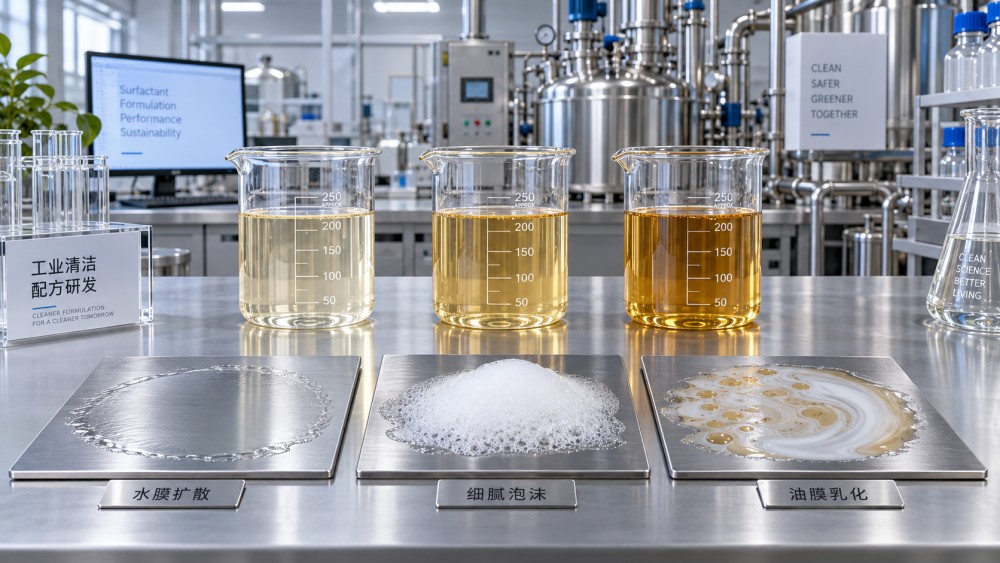
Wetting, detergency, and emulsification should be tested separately
High-performance cleaners often fail because a formulation is judged by a single visible result. A product may wet a surface immediately but lack enough oil-handling capacity to remove heavy grease. Another may emulsify oil effectively in a beaker yet leave a difficult film on vertical stainless steel in a real-use test.
APGs can support all three functions, but their contribution changes with grade selection and co-formulation. A useful evaluation plan separates the following tests:
- Dynamic wetting: How quickly does the diluted cleaner spread over the target substrate?
- Soil penetration: Can it reach beneath aged, baked-on, or particulate-bound contamination?
- Oil emulsification and dispersion: Does removed soil remain suspended, or does it redeposit during rinsing?
- Detergency: How much soil is actually removed under defined time, temperature, mechanical action, and dilution conditions?
- Rinse behavior: Does the system leave streaks, haze, tackiness, or a surfactant film?
For hydrocarbon oils and industrial lubricants, APG alone may not provide the optimal balance. Blending with other non-ionic surfactants, amphoteric surfactants, hydrotropes, solvents, builders, chelating agents, or alkaline components may be necessary. The technical goal is not to make APG carry the entire formulation; it is to use it where its wetting, detergency, and sustainability profile add genuine value.
Foam is a design variable, not a universal benefit
APGs are often selected because they can generate rich, stable foam. In manual cleaning, this can improve product perception, support longer contact time on vertical surfaces, and make soil removal feel more controllable. In food-service cleaning and hand-applied degreasers, foam may also help users see where the product has been applied.
But foam can become an operational problem in spray equipment, automatic dishwashing, parts washers, floor scrubbers, and recirculating systems. Excessive foam reduces mechanical efficiency, complicates tank management, creates overflow risk, and may require defoamer addition that changes the rest of the surfactant balance.
Evaluate foam under actual use conditions rather than only through a standard cylinder shake test. Temperature, water hardness, soil loading, pump shear, spray pattern, and the presence of alkaline salts all change foam behavior. A formulation that looks controlled in a laboratory bottle can become unexpectedly foam-rich once air is introduced by industrial equipment.
Electrolytes, alkalinity, and hard water can change the answer
Many high-performance cleaners are not simple surfactant-and-water blends. They may contain sodium carbonate, sodium metasilicate, hydroxide, citrate, phosphonate alternatives, chelants, corrosion inhibitors, solvents, and salts from process water. These components can alter APG solubility, cloudiness, viscosity, and phase stability.
APGs are generally known for useful compatibility, but “compatible” is not the same as “stable in every formulation window.” A grade that works in a neutral hard-surface cleaner may show turbidity or separation in a strongly alkaline degreaser, particularly during cold storage. High electrolyte loading can also affect foam and viscosity in ways that are not obvious during small-scale room-temperature trials.
For each candidate APG, run stability screens across the expected pH and temperature range. Include freeze-thaw cycling where relevant, elevated-temperature aging, and dilution tests using both soft and hard water. If the product is a concentrate, test dilution into the water quality customers will actually use. A clear concentrate that becomes hazy, unstable, or weakly performing after dilution is not a robust commercial solution.
Material compatibility deserves early attention
In specialty cleaning, the cost of a compatibility failure can exceed the cost of the entire raw-material program. APG itself may be relatively mild, but cleaner systems are judged as a whole. Alkalinity, solvents, builders, chelants, and contact time can each influence corrosion, coating damage, stress cracking, or surface residue.
For metal cleaning, test on the relevant alloys rather than assuming stainless steel data applies to aluminum, galvanized steel, brass, copper, or mixed-metal assemblies. For plastics and elastomers, exposure conditions matter: a short spray-and-wipe contact is not equivalent to a heated immersion process. Electronics and precision cleaning applications require additional scrutiny for nonvolatile residue, ionic contamination, rinse completeness, and drying behavior.
Technical evaluators should request information on residual impurities, preservative systems, color stability, and batch-to-batch control, especially when APGs are being considered for high-purity or appearance-sensitive applications. The surfactant may not be the only source of risk, but its specification profile can affect how predictable the final formulation will be.
A practical scorecard for supplier and grade comparison
Once two or more Alkyl Polyglucosides appear promising, a weighted scorecard helps keep the decision connected to the application rather than personal preference. The scoring categories should reflect the finished cleaner’s critical-to-quality requirements.
The scorecard should include commercial factors, but price should come after performance normalization. A lower-cost APG can become expensive if it requires higher dosage, additional hydrotropes, more defoamer, extra processing time, or tighter storage controls.
Common selection mistakes
One frequent error is choosing an APG grade solely because it is marketed for “natural” or “bio-based” cleaning. Those attributes may be important for product positioning, but they do not replace cleaning validation. Another is using a single laboratory soil for every decision. Real contamination often includes a mix of oils, dust, salts, proteins, and aged residues that behave differently from a clean model substrate.
Technical teams also sometimes test only freshly prepared samples. This overlooks viscosity drift, odor changes, color development, phase separation, and loss of clarity that may emerge during storage. Finally, evaluators may compare suppliers without aligning testing conditions. If one APG is tested at a higher active level, in softer water, or with a more favorable co-surfactant package, the comparison is not meaningful.
Making the final decision
The best Alkyl Polyglucosides for high-performance cleaners are not necessarily the ones with the broadest claims or the highest active matter. They are the grades that fit the soil, cleaning method, substrate, formulation architecture, and supply requirements of the intended product.
For a technical evaluation team, the most reliable path is to define performance targets before requesting samples, compare APG grades at equal active matter, test under realistic water and soil conditions, and assess the finished formulation after aging. This turns APG selection from a raw-material comparison into a controlled formulation decision.
As industrial and institutional cleaning systems face greater pressure for effective soil removal, safer handling, material protection, and more responsible ingredient choices, APGs will remain a useful part of the surfactant toolbox. Their value is highest when they are selected with the same discipline applied to every other critical component in the cleaning system.
Related News
 Antioxidants & Natural PreservativesWhat Quality Checks Matter When Sourcing Butylparaben for Personal CareButylparaben for personal care sourcing guide: compare assay, impurities, physical performance, documentation, traceability, and supplier quality to reduce formulation risk.MORE+
 Nano-microcapsule FormulationsHow Encapsulated Flavors Protect Taste During Processing and StorageEncapsulated Flavors protect taste from heat, oxygen, moisture, and storage loss. Explore smarter release, carrier selection, and processing strategies.MORE+
 Chelated Trace Element FertilizersHow Greenhouse Fertigation Systems Reduce Water and Fertilizer WasteGreenhouse fertigation systems reduce water and fertilizer waste with precise dosing, uniform irrigation, drainage monitoring, and smarter crop-zone control. Learn practical strategies.MORE+
 Supercritical CO2 Essential OilsHow Natural Essential Oil Blends Improve Consistent Product FragranceNatural essential oil blends help brands achieve consistent, appealing fragrance across batches. Explore smart blend design, stability testing, and product compatibility strategies.MORE+
 Non-ionic Surfactants & DefoamersHow to Choose Non Ionic Low Foaming Surfactants for CIP CleaningNon ionic low foaming surfactants for CIP cleaning: learn how to balance wetting, foam control, compatibility, and rinseability for reliable cleaning performance.MORE+
 Nano-microcapsule FormulationsHow Food Grade Cyclodextrin Complexes Protect Sensitive FlavorsFood grade cyclodextrin inclusion complexes help protect sensitive flavors from oxidation, evaporation, and processing loss while supporting controlled release and consistent sensory quality.MORE+
 Polymer-Coated Water Soluble NPKHow Fertilizer Coating Polymers Improve NPK Granule ReleaseFertilizer coating polymers for NPK granules improve controlled nutrient release, reduce loss risks, and enhance product consistency. Discover key selection and process insights.MORE+
 Chelated Trace Element FertilizersWhat Diammonium Phosphate Means for Crop Nutrition PlanningDiammonium Phosphate: learn how DAP supports early phosphorus access, nitrogen budgeting, smart placement, and balanced crop nutrition planning.MORE+
 Maillard Reaction Savory FlavorsHow to Assess a Flavor Bases Supplier List for Reliable SourcingGlobal Fine Chemicals & Agrochemical Intelligence Network flavor bases supplier list: assess specs, samples, supply risk, and true cost to source with confidence.MORE+
 Hydrocolloids & EmulsifiersHow Konjac Gum Powder Improves Texture in Low-Calorie FoodsKonjac gum powder improves body, stability, and mouthfeel in low-calorie foods. Discover practical tips for smoother sauces, beverages, and reduced-fat formulations.MORE+
 Supercritical CO2 Essential OilsWhat to Check Before Choosing a Botanical Essential Oils ManufacturerChoose a botanical essential oils manufacturer with confidence. Explore key checks for purity, traceability, compliance, batch consistency, and reliable supply.MORE+
 Microencapsulated FragrancesHow Fragrance Carriers for Detergents Improve Scent PerformanceFragrance carriers for detergents improve stability, fabric deposition, and long-lasting scent. Explore practical solutions for better wash-to-wear fragrance performance.MORE+
 Antioxidants & Natural PreservativesWhen Propyl Gallate Antioxidant Is the Right Choice for Oil StabilityPropyl gallate antioxidant: learn when it is the right choice for oil stability, shelf-life protection, processing compatibility, and smarter formulation decisions.MORE+
 Antioxidants & Natural PreservativesHow Potassium Sorbate Extends Shelf Life in Food and Beverage ProductsPotassium Sorbate helps food and beverage brands control yeast and mold spoilage. Explore pH, dosage, processing, and packaging strategies for reliable shelf life.MORE+
 Antioxidants & Natural PreservativesHow to Source Bulk Herbal Extracts With Reliable Quality ControlBulk herbal extracts sourcing guide: compare suppliers, verify traceability, review CoAs, and build reliable quality controls for safer, consistent purchasing.MORE+
 Antioxidants & Natural PreservativesWhat to Check Before Sourcing Butylparaben for Personal Care FormulasButylparaben for personal care sourcing guide: check market eligibility, purity, supplier controls, formula compatibility, packaging, and total risk before buying.MORE+
 Targeted Bio-pesticides & APIsChoosing Microbial Fungicides for Foliar Diseases in Integrated Crop ProgramsMicrobial fungicides for foliar diseases: learn how to match biology, formulation, tank compatibility, and timing for stronger integrated crop protection.MORE+
 Targeted Bio-pesticides & APIsHow Microbial Insecticides Control Caterpillars With Lower Crop Residue RiskMicrobial insecticides for caterpillars help protect crops with targeted early-larval control and lower residue-management pressure. Learn timing, coverage, compliance, and scouting essentials.MORE+
 Microencapsulated FragrancesHow to Add Encapsulated Laundry Fragrances Without Weakening Wash ResultsEncapsulated laundry fragrances: learn how to boost long-lasting scent while protecting cleaning power, stability, foam control, and fabric care.MORE+
 Supercritical CO2 Essential OilsHow Aroma Ingredients Shape Lasting and Skin-Safe Personal Care ProductsAroma ingredients for personal care: discover how to achieve lasting scent, formulation stability, skin safety, and confident product performance.MORE+
 Targeted Bio-pesticides & APIsInsecticides Explained Through Labels, Active Ingredients, and SafetyInsecticides explained through labels, active ingredients, formulations, and safety. Learn how to compare products, manage risk, and make informed crop protection decisions.MORE+
 Heavy-duty Industrial DegreasersHow to Select Parts Wash Cleaners for Automotive ComponentsParts wash cleaners for automotive components: learn how to match chemistry, materials, rinsing, safety, and waste controls for reliable cleaning results.MORE+
 Chelated Trace Element FertilizersHow Precision Fertigation Systems Improve Water and Nutrient ControlPrecision fertigation systems improve water and nutrient control with accurate dosing, uniform irrigation, smart monitoring, and reduced waste. Discover how to optimize crop performance.MORE+
 Hydrocolloids & EmulsifiersHow Bulk Price Factors Affect Hydrocolloid Stabilizer Blend SourcingHydrocolloid stabilizer blends bulk price: compare dosage efficiency, quality consistency, logistics, and documentation to reduce total sourcing costs.MORE+
 Zero-Calorie Sweeteners & AcidulantsHow to Choose a Natural Sweeteners Supplier for Clean-Label ProductsNatural sweeteners supplier selection guide for clean-label products: compare formulation fit, traceability, documentation, and supply reliability.MORE+
 Non-ionic Surfactants & DefoamersWhat Cationic Surfactants Do and Where They Are UsedCationic Surfactants deliver antimicrobial action, conditioning, antistatic control, and surface treatment benefits. Explore key uses, compatibility, and safe selection tips.MORE+
 Targeted Bio-pesticides & APIsHow to Evaluate Pesticide Suspension Concentrates for Field StabilityPesticide Suspension Concentrates: learn how to evaluate field stability, redispersibility, dilution, tank-mix compatibility, and spray safety for reliable performance.MORE+
 Hydrocolloids & EmulsifiersHow Hydrocolloid Systems for Meat Products Improve Texture and YieldHydrocolloid systems for meat products improve yield, texture, water retention, and slicing quality. Explore practical formulation strategies for stable, high-performing meat products.MORE+
 Microencapsulated FragrancesHow Laundry Fragrances for Liquid Detergents Improve Scent LongevityLaundry fragrances for liquid detergents: discover how fragrance design, deposition, and encapsulation create lasting fabric freshness and stronger product appeal.MORE+
 Nano-microcapsule FormulationsChoosing Fragrance Preparations That Perform Well in Personal WashFragrance preparations for personal wash: learn how to select options that protect clarity, stability, foam, scent performance, and packaging compatibility.MORE+
 Controlled-Release ThermodynamicsModified Cyclodextrins Explained for Controlled Fragrance ReleaseModified cyclodextrins enable controlled fragrance release, odor control, and volatile-note protection. Explore how they optimize performance in detergents, fabric care, and more.MORE+
 Microencapsulated FragrancesHow Fragrance Delivery Systems Improve Fabric Softener LongevityFragrance delivery systems for fabric softeners improve scent longevity through smart protection, reliable deposition, and controlled release for lasting freshness.MORE+
 Supercritical CO2 Essential OilsHow to Evaluate a Natural Cardamom Oil Supplier for Reliable SupplyNatural cardamom oil supplier evaluation guide: verify botanical origin, purity, batch consistency, documentation, packaging, and delivery reliability for confident sourcing.MORE+
 Maillard Reaction Savory FlavorsHow Ethyl Maltol Purity Testing Supports Flavor Safety ComplianceEthyl Maltol purity testing strengthens flavor safety compliance through identity checks, impurity profiling, supplier verification, and audit-ready documentation.MORE+
 Microencapsulated FragrancesEssential Oil Extracts Compared for Fragrance and Wellness UsesEssential Oil Extracts compared for fragrance and wellness: explore scent profiles, extraction methods, stability, safety, and sourcing insights for smarter formulation choices.MORE+
 Zero-Calorie Sweeteners & AcidulantsWhat Drives Zero Calorie Sweeteners Bulk Price in 2026Zero calorie sweeteners bulk price in 2026: compare specifications, dosage, quality, freight, and supply risk to make smarter sourcing decisions.MORE+
 EPA FIFRA & FDA GRAS RegsSynthetic Food Preservatives Rules That Support Safer FormulasSynthetic Food Preservatives: learn the rules for safer formulas, compliant use levels, validated shelf life, labeling, and reliable microbial control.MORE+
 Micelle Fluidics & ChelationHow Anionic Industrial Dispersants Improve Coating StabilityAnionic industrial dispersants improve coating stability, pigment wetting, viscosity control, gloss, and storage performance. Learn how to select and test the right solution.MORE+
 Supercritical CO2 Essential OilsHow to Choose Eucalyptus Oil Grades for Clean, Consistent ProductsChoose the right Eucalyptus Oil grade with confidence. Compare cineole content, purity, origin, processing, documentation, and application fit for consistent products.MORE+
 Micelle Fluidics & ChelationWhat Are Cationic Surfactants and Where Are They Commonly Used?Cationic Surfactants deliver powerful surface affinity for disinfection, fabric softening, hair conditioning, antistatic control, and industrial treatments. Explore key uses and selection factors.MORE+







































