
How to Choose Low Foam Cleaning Auxiliaries for CIP Systems
Choose a low foam cleaning auxiliary by starting with the actual CIP circuit, soil load, and rinse limit rather than selecting from a generic “low foam” label. An auxiliary that remains quiet in a beaker can still foam in a return line, at a pump seal, or when air enters through a poorly drained vessel. The preferred product must preserve circulation, wet the soiled surface quickly, support the main detergent chemistry, and leave a rinseable residue profile under the temperature and water conditions used in the plant.
Foam control matters because CIP depends on predictable hydraulic behavior. Excess foam can reduce pump efficiency, disturb return flow, create unreliable tank-level readings, prolong rinsing, and interfere with spray-device coverage. Yet an auxiliary that suppresses foam too aggressively may impair wetting, soil dispersion, or detergent stability. Selection therefore involves balancing foam behavior with cleaning contribution, rather than treating defoaming as an isolated requirement.
Begin with the cleaning circuit, not the chemical brochure
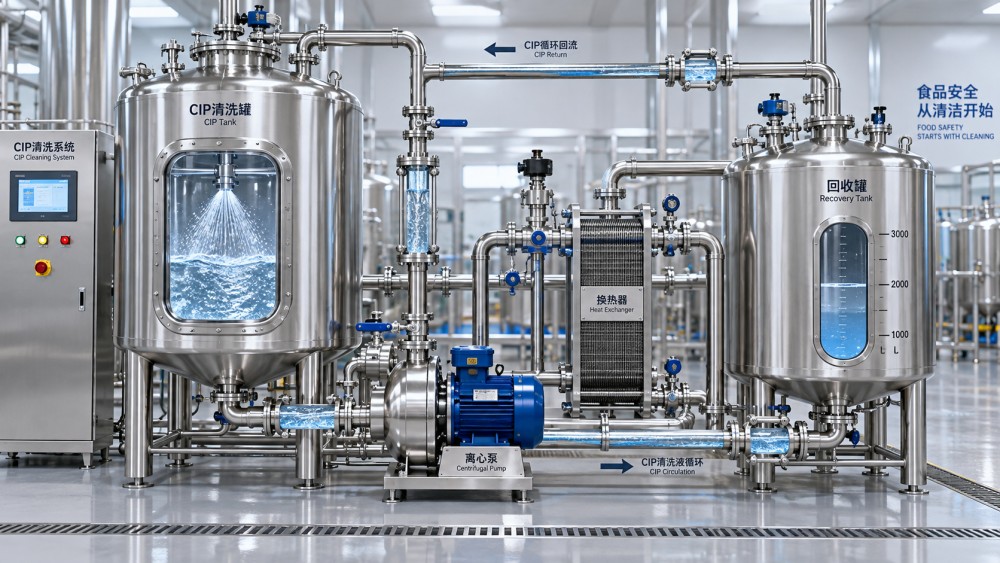
Map the route followed by the cleaning solution: supply tank, pump, heat exchanger, valves, spray balls or rotary devices, process vessels, return piping, and recovery tank. Note the points where liquid drops freely, recirculation becomes turbulent, or air can be drawn into the system. These locations often explain foam incidents better than the nominal foam rating of the auxiliary.
A long return line with elevation changes behaves differently from a compact loop. A circuit that repeatedly fills and drains through valve manifolds introduces more air than a fully flooded circuit. High-shear centrifugal pumping can disperse entrained air into fine bubbles, while a low-flow branch may retain foam after the rest of the system has cleared. An auxiliary should be assessed under the most demanding hydraulic section, not only in a sample prepared with gentle mixing.
Also separate a foam-control problem from a mechanical problem. Persistent foam caused by air leakage, an incorrectly positioned return pipe, incomplete drainage, a worn gasket, or an oversized pump will often recur after a chemical change. A low foam auxiliary can reduce the symptom, but it cannot restore stable circulation where the circuit continuously introduces air.
Define the soil before comparing auxiliary types
The auxiliary must work with the soil that remains after the principal caustic, acid, or neutral cleaner has been selected. Product residues are rarely uniform. Protein-rich deposits, fats, starch, mineral scale, sugar films, fermented residues, oils, pigments, and process additives each respond differently to wetting, emulsification, dispersion, alkalinity, and temperature.
For oily or fatty soil, a low-foaming surfactant may need sufficient emulsification and anti-redeposition performance to keep released soil from attaching downstream. A product designed only to collapse foam may allow oil droplets to separate, collect in a return tank, and re-enter the circuit. With protein or carbohydrate films, rapid wetting and penetration can be more important than high emulsifying power. Mineral deposits generally require appropriate acid chemistry; adding more surfactant to an acid wash will not compensate for inadequate scale dissolution.
Soil composition can shift with product formulation, season, production campaign, or upstream process changes. A cleaning program that performs well after one product can struggle after a high-fat blend, a thickened beverage, or a formulation containing silicone, wax, or hydrophobic flavor components. Review the heaviest realistic soil condition before committing to a single auxiliary.
Read “low foam” in relation to temperature, alkalinity, and water quality
Foam behavior is sensitive to the full wash solution. Temperature can change surfactant solubility, cloud point behavior, viscosity, and the rate at which bubbles drain. A product that foams little at elevated wash temperature may generate substantial foam during a cooler pre-rinse or final rinse. Conversely, a material that appears stable in cool water can lose performance or separate at the upper end of the operating range.
Alkalinity changes the result as well. Caustic cleaning solutions can alter the solubility and interfacial behavior of some surfactants. Acid cleaning phases bring a different compatibility question, particularly where the auxiliary is expected to remain effective across both alkaline and acidic cycles. Do not assume one additive package suits every stage simply because it is described as suitable for CIP.
Water hardness deserves the same attention. Calcium and magnesium can affect detergency, dispersancy, and residue formation, especially where sequestrants are limited or water quality changes between sites. High dissolved solids, recycled water, and carryover from earlier process steps may also shift foam behavior. A trial using only softened or laboratory-grade water can hide problems that emerge in routine operation.
Distinguish foam suppression from cleaning performance
Low foam cleaning auxiliaries commonly contribute one or more functions: wetting, emulsification, solubilization, dispersing, anti-redeposition, or foam suppression. The relative importance of those functions should be explicit. A defoamer added to a poorly wetting detergent is not automatically a cleaning auxiliary. It may reduce visible foam while leaving difficult soil removal unchanged.
Likewise, strong detergency alone is not a satisfactory answer when it creates foam that reduces spray impact or forces a cycle to stop. The better comparison asks whether the candidate allows the system to achieve adequate cleaning at the intended time, concentration, temperature, and flow conditions without creating a rinse burden.
Pay particular attention to wetting speed. In closed equipment, solution must contact dry or partially dried residues across vessel walls, pipe surfaces, valve seats, and hard-to-reach connections. Surface tension reduction can improve initial contact, but very fast wetting is only useful when the released soil remains dispersed and the solution can circulate without excessive aeration. Bench measurements provide direction; circulation testing establishes whether the balance is right.
Compatibility has several layers
Material compatibility is broader than whether stainless steel visibly corrodes. Review the complete wetted system: common stainless grades, elastomer seals, gaskets, hose linings, plastics, coatings, sight-glass components, and any soft metals present in pumps or fittings. The cleaning chemistry, temperature, exposure time, and residual concentration all matter. A low foam additive can change the ability of the solution to wet seals and crevices, which may reveal compatibility concerns not seen with the base cleaner alone.
Compatibility with the process is equally important. In food, beverage, fermentation, pharmaceutical-adjacent, and high-purity applications, rinseability and residue control may be the deciding factors. A persistent hydrophobic defoaming component could leave a film that affects a subsequent product, interferes with analytical results, or requires additional rinse time. The relevant question is not simply whether the auxiliary is effective during washing, but whether it is removed consistently by the established rinse sequence.
Consider interactions with other chemicals already in the program. Oxidizing agents, sanitizers, acid descalers, sequestrants, corrosion inhibitors, and existing detergents may be used in adjacent steps. Chemical carryover through incomplete draining can alter performance. Mixing instructions, dilution order, and restrictions on direct blending should be available before installation into an automated dosing system.
Use a staged evaluation instead of a single-pass trial
A practical evaluation begins with documentation review and controlled solution checks, then moves into a representative circuit trial. Confirm the candidate’s recommended concentration range, operating temperature range, pH compatibility, storage conditions, mixing requirements, and information relevant to the intended application. Check whether the supplied product stays homogeneous after normal storage and whether it can be metered accurately at the required dilution.
Next, prepare the cleaning solution using normal plant water and the intended base chemistry. Observe clarity, phase separation, excessive viscosity, sediment, or unexpected heat generation during addition. These are not minor laboratory details: an incompatible blend can plug a dosing line, create inconsistent concentration, or give different results from one shift to another.
During circulation, record the cycle stage, solution temperature, conductivity or other established concentration control, tank level behavior, pump sound, return appearance, and time required for foam to subside after stopping flow. Examine the locations that are normally hardest to clean rather than relying only on a clear return stream. A visually clean tank may coexist with residue in valve blocks, heat exchangers, dead legs, or small-bore branches.
After the final rinse, evaluate whether rinsing returns to the expected baseline without extending the programmed cycle. A product that improves washing but adds several rinse phases may not be the best operational choice. Where the process uses recovery or reuse of cleaning solution, also check whether the auxiliary accumulates, loses effectiveness, or changes foam behavior over repeated cycles.
Common selection errors
- Judging from a static foam test alone. Shaking a bottle or using a simple cylinder test does not reproduce pump shear, pressure changes, spray impact, return turbulence, or air ingress.
- Using the lowest possible foam result as the only target. Very low foam is valuable only when soil removal, wetting, and rinseability remain adequate for the circuit.
- Changing chemistry before checking the equipment condition. Damaged seals, poor drainability, suction-side air leaks, and unstable pump operation can dominate the observed foam problem.
- Testing a clean system. A trial performed after an easy product run or after manual pre-cleaning may overstate performance. The comparison needs representative deposits and normal production conditions.
- Ignoring dosing precision. A concentrated auxiliary with difficult handling, crystallization risk, or poor low-rate metering can create more variability than a less concentrated but stable alternative.
Match the formulation form to dosing and storage reality
Liquid auxiliaries are often chosen because they integrate readily with automated dosing, but pumpability at storage temperature should be checked. Viscosity can rise in cold conditions, and certain materials may separate after long storage or repeated temperature cycling. A product requiring agitation, warming, or special transfer equipment should be evaluated against the actual chemical room arrangement, not an ideal setup.
Concentration affects handling and control. Highly concentrated products reduce packaging volume, yet a narrow dosing window can make calibration more sensitive to pump stroke, feed-line condition, and dilution water pressure. A wider and more forgiving working range may produce steadier results where dosing equipment has normal operational variation.
Packaging compatibility also has practical consequences. Confirm that containers, closures, suction tubes, and transfer fittings suit the formulation. Incompatible packaging can introduce contamination, leakage, swelling, or loss of product integrity before the chemical reaches the CIP tank. Storage instructions should align with the site's likely temperature range and stock-turn pattern.
Set acceptance criteria that reflect the whole cycle
Before comparing candidates, define the outcome that must improve. It could be stable pump circulation, lower foam in the recovery tank, better removal of a recurring deposit, shorter return-to-clear time, or a final rinse that reaches the established endpoint without intervention. Each criterion should be tied to an observable part of the cycle.
A sound selection is supported by repeatable behavior across routine conditions, including the relevant product soils, water quality, temperatures, and circuit configurations. Keep the final formulation, dose, addition point, cleaning sequence, and any equipment adjustments clearly documented. That record prevents a later change in detergent, water treatment, or production residue from being mistaken for failure of the low foam auxiliary itself.
Related News
 Antioxidants & Natural PreservativesWhat Quality Checks Matter When Sourcing Butylparaben for Personal CareButylparaben for personal care sourcing guide: compare assay, impurities, physical performance, documentation, traceability, and supplier quality to reduce formulation risk.MORE+
 Nano-microcapsule FormulationsHow Encapsulated Flavors Protect Taste During Processing and StorageEncapsulated Flavors protect taste from heat, oxygen, moisture, and storage loss. Explore smarter release, carrier selection, and processing strategies.MORE+
 Chelated Trace Element FertilizersHow Greenhouse Fertigation Systems Reduce Water and Fertilizer WasteGreenhouse fertigation systems reduce water and fertilizer waste with precise dosing, uniform irrigation, drainage monitoring, and smarter crop-zone control. Learn practical strategies.MORE+
 Supercritical CO2 Essential OilsHow Natural Essential Oil Blends Improve Consistent Product FragranceNatural essential oil blends help brands achieve consistent, appealing fragrance across batches. Explore smart blend design, stability testing, and product compatibility strategies.MORE+
 Non-ionic Surfactants & DefoamersHow to Choose Non Ionic Low Foaming Surfactants for CIP CleaningNon ionic low foaming surfactants for CIP cleaning: learn how to balance wetting, foam control, compatibility, and rinseability for reliable cleaning performance.MORE+
 Nano-microcapsule FormulationsHow Food Grade Cyclodextrin Complexes Protect Sensitive FlavorsFood grade cyclodextrin inclusion complexes help protect sensitive flavors from oxidation, evaporation, and processing loss while supporting controlled release and consistent sensory quality.MORE+
 Polymer-Coated Water Soluble NPKHow Fertilizer Coating Polymers Improve NPK Granule ReleaseFertilizer coating polymers for NPK granules improve controlled nutrient release, reduce loss risks, and enhance product consistency. Discover key selection and process insights.MORE+
 Chelated Trace Element FertilizersWhat Diammonium Phosphate Means for Crop Nutrition PlanningDiammonium Phosphate: learn how DAP supports early phosphorus access, nitrogen budgeting, smart placement, and balanced crop nutrition planning.MORE+
 Maillard Reaction Savory FlavorsHow to Assess a Flavor Bases Supplier List for Reliable SourcingGlobal Fine Chemicals & Agrochemical Intelligence Network flavor bases supplier list: assess specs, samples, supply risk, and true cost to source with confidence.MORE+
 Hydrocolloids & EmulsifiersHow Konjac Gum Powder Improves Texture in Low-Calorie FoodsKonjac gum powder improves body, stability, and mouthfeel in low-calorie foods. Discover practical tips for smoother sauces, beverages, and reduced-fat formulations.MORE+
 Supercritical CO2 Essential OilsWhat to Check Before Choosing a Botanical Essential Oils ManufacturerChoose a botanical essential oils manufacturer with confidence. Explore key checks for purity, traceability, compliance, batch consistency, and reliable supply.MORE+
 Microencapsulated FragrancesHow Fragrance Carriers for Detergents Improve Scent PerformanceFragrance carriers for detergents improve stability, fabric deposition, and long-lasting scent. Explore practical solutions for better wash-to-wear fragrance performance.MORE+
 Antioxidants & Natural PreservativesWhen Propyl Gallate Antioxidant Is the Right Choice for Oil StabilityPropyl gallate antioxidant: learn when it is the right choice for oil stability, shelf-life protection, processing compatibility, and smarter formulation decisions.MORE+
 Antioxidants & Natural PreservativesHow Potassium Sorbate Extends Shelf Life in Food and Beverage ProductsPotassium Sorbate helps food and beverage brands control yeast and mold spoilage. Explore pH, dosage, processing, and packaging strategies for reliable shelf life.MORE+
 Antioxidants & Natural PreservativesHow to Source Bulk Herbal Extracts With Reliable Quality ControlBulk herbal extracts sourcing guide: compare suppliers, verify traceability, review CoAs, and build reliable quality controls for safer, consistent purchasing.MORE+
 Antioxidants & Natural PreservativesWhat to Check Before Sourcing Butylparaben for Personal Care FormulasButylparaben for personal care sourcing guide: check market eligibility, purity, supplier controls, formula compatibility, packaging, and total risk before buying.MORE+
 Targeted Bio-pesticides & APIsChoosing Microbial Fungicides for Foliar Diseases in Integrated Crop ProgramsMicrobial fungicides for foliar diseases: learn how to match biology, formulation, tank compatibility, and timing for stronger integrated crop protection.MORE+
 Targeted Bio-pesticides & APIsHow Microbial Insecticides Control Caterpillars With Lower Crop Residue RiskMicrobial insecticides for caterpillars help protect crops with targeted early-larval control and lower residue-management pressure. Learn timing, coverage, compliance, and scouting essentials.MORE+
 Microencapsulated FragrancesHow to Add Encapsulated Laundry Fragrances Without Weakening Wash ResultsEncapsulated laundry fragrances: learn how to boost long-lasting scent while protecting cleaning power, stability, foam control, and fabric care.MORE+
 Supercritical CO2 Essential OilsHow Aroma Ingredients Shape Lasting and Skin-Safe Personal Care ProductsAroma ingredients for personal care: discover how to achieve lasting scent, formulation stability, skin safety, and confident product performance.MORE+
 Targeted Bio-pesticides & APIsInsecticides Explained Through Labels, Active Ingredients, and SafetyInsecticides explained through labels, active ingredients, formulations, and safety. Learn how to compare products, manage risk, and make informed crop protection decisions.MORE+
 Heavy-duty Industrial DegreasersHow to Select Parts Wash Cleaners for Automotive ComponentsParts wash cleaners for automotive components: learn how to match chemistry, materials, rinsing, safety, and waste controls for reliable cleaning results.MORE+
 Chelated Trace Element FertilizersHow Precision Fertigation Systems Improve Water and Nutrient ControlPrecision fertigation systems improve water and nutrient control with accurate dosing, uniform irrigation, smart monitoring, and reduced waste. Discover how to optimize crop performance.MORE+
 Hydrocolloids & EmulsifiersHow Bulk Price Factors Affect Hydrocolloid Stabilizer Blend SourcingHydrocolloid stabilizer blends bulk price: compare dosage efficiency, quality consistency, logistics, and documentation to reduce total sourcing costs.MORE+
 Zero-Calorie Sweeteners & AcidulantsHow to Choose a Natural Sweeteners Supplier for Clean-Label ProductsNatural sweeteners supplier selection guide for clean-label products: compare formulation fit, traceability, documentation, and supply reliability.MORE+
 Non-ionic Surfactants & DefoamersWhat Cationic Surfactants Do and Where They Are UsedCationic Surfactants deliver antimicrobial action, conditioning, antistatic control, and surface treatment benefits. Explore key uses, compatibility, and safe selection tips.MORE+
 Targeted Bio-pesticides & APIsHow to Evaluate Pesticide Suspension Concentrates for Field StabilityPesticide Suspension Concentrates: learn how to evaluate field stability, redispersibility, dilution, tank-mix compatibility, and spray safety for reliable performance.MORE+
 Hydrocolloids & EmulsifiersHow Hydrocolloid Systems for Meat Products Improve Texture and YieldHydrocolloid systems for meat products improve yield, texture, water retention, and slicing quality. Explore practical formulation strategies for stable, high-performing meat products.MORE+
 Microencapsulated FragrancesHow Laundry Fragrances for Liquid Detergents Improve Scent LongevityLaundry fragrances for liquid detergents: discover how fragrance design, deposition, and encapsulation create lasting fabric freshness and stronger product appeal.MORE+
 Nano-microcapsule FormulationsChoosing Fragrance Preparations That Perform Well in Personal WashFragrance preparations for personal wash: learn how to select options that protect clarity, stability, foam, scent performance, and packaging compatibility.MORE+
 Controlled-Release ThermodynamicsModified Cyclodextrins Explained for Controlled Fragrance ReleaseModified cyclodextrins enable controlled fragrance release, odor control, and volatile-note protection. Explore how they optimize performance in detergents, fabric care, and more.MORE+
 Microencapsulated FragrancesHow Fragrance Delivery Systems Improve Fabric Softener LongevityFragrance delivery systems for fabric softeners improve scent longevity through smart protection, reliable deposition, and controlled release for lasting freshness.MORE+
 Supercritical CO2 Essential OilsHow to Evaluate a Natural Cardamom Oil Supplier for Reliable SupplyNatural cardamom oil supplier evaluation guide: verify botanical origin, purity, batch consistency, documentation, packaging, and delivery reliability for confident sourcing.MORE+
 Maillard Reaction Savory FlavorsHow Ethyl Maltol Purity Testing Supports Flavor Safety ComplianceEthyl Maltol purity testing strengthens flavor safety compliance through identity checks, impurity profiling, supplier verification, and audit-ready documentation.MORE+
 Microencapsulated FragrancesEssential Oil Extracts Compared for Fragrance and Wellness UsesEssential Oil Extracts compared for fragrance and wellness: explore scent profiles, extraction methods, stability, safety, and sourcing insights for smarter formulation choices.MORE+
 Zero-Calorie Sweeteners & AcidulantsWhat Drives Zero Calorie Sweeteners Bulk Price in 2026Zero calorie sweeteners bulk price in 2026: compare specifications, dosage, quality, freight, and supply risk to make smarter sourcing decisions.MORE+
 EPA FIFRA & FDA GRAS RegsSynthetic Food Preservatives Rules That Support Safer FormulasSynthetic Food Preservatives: learn the rules for safer formulas, compliant use levels, validated shelf life, labeling, and reliable microbial control.MORE+
 Micelle Fluidics & ChelationHow Anionic Industrial Dispersants Improve Coating StabilityAnionic industrial dispersants improve coating stability, pigment wetting, viscosity control, gloss, and storage performance. Learn how to select and test the right solution.MORE+
 Supercritical CO2 Essential OilsHow to Choose Eucalyptus Oil Grades for Clean, Consistent ProductsChoose the right Eucalyptus Oil grade with confidence. Compare cineole content, purity, origin, processing, documentation, and application fit for consistent products.MORE+
 Micelle Fluidics & ChelationWhat Are Cationic Surfactants and Where Are They Commonly Used?Cationic Surfactants deliver powerful surface affinity for disinfection, fabric softening, hair conditioning, antistatic control, and industrial treatments. Explore key uses and selection factors.MORE+







































