
How Non Ionic Intermediates Improve Pesticide Formulation Stability
For technical evaluators, formulation stability is rarely an abstract quality attribute. It determines whether a pesticide product remains homogeneous after transport, whether it dilutes predictably in spray water, and whether the active ingredient reaches the target surface in the intended form. A formulation that looks acceptable after production can still fail under temperature cycling, hard-water dilution, long storage, or contact with incompatible packaging.
Non ionic pesticide formulation intermediates are often central to preventing those failures. Used as emulsifiers, wetting agents, solubilizers, dispersing aids, co-emulsifiers, or compatibility modifiers, these materials help bridge the different chemical behaviors present in modern crop-protection systems. Their value is not simply that they “mix ingredients together.” A well-selected non-ionic intermediate can influence droplet formation, particle wetting, phase equilibrium, active ingredient availability, and the formulation’s tolerance of real-world handling conditions.
For teams reviewing a new suspension concentrate, emulsifiable concentrate, microemulsion, oil dispersion, or seed-treatment system, the important question is not whether a non-ionic surfactant is included. The question is whether its molecular structure and performance profile match the active ingredient, carrier phase, intended dilution conditions, and storage requirements of the product.
Why pesticide formulations become unstable
Pesticide products are usually multicomponent systems. They may contain a hydrophobic active ingredient, aromatic or aliphatic solvents, vegetable oils, water, dispersants, polymers, antifoams, preservatives, salts, pigments, and other functional additives. Each ingredient has its own polarity, solubility behavior, density, and interfacial preference. Stability problems appear when these forces are not properly balanced.
In an emulsifiable concentrate (EC), for example, the active ingredient and oil phase must form a stable emulsion after dilution in water. If the interfacial film is weak, the emulsion may cream, coalesce, or release oil. In a suspension concentrate (SC), solid active particles must remain finely distributed without excessive settling, caking, crystal growth, or viscosity drift. Water-dispersible granules (WG) face a different challenge: they need to disintegrate rapidly, wet completely, and disperse without persistent agglomerates.
Temperature adds another layer of difficulty. Low temperatures can induce crystallization or clouding; high temperatures can accelerate hydrolysis, solvent loss, polymer degradation, or surfactant rearrangement. A formulation may also behave differently when farmers use hard water, fertilizer-containing tank mixes, or high-shear application equipment. These are the conditions that expose whether the selected intermediate system is genuinely robust.
What makes non-ionic intermediates different?
Non-ionic materials do not carry a permanent positive or negative charge in normal formulation conditions. Their hydrophilic character commonly comes from groups such as ethoxylates, polyols, sugar-derived moieties, or other polar segments, while their lipophilic region may derive from fatty alcohols, fatty acids, alkylphenol alternatives, vegetable oils, sorbitan structures, or synthetic hydrophobes.
This absence of ionic charge can be valuable in pesticide formulation work because non-ionic intermediates are often less sensitive than ionic surfactants to dissolved salts, pH changes, and water hardness. That does not mean they are universally compatible. Their cloud point, hydrophilic-lipophilic balance (HLB), molecular weight distribution, and interaction with other surfactants still matter greatly. However, they can provide formulation latitude where anionic or cationic systems are destabilized by electrolyte load or active ingredient interactions.
In practical terms, non-ionic intermediates can contribute to:
- Lowering interfacial tension between oil and water phases;
- Improving wetting of hydrophobic active ingredient particles;
- Supporting self-emulsification during spray-tank dilution;
- Maintaining dispersion uniformity and reducing particle agglomeration;
- Improving the solubilization of low-water-solubility components;
- Reducing sensitivity to mineral-rich dilution water;
- Helping form more uniform spray droplets and surface coverage.
The effect depends on the formulation architecture. A non-ionic surfactant that produces an excellent oil-in-water emulsion may be poorly suited to a concentrated aqueous suspension. Likewise, a highly effective wetting agent may generate unacceptable foam or interfere with a polymeric thickener.
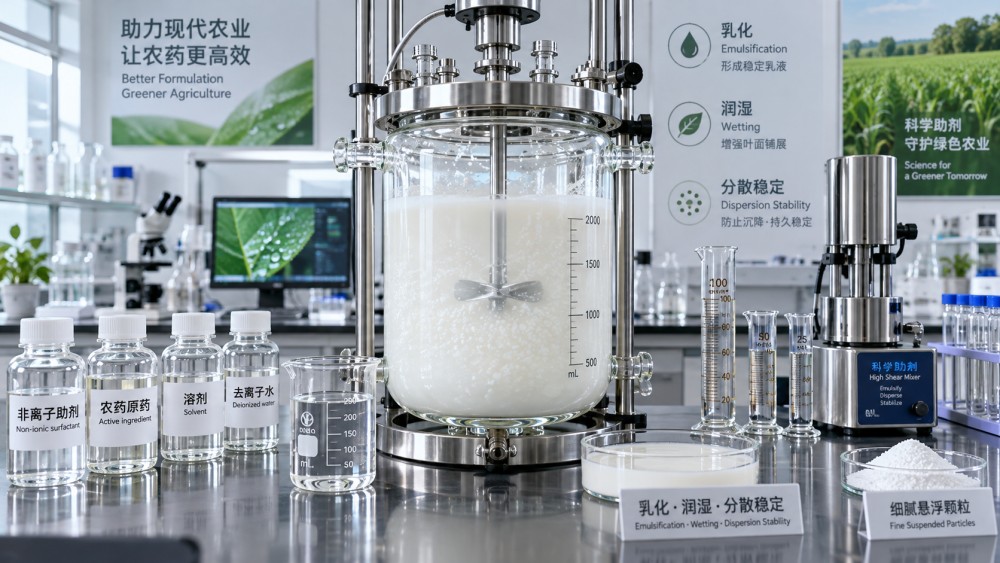
Interfacial control is the foundation of stable emulsions
Many pesticide active ingredients are hydrophobic. When they are dissolved in a solvent or oil carrier and later dispersed into water, the interface between the two phases becomes the critical zone. Without a suitable emulsifier package, droplets collide and merge because reducing interfacial area is thermodynamically favorable.
Non-ionic pesticide formulation intermediates adsorb at this interface. Their lipophilic portion associates with the oil phase, while the hydrophilic portion interacts with water. This orientation reduces interfacial tension and creates a protective layer around droplets. Depending on the chemistry, stabilization may come mainly from steric hindrance: hydrated molecular chains prevent droplets from approaching closely enough to coalesce.
Steric stabilization is particularly relevant in systems where electrolyte tolerance matters. Ionic emulsifiers can rely heavily on electrostatic repulsion, but that repulsion may weaken in the presence of calcium, magnesium, or dissolved fertilizer salts. Non-ionic structures are not immune to environmental changes, yet their stabilizing mechanism can remain more reliable under many practical dilution conditions.
HLB remains a useful screening concept. Materials with a relatively low HLB tend to favor water-in-oil behavior, while higher-HLB materials generally support oil-in-water emulsions. But technical evaluators should avoid treating HLB as a complete selection rule. The required HLB of the actual oil phase, the active ingredient loading, solvent polarity, temperature, and the presence of co-surfactants all influence the final result.
In suspension concentrates, wetting and dispersion must work together
An SC formulation does not require oil-droplet stabilization in the same way as an EC. Instead, it requires controlled behavior of fine solid particles in an aqueous continuous phase. Hydrophobic crystals may resist wetting, trap air, form agglomerates, or settle rapidly. During milling, inadequate wetting can also make it difficult to achieve the target particle-size distribution efficiently.
Here, non-ionic intermediates may act as wetting agents and dispersion-supporting components. By lowering the contact angle between water and the particle surface, they help liquid penetrate particle clusters. This assists deagglomeration and can improve the access of polymeric dispersants to the solid surface.
It is important to distinguish between wetting and long-term dispersion stability. A fast-wetting additive may help during manufacturing but may not provide sufficient protection against particle-particle attraction during storage. Many successful SC systems therefore use a coordinated package: a non-ionic wetting agent for rapid hydration and milling efficiency, plus an anionic or polymeric dispersant for adsorption and steric or electrosteric stabilization.
The compatibility of this package should be assessed with the actual active ingredient rather than inferred from generic surfactant performance. Crystal habit, surface energy, particle morphology, and impurity profile can all alter adsorption behavior. A change in technical active supplier can therefore change formulation stability even when the nominal active ingredient is the same.
Choosing an intermediate: evaluate function before chemistry labels
Procurement and development discussions sometimes begin with broad requests such as “a non-ionic emulsifier for pesticide use.” That description is too broad to guide a technically reliable choice. The relevant starting point is the job the intermediate must perform within the formula.
The chemical identity of a non-ionic intermediate is still essential, especially for regulatory review, toxicological assessment, and impurity control. Yet a chemistry label alone does not predict field performance. Two ethoxylated materials with similar descriptions may differ in ethoxylation distribution, residual feedstocks, water content, color, cloud point, pour point, and batch consistency. Those differences can affect a sensitive pesticide formulation.
Cloud point, temperature response, and storage reality
One of the most overlooked properties in non-ionic surfactant selection is cloud point. In some aqueous systems, a non-ionic surfactant becomes less soluble as temperature rises and eventually separates into a surfactant-rich phase, producing visible turbidity. This behavior can be useful in certain industrial cleaning applications, but it can be problematic in crop-protection formulations exposed to warm warehouses or container transport.
A cloud point should never be considered in isolation. Solvents, active ingredients, salts, and co-surfactants can shift it significantly. Nevertheless, it provides a meaningful early indication of whether a non-ionic system may remain compatible over the required storage range. Technical teams should test both the concentrate and the diluted spray mixture, since the chemical environment changes sharply after water is added.
Cold stability deserves equal attention. Some non-ionic intermediates become waxy, crystallize, or increase in viscosity at low temperature. In an EC, this may slow emulsification. In an SC, it can change rheology and interfere with redispersion. A formulation that passes a room-temperature appearance check is not necessarily ready for distribution across different climates.
Compatibility is broader than the active ingredient
The active ingredient is the obvious compatibility target, but it is only one part of the risk picture. Non-ionic intermediates must also be compatible with solvents, co-emulsifiers, thickeners, antifoams, preservatives, pH adjusters, dye systems, packaging materials, and any intended tank-mix partners.
For example, a highly surface-active non-ionic additive may improve wetting while increasing foam beyond acceptable limits. Another may interact with a hydrophobic defoamer and reduce its effectiveness. Some materials can alter preservative partitioning or change the viscosity contribution of associative thickeners. In seed-treatment products, the surfactant system may influence film formation, pigment dispersion, and adhesion to the seed surface.
Tank-mix compatibility also has commercial significance. End users may mix a pesticide with micronutrients, foliar fertilizers, biological products, or other crop-protection products. A formulation cannot be expected to remain universally compatible with every agricultural input, but evaluating likely use combinations can prevent avoidable complaints and clarify label guidance.
A practical testing sequence for technical evaluation
Bench screening should move from simple observations to conditions that resemble production and field use. A disciplined sequence can reduce wasted development time:
- Screen solubility and phase behavior. Observe clarity, precipitation, gel formation, and separation across realistic concentration ranges.
- Measure emulsification or dispersion quality. For EC systems, assess emulsion appearance, cream layer formation, and re-emulsification after standing. For SC systems, measure particle size, sedimentation, and ease of redispersion.
- Apply stress conditions. Include elevated and low-temperature storage, temperature cycling, centrifugation where appropriate, and vibration or agitation simulation.
- Test dilution water quality. Compare soft water with hard water and, where relevant, water containing dissolved fertilizer salts.
- Review application behavior. Foam, sprayability, nozzle performance, wetting, and residue characteristics should be assessed alongside physical stability.
- Confirm chemical and documentation suitability. Review impurity information, safety data, compositional consistency, regulatory status, and supply specifications before final selection.
Accelerated tests are valuable indicators, but they are not perfect substitutes for real-time stability data. They should be interpreted as risk-screening tools, particularly when the product contains temperature-sensitive active ingredients, biological components, or complex solvent systems.
Common selection mistakes
A frequent mistake is choosing a non-ionic intermediate solely because it performs well in a simple water-and-oil demonstration. Such a test may show attractive immediate emulsification but reveal little about long-term droplet stability, active ingredient crystallization, or compatibility with the full additive package.
Another error is assuming that “non-ionic” automatically means low-risk for hard water or tank mixing. The absence of charge reduces some electrolyte-related concerns, but formulation behavior remains dependent on the complete system. Excessive surfactant dosage can also create problems: foam, phytotoxicity risk, altered biological uptake, increased cost, or changes in drying and residue behavior.
Finally, technical evaluators should not overlook supply consistency. A formulation optimized around a narrow surfactant composition can become unstable when water content, color, active matter, or molecular distribution varies between lots. Defining meaningful incoming specifications and requesting batch-level documentation is as important as finding the right chemistry during development.
Stability is a formulation outcome, not an additive claim
Non-ionic pesticide formulation intermediates are powerful tools because they help manage the interfaces where instability begins: oil against water, solid against liquid, active ingredient against carrier, and concentrate against dilution water. Their contribution can be visible in a cleaner emulsion, faster wetting, reduced sedimentation, or more reliable redispersion. More often, their value is seen quietly over time—when a product still performs consistently after storage, transport, and field preparation.
For technical assessment teams, the most defensible selection approach combines chemical understanding with formulation-specific testing. Consider molecular structure, HLB range, cloud point, foam behavior, water quality tolerance, impurity profile, and interaction with the whole formulation package. Platforms such as FCAS can support this work by organizing practical information on surfactant functions, formulation formats, active ingredient behavior, safety requirements, and supply-chain considerations across the crop-protection value chain.
In the end, a stable pesticide formulation is not created by adding more ingredients. It is created by selecting the few ingredients that perform the right functions together, under the conditions the product will actually face.
Related News
 Antioxidants & Natural PreservativesWhat Quality Checks Matter When Sourcing Butylparaben for Personal CareButylparaben for personal care sourcing guide: compare assay, impurities, physical performance, documentation, traceability, and supplier quality to reduce formulation risk.MORE+
 Nano-microcapsule FormulationsHow Encapsulated Flavors Protect Taste During Processing and StorageEncapsulated Flavors protect taste from heat, oxygen, moisture, and storage loss. Explore smarter release, carrier selection, and processing strategies.MORE+
 Chelated Trace Element FertilizersHow Greenhouse Fertigation Systems Reduce Water and Fertilizer WasteGreenhouse fertigation systems reduce water and fertilizer waste with precise dosing, uniform irrigation, drainage monitoring, and smarter crop-zone control. Learn practical strategies.MORE+
 Supercritical CO2 Essential OilsHow Natural Essential Oil Blends Improve Consistent Product FragranceNatural essential oil blends help brands achieve consistent, appealing fragrance across batches. Explore smart blend design, stability testing, and product compatibility strategies.MORE+
 Non-ionic Surfactants & DefoamersHow to Choose Non Ionic Low Foaming Surfactants for CIP CleaningNon ionic low foaming surfactants for CIP cleaning: learn how to balance wetting, foam control, compatibility, and rinseability for reliable cleaning performance.MORE+
 Nano-microcapsule FormulationsHow Food Grade Cyclodextrin Complexes Protect Sensitive FlavorsFood grade cyclodextrin inclusion complexes help protect sensitive flavors from oxidation, evaporation, and processing loss while supporting controlled release and consistent sensory quality.MORE+
 Polymer-Coated Water Soluble NPKHow Fertilizer Coating Polymers Improve NPK Granule ReleaseFertilizer coating polymers for NPK granules improve controlled nutrient release, reduce loss risks, and enhance product consistency. Discover key selection and process insights.MORE+
 Chelated Trace Element FertilizersWhat Diammonium Phosphate Means for Crop Nutrition PlanningDiammonium Phosphate: learn how DAP supports early phosphorus access, nitrogen budgeting, smart placement, and balanced crop nutrition planning.MORE+
 Maillard Reaction Savory FlavorsHow to Assess a Flavor Bases Supplier List for Reliable SourcingGlobal Fine Chemicals & Agrochemical Intelligence Network flavor bases supplier list: assess specs, samples, supply risk, and true cost to source with confidence.MORE+
 Hydrocolloids & EmulsifiersHow Konjac Gum Powder Improves Texture in Low-Calorie FoodsKonjac gum powder improves body, stability, and mouthfeel in low-calorie foods. Discover practical tips for smoother sauces, beverages, and reduced-fat formulations.MORE+
 Supercritical CO2 Essential OilsWhat to Check Before Choosing a Botanical Essential Oils ManufacturerChoose a botanical essential oils manufacturer with confidence. Explore key checks for purity, traceability, compliance, batch consistency, and reliable supply.MORE+
 Microencapsulated FragrancesHow Fragrance Carriers for Detergents Improve Scent PerformanceFragrance carriers for detergents improve stability, fabric deposition, and long-lasting scent. Explore practical solutions for better wash-to-wear fragrance performance.MORE+
 Antioxidants & Natural PreservativesWhen Propyl Gallate Antioxidant Is the Right Choice for Oil StabilityPropyl gallate antioxidant: learn when it is the right choice for oil stability, shelf-life protection, processing compatibility, and smarter formulation decisions.MORE+
 Antioxidants & Natural PreservativesHow Potassium Sorbate Extends Shelf Life in Food and Beverage ProductsPotassium Sorbate helps food and beverage brands control yeast and mold spoilage. Explore pH, dosage, processing, and packaging strategies for reliable shelf life.MORE+
 Antioxidants & Natural PreservativesHow to Source Bulk Herbal Extracts With Reliable Quality ControlBulk herbal extracts sourcing guide: compare suppliers, verify traceability, review CoAs, and build reliable quality controls for safer, consistent purchasing.MORE+
 Antioxidants & Natural PreservativesWhat to Check Before Sourcing Butylparaben for Personal Care FormulasButylparaben for personal care sourcing guide: check market eligibility, purity, supplier controls, formula compatibility, packaging, and total risk before buying.MORE+
 Targeted Bio-pesticides & APIsChoosing Microbial Fungicides for Foliar Diseases in Integrated Crop ProgramsMicrobial fungicides for foliar diseases: learn how to match biology, formulation, tank compatibility, and timing for stronger integrated crop protection.MORE+
 Targeted Bio-pesticides & APIsHow Microbial Insecticides Control Caterpillars With Lower Crop Residue RiskMicrobial insecticides for caterpillars help protect crops with targeted early-larval control and lower residue-management pressure. Learn timing, coverage, compliance, and scouting essentials.MORE+
 Microencapsulated FragrancesHow to Add Encapsulated Laundry Fragrances Without Weakening Wash ResultsEncapsulated laundry fragrances: learn how to boost long-lasting scent while protecting cleaning power, stability, foam control, and fabric care.MORE+
 Supercritical CO2 Essential OilsHow Aroma Ingredients Shape Lasting and Skin-Safe Personal Care ProductsAroma ingredients for personal care: discover how to achieve lasting scent, formulation stability, skin safety, and confident product performance.MORE+
 Targeted Bio-pesticides & APIsInsecticides Explained Through Labels, Active Ingredients, and SafetyInsecticides explained through labels, active ingredients, formulations, and safety. Learn how to compare products, manage risk, and make informed crop protection decisions.MORE+
 Heavy-duty Industrial DegreasersHow to Select Parts Wash Cleaners for Automotive ComponentsParts wash cleaners for automotive components: learn how to match chemistry, materials, rinsing, safety, and waste controls for reliable cleaning results.MORE+
 Chelated Trace Element FertilizersHow Precision Fertigation Systems Improve Water and Nutrient ControlPrecision fertigation systems improve water and nutrient control with accurate dosing, uniform irrigation, smart monitoring, and reduced waste. Discover how to optimize crop performance.MORE+
 Hydrocolloids & EmulsifiersHow Bulk Price Factors Affect Hydrocolloid Stabilizer Blend SourcingHydrocolloid stabilizer blends bulk price: compare dosage efficiency, quality consistency, logistics, and documentation to reduce total sourcing costs.MORE+
 Zero-Calorie Sweeteners & AcidulantsHow to Choose a Natural Sweeteners Supplier for Clean-Label ProductsNatural sweeteners supplier selection guide for clean-label products: compare formulation fit, traceability, documentation, and supply reliability.MORE+
 Non-ionic Surfactants & DefoamersWhat Cationic Surfactants Do and Where They Are UsedCationic Surfactants deliver antimicrobial action, conditioning, antistatic control, and surface treatment benefits. Explore key uses, compatibility, and safe selection tips.MORE+
 Targeted Bio-pesticides & APIsHow to Evaluate Pesticide Suspension Concentrates for Field StabilityPesticide Suspension Concentrates: learn how to evaluate field stability, redispersibility, dilution, tank-mix compatibility, and spray safety for reliable performance.MORE+
 Hydrocolloids & EmulsifiersHow Hydrocolloid Systems for Meat Products Improve Texture and YieldHydrocolloid systems for meat products improve yield, texture, water retention, and slicing quality. Explore practical formulation strategies for stable, high-performing meat products.MORE+
 Microencapsulated FragrancesHow Laundry Fragrances for Liquid Detergents Improve Scent LongevityLaundry fragrances for liquid detergents: discover how fragrance design, deposition, and encapsulation create lasting fabric freshness and stronger product appeal.MORE+
 Nano-microcapsule FormulationsChoosing Fragrance Preparations That Perform Well in Personal WashFragrance preparations for personal wash: learn how to select options that protect clarity, stability, foam, scent performance, and packaging compatibility.MORE+
 Controlled-Release ThermodynamicsModified Cyclodextrins Explained for Controlled Fragrance ReleaseModified cyclodextrins enable controlled fragrance release, odor control, and volatile-note protection. Explore how they optimize performance in detergents, fabric care, and more.MORE+
 Microencapsulated FragrancesHow Fragrance Delivery Systems Improve Fabric Softener LongevityFragrance delivery systems for fabric softeners improve scent longevity through smart protection, reliable deposition, and controlled release for lasting freshness.MORE+
 Supercritical CO2 Essential OilsHow to Evaluate a Natural Cardamom Oil Supplier for Reliable SupplyNatural cardamom oil supplier evaluation guide: verify botanical origin, purity, batch consistency, documentation, packaging, and delivery reliability for confident sourcing.MORE+
 Maillard Reaction Savory FlavorsHow Ethyl Maltol Purity Testing Supports Flavor Safety ComplianceEthyl Maltol purity testing strengthens flavor safety compliance through identity checks, impurity profiling, supplier verification, and audit-ready documentation.MORE+
 Microencapsulated FragrancesEssential Oil Extracts Compared for Fragrance and Wellness UsesEssential Oil Extracts compared for fragrance and wellness: explore scent profiles, extraction methods, stability, safety, and sourcing insights for smarter formulation choices.MORE+
 Zero-Calorie Sweeteners & AcidulantsWhat Drives Zero Calorie Sweeteners Bulk Price in 2026Zero calorie sweeteners bulk price in 2026: compare specifications, dosage, quality, freight, and supply risk to make smarter sourcing decisions.MORE+
 EPA FIFRA & FDA GRAS RegsSynthetic Food Preservatives Rules That Support Safer FormulasSynthetic Food Preservatives: learn the rules for safer formulas, compliant use levels, validated shelf life, labeling, and reliable microbial control.MORE+
 Micelle Fluidics & ChelationHow Anionic Industrial Dispersants Improve Coating StabilityAnionic industrial dispersants improve coating stability, pigment wetting, viscosity control, gloss, and storage performance. Learn how to select and test the right solution.MORE+
 Supercritical CO2 Essential OilsHow to Choose Eucalyptus Oil Grades for Clean, Consistent ProductsChoose the right Eucalyptus Oil grade with confidence. Compare cineole content, purity, origin, processing, documentation, and application fit for consistent products.MORE+
 Micelle Fluidics & ChelationWhat Are Cationic Surfactants and Where Are They Commonly Used?Cationic Surfactants deliver powerful surface affinity for disinfection, fabric softening, hair conditioning, antistatic control, and industrial treatments. Explore key uses and selection factors.MORE+







































