
Are Cleaning Defoamers Compatible With Acidic Cleaning Solutions?
Are Cleaning Defoamers Compatible With Acidic Cleaning Solutions?
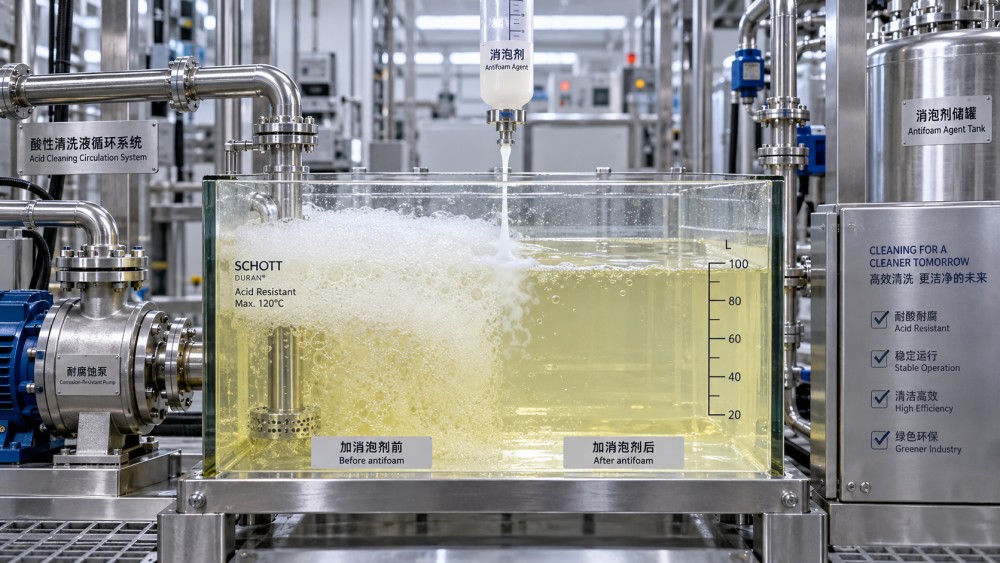
Are cleaning defoamers compatible with acidic cleaning solutions? Often, yes, but compatibility is never automatic. Acid concentration, temperature, surfactants, contamination, process conditions, and defoamer chemistry all determine performance.
For industrial cleaning formulators and procurement teams, the practical question is not whether a product can reduce foam initially. It is whether it controls foam reliably throughout use.
An unsuitable defoamer may separate, lose activity, create residues, interfere with rinsing, affect downstream processing, or introduce unacceptable risks for equipment, coatings, seals, and wastewater treatment.
Acid-stable defoamers are therefore selected as part of the overall cleaning formulation. They must support cleaning efficiency while maintaining process control, material compatibility, and consistent product quality.
Why Acidic Cleaning Systems Create a Compatibility Challenge
Acidic cleaners are widely used to remove mineral scale, rust, oxides, water hardness deposits, cement residues, inorganic salts, and certain process contaminants from industrial surfaces.
Common acidic cleaning ingredients include phosphoric acid, citric acid, sulfamic acid, nitric acid, hydrochloric acid, sulfuric acid, and organic acid blends designed for specific materials or soils.
Foam can develop when acids are combined with surfactants, wetting agents, corrosion inhibitors, chelants, dispersants, organic residues, or mechanical agitation during recirculation and spray cleaning.
In many applications, moderate foam improves surface contact or visual perception. Excessive foam, however, can reduce tank capacity, disrupt pumps, trigger overflow, slow rinsing, and compromise automated operations.
Acidic environments can destabilize certain defoamer emulsions. Low pH may alter emulsifier behavior, hydrolyze sensitive components, change particle dispersion, or reduce the defoamer's ability to spread rapidly.
Temperature adds another variable. A defoamer that performs well in a room-temperature laboratory blend may fail when exposed to hot acid circulation, steam-adjacent surfaces, or extended cleaning cycles.
Compatibility also changes over time. Fresh concentrate behavior can differ substantially from diluted working solutions, aged formulations, reclaimed baths, and systems contaminated with oils or dissolved metal salts.
The Short Answer: Some Defoamers Work Well in Acid, Others Do Not
Silicone-based, mineral-oil-based, polymeric, and specialty non-silicone defoamers can all be used in acidic cleaners. Their suitability depends on formulation design and final application requirements.
Silicone defoamers are widely valued for rapid foam knockdown at low dosage. Properly formulated silicone emulsions can provide robust performance across a broad pH range.
However, silicone chemistry is not universally acceptable. Electronics, coating, painting, membrane, and high-purity processes may restrict silicone because trace carryover can cause downstream defects.
Mineral-oil defoamers can offer practical foam suppression in many industrial formulations. They may be economical, but their residue profile and cleaning-system compatibility require careful evaluation.
Polyether-modified silicones often provide useful balance between dispersibility and antifoam activity. Their behavior varies significantly according to molecular structure, emulsification system, and acid exposure conditions.
Non-silicone polymeric defoamers may be appropriate where silicone avoidance is necessary. These products can perform effectively, although dosage, persistence, and rinsability require application-specific testing.
Natural oil or ester-based defoamers may suit selected lower-severity systems. In strongly acidic or high-temperature cleaning environments, hydrolysis, odor, separation, and oxidation risks deserve particular attention.
The correct conclusion is therefore conditional: cleaning defoamers can be compatible with acidic cleaning solutions, provided they remain stable, effective, clean-rinsing, and process-safe under actual use conditions.
Evaluate Acid Type, Concentration, and Exposure Time First
Acid identity matters because acids differ in strength, oxidizing potential, salt formation, volatility, and interaction with surfactant systems. A defoamer approved for citric acid may not suit nitric acid.
Mild organic acids usually present different formulation demands than concentrated mineral acids. A product stable at pH 2.5 may still fail in a hydrochloric acid cleaner below pH 1.
Formulators should test the intended concentration range, including concentrate, in-use dilution, and worst-case overdosing. Compatibility claims based on a single dilution point are incomplete.
Exposure duration is equally important. Short-contact spray cleaning may tolerate a defoamer that gradually separates, while recirculating baths require stable performance over many operating hours.
Oxidizing acids deserve special attention. Nitric acid and mixed acid systems can impose stronger chemical stress than non-oxidizing formulations, particularly where elevated temperatures accelerate degradation reactions.
Acid cleaners also accumulate dissolved scale and metals during use. Calcium, iron, copper, aluminum, and other ions may affect emulsion stability, foam behavior, and defoamer activity.
A practical supplier discussion should specify acid type, concentration, operating pH, cleaning duration, replenishment strategy, and expected bath life before a recommended defoamer is selected.
Surfactants and Soil Loads Can Change Defoamer Performance
Foam is generated by the entire system rather than one ingredient alone. Surfactant type, concentration, water quality, agitation, temperature, and contaminants determine how persistent the foam becomes.
Non-ionic surfactants often support wetting and soil removal in acidic cleaners. Depending on their cloud point and structure, they can also create foam profiles that require tailored defoaming.
Anionic surfactants may generate stronger and more stable foam, especially in spray or high-shear systems. The defoamer must rapidly enter the foam lamella and destabilize it.
Amphoteric surfactants, solvent packages, hydrotropes, and corrosion inhibitors can further alter foam behavior. Changing a single raw material may change the required defoamer dosage dramatically.
Process soil is another overlooked factor. Oils, proteins, polishing compounds, mineral fines, lubricants, and residues can either suppress foam naturally or create highly persistent contaminated foam.
A cleaner that appears over-defoamed in fresh laboratory water may become excessively foamy on the production floor. Testing with representative soil and water conditions is more meaningful.
For this reason, procurement teams should avoid comparing defoamers solely by active content or price per kilogram. Effective dosage under real operating conditions is the relevant cost metric.
Choose the Defoamer Around the Cleaning Method
Spray cleaning normally requires fast knockdown because foam can affect nozzle performance, spray pattern, drainage, and visibility. A slower, persistent defoamer may be insufficient in this environment.
Clean-in-place systems require a different balance. The defoamer must control circulation foam without reducing chemical contact, leaving difficult residues, or compromising rinse-water efficiency.
Immersion cleaning tanks may benefit from longer-lasting foam control. Here, product stability and resistance to repeated agitation can be more important than immediate foam collapse.
Ultrasonic cleaning systems require particular care. Excess defoamer may interfere with cavitation efficiency, while uncontrolled foam can reduce operating consistency and create handling problems.
Metal cleaning operations must consider downstream welding, coating, plating, painting, and passivation. Defoamer residues can be more costly than temporary foam, particularly in quality-critical manufacturing.
In food and beverage equipment cleaning, ingredients must meet applicable regulatory and plant hygiene expectations. Rinse performance, carryover control, and documentation are central selection factors.
For electronics and semiconductor-related cleaning, high purity is often decisive. Low-residue, low-silicone, traceable products may be necessary even when standard defoamers offer lower purchase prices.
Material Compatibility Must Be Assessed Alongside Foam Control
Acidic cleaning solutions already place stress on equipment materials. The selected defoamer should not worsen corrosion, swelling, crazing, staining, coating damage, or seal degradation.
Stainless steel, carbon steel, aluminum, copper alloys, plastics, elastomers, glass, and protective coatings respond differently to acidic formulations and associated additive packages.
Corrosion inhibitors are often included in acid cleaners to protect substrates. A new defoamer can affect inhibitor solubility, adsorption, dispersion, or overall formulation stability.
Packaging compatibility matters as well. Long-term contact with acidic concentrates can affect container integrity, closures, liners, labels, and transportation safety, especially at elevated warehouse temperatures.
Finished-cleaning quality should be assessed visually and analytically. Streaking, haze, oily films, water-break failure, poor paint adhesion, or odor may indicate unsuitable defoamer carryover.
Where customer specifications are strict, define measurable acceptance criteria before trials begin. Examples include residue limits, contact angle, conductivity, particle count, adhesion performance, or rinse-water appearance.
A defoamer that resolves foam but damages downstream quality is not compatible in commercial terms. Compatibility must include both chemical survival and the value of the cleaned surface.
How to Test an Acid-Stable Defoamer Before Scale-Up
Start with a formulation compatibility screening. Blend the proposed defoamer into the acid cleaner at expected dosage, maximum dosage, and a reasonable overdosage level for comparison.
Observe the samples after preparation, then after storage at ambient temperature and elevated temperature. Look for separation, sediment, viscosity changes, color changes, odor, or precipitation.
Measure pH and inspect any shift caused by the additive. While defoamers are usually low-dose components, emulsifier systems or carriers can influence sensitive acid formulations.
Conduct foam testing using the relevant process method. Cylinder shake tests are useful for early screening, but recirculation, spray, agitation, or dynamic foam tests are more representative.
Use actual process water whenever possible. Hardness, dissolved salts, recycled rinse water, and treatment chemicals can create results that differ from deionized-water laboratory trials.
Add representative soil loads to the test program. For metal cleaning, include process oils or fines; for CIP applications, consider product residues, proteins, fats, and mineral deposits.
Evaluate cleaning performance rather than foam alone. Confirm that wetting, scale removal, soil removal, rinse behavior, corrosion protection, and surface finish remain within specification after defoamer addition.
Finally, run a controlled plant trial. Monitor foam height, pump behavior, overflow events, cleaning-cycle duration, water use, residue complaints, and actual defoamer consumption over several cycles.
Questions Procurement Teams Should Ask Suppliers
Ask whether the defoamer has been tested in acidic cleaning systems, and request the tested pH range, acid types, temperatures, surfactants, and duration of exposure.
Request technical data covering appearance, active content, density, viscosity, flash point where relevant, recommended dosage, storage conditions, and expected shelf life in unopened packaging.
Clarify whether the product contains silicone, mineral oil, alkylphenol ethoxylates, fluorinated substances, volatile solvents, or other substances restricted by internal or customer requirements.
Documentation should match the application's regulatory needs. Depending on the sector, this may include safety data sheets, composition statements, food-contact support, allergen information, and regional compliance declarations.
Ask about batch consistency and supply continuity. Defoamer performance can be sensitive to manufacturing variation, especially when emulsification quality or carrier composition changes between lots.
Obtain guidance on addition point and dosing method. Some products work best when added before agitation, while others should be metered into high-foam zones during operation.
Compare total operating cost, not only unit price. Lower dosage, reduced downtime, fewer overflow incidents, faster rinsing, and lower rejection rates can justify a higher-cost specialty defoamer.
Common Selection Mistakes to Avoid
A common error is selecting a defoamer based on neutral detergent experience. Acid conditions can destabilize the product or change the surfactant system enough to invalidate previous results.
Another mistake is assuming that higher dosage will solve every foam problem. Overdosing can produce residues, reduce cleaning quality, increase costs, and complicate wastewater treatment.
Some teams focus only on initial foam collapse. Persistent performance matters more in many industrial systems, particularly when cleaners are recirculated, heated, or repeatedly exposed to contamination.
Ignoring downstream operations is also risky. A defoamer that is acceptable in a cleaning tank may create adhesion, coating, plating, filtration, or analytical problems later in production.
Finally, avoid relying on generic “acid-resistant” claims without understanding the test conditions. Acid resistance is meaningful only when it reflects the real formulation and operating environment.
Conclusion: Compatibility Is a Formulation Decision, Not a Product Label
Cleaning defoamers can be compatible with acidic cleaning solutions, but successful selection requires more than choosing a product described as acid-stable or industrial-grade.
The best option remains stable in the intended acid system, controls foam at practical dosage, preserves cleaning performance, rinses cleanly, protects process quality, and meets documentation requirements.
For formulators, the priority is representative testing across concentration, temperature, water quality, soils, and operating conditions. For buyers, the priority is verified performance and total operating value.
When these factors are reviewed systematically, an acid-stable defoamer becomes a process-control tool that supports safer cleaning, consistent throughput, lower waste, and more reliable industrial operations.
Related News
 Antioxidants & Natural PreservativesWhat Quality Checks Matter When Sourcing Butylparaben for Personal CareButylparaben for personal care sourcing guide: compare assay, impurities, physical performance, documentation, traceability, and supplier quality to reduce formulation risk.MORE+
 Nano-microcapsule FormulationsHow Encapsulated Flavors Protect Taste During Processing and StorageEncapsulated Flavors protect taste from heat, oxygen, moisture, and storage loss. Explore smarter release, carrier selection, and processing strategies.MORE+
 Chelated Trace Element FertilizersHow Greenhouse Fertigation Systems Reduce Water and Fertilizer WasteGreenhouse fertigation systems reduce water and fertilizer waste with precise dosing, uniform irrigation, drainage monitoring, and smarter crop-zone control. Learn practical strategies.MORE+
 Supercritical CO2 Essential OilsHow Natural Essential Oil Blends Improve Consistent Product FragranceNatural essential oil blends help brands achieve consistent, appealing fragrance across batches. Explore smart blend design, stability testing, and product compatibility strategies.MORE+
 Non-ionic Surfactants & DefoamersHow to Choose Non Ionic Low Foaming Surfactants for CIP CleaningNon ionic low foaming surfactants for CIP cleaning: learn how to balance wetting, foam control, compatibility, and rinseability for reliable cleaning performance.MORE+
 Nano-microcapsule FormulationsHow Food Grade Cyclodextrin Complexes Protect Sensitive FlavorsFood grade cyclodextrin inclusion complexes help protect sensitive flavors from oxidation, evaporation, and processing loss while supporting controlled release and consistent sensory quality.MORE+
 Polymer-Coated Water Soluble NPKHow Fertilizer Coating Polymers Improve NPK Granule ReleaseFertilizer coating polymers for NPK granules improve controlled nutrient release, reduce loss risks, and enhance product consistency. Discover key selection and process insights.MORE+
 Chelated Trace Element FertilizersWhat Diammonium Phosphate Means for Crop Nutrition PlanningDiammonium Phosphate: learn how DAP supports early phosphorus access, nitrogen budgeting, smart placement, and balanced crop nutrition planning.MORE+
 Maillard Reaction Savory FlavorsHow to Assess a Flavor Bases Supplier List for Reliable SourcingGlobal Fine Chemicals & Agrochemical Intelligence Network flavor bases supplier list: assess specs, samples, supply risk, and true cost to source with confidence.MORE+
 Hydrocolloids & EmulsifiersHow Konjac Gum Powder Improves Texture in Low-Calorie FoodsKonjac gum powder improves body, stability, and mouthfeel in low-calorie foods. Discover practical tips for smoother sauces, beverages, and reduced-fat formulations.MORE+
 Supercritical CO2 Essential OilsWhat to Check Before Choosing a Botanical Essential Oils ManufacturerChoose a botanical essential oils manufacturer with confidence. Explore key checks for purity, traceability, compliance, batch consistency, and reliable supply.MORE+
 Microencapsulated FragrancesHow Fragrance Carriers for Detergents Improve Scent PerformanceFragrance carriers for detergents improve stability, fabric deposition, and long-lasting scent. Explore practical solutions for better wash-to-wear fragrance performance.MORE+
 Antioxidants & Natural PreservativesWhen Propyl Gallate Antioxidant Is the Right Choice for Oil StabilityPropyl gallate antioxidant: learn when it is the right choice for oil stability, shelf-life protection, processing compatibility, and smarter formulation decisions.MORE+
 Antioxidants & Natural PreservativesHow Potassium Sorbate Extends Shelf Life in Food and Beverage ProductsPotassium Sorbate helps food and beverage brands control yeast and mold spoilage. Explore pH, dosage, processing, and packaging strategies for reliable shelf life.MORE+
 Antioxidants & Natural PreservativesHow to Source Bulk Herbal Extracts With Reliable Quality ControlBulk herbal extracts sourcing guide: compare suppliers, verify traceability, review CoAs, and build reliable quality controls for safer, consistent purchasing.MORE+
 Antioxidants & Natural PreservativesWhat to Check Before Sourcing Butylparaben for Personal Care FormulasButylparaben for personal care sourcing guide: check market eligibility, purity, supplier controls, formula compatibility, packaging, and total risk before buying.MORE+
 Targeted Bio-pesticides & APIsChoosing Microbial Fungicides for Foliar Diseases in Integrated Crop ProgramsMicrobial fungicides for foliar diseases: learn how to match biology, formulation, tank compatibility, and timing for stronger integrated crop protection.MORE+
 Targeted Bio-pesticides & APIsHow Microbial Insecticides Control Caterpillars With Lower Crop Residue RiskMicrobial insecticides for caterpillars help protect crops with targeted early-larval control and lower residue-management pressure. Learn timing, coverage, compliance, and scouting essentials.MORE+
 Microencapsulated FragrancesHow to Add Encapsulated Laundry Fragrances Without Weakening Wash ResultsEncapsulated laundry fragrances: learn how to boost long-lasting scent while protecting cleaning power, stability, foam control, and fabric care.MORE+
 Supercritical CO2 Essential OilsHow Aroma Ingredients Shape Lasting and Skin-Safe Personal Care ProductsAroma ingredients for personal care: discover how to achieve lasting scent, formulation stability, skin safety, and confident product performance.MORE+
 Targeted Bio-pesticides & APIsInsecticides Explained Through Labels, Active Ingredients, and SafetyInsecticides explained through labels, active ingredients, formulations, and safety. Learn how to compare products, manage risk, and make informed crop protection decisions.MORE+
 Heavy-duty Industrial DegreasersHow to Select Parts Wash Cleaners for Automotive ComponentsParts wash cleaners for automotive components: learn how to match chemistry, materials, rinsing, safety, and waste controls for reliable cleaning results.MORE+
 Chelated Trace Element FertilizersHow Precision Fertigation Systems Improve Water and Nutrient ControlPrecision fertigation systems improve water and nutrient control with accurate dosing, uniform irrigation, smart monitoring, and reduced waste. Discover how to optimize crop performance.MORE+
 Hydrocolloids & EmulsifiersHow Bulk Price Factors Affect Hydrocolloid Stabilizer Blend SourcingHydrocolloid stabilizer blends bulk price: compare dosage efficiency, quality consistency, logistics, and documentation to reduce total sourcing costs.MORE+
 Zero-Calorie Sweeteners & AcidulantsHow to Choose a Natural Sweeteners Supplier for Clean-Label ProductsNatural sweeteners supplier selection guide for clean-label products: compare formulation fit, traceability, documentation, and supply reliability.MORE+
 Non-ionic Surfactants & DefoamersWhat Cationic Surfactants Do and Where They Are UsedCationic Surfactants deliver antimicrobial action, conditioning, antistatic control, and surface treatment benefits. Explore key uses, compatibility, and safe selection tips.MORE+
 Targeted Bio-pesticides & APIsHow to Evaluate Pesticide Suspension Concentrates for Field StabilityPesticide Suspension Concentrates: learn how to evaluate field stability, redispersibility, dilution, tank-mix compatibility, and spray safety for reliable performance.MORE+
 Hydrocolloids & EmulsifiersHow Hydrocolloid Systems for Meat Products Improve Texture and YieldHydrocolloid systems for meat products improve yield, texture, water retention, and slicing quality. Explore practical formulation strategies for stable, high-performing meat products.MORE+
 Microencapsulated FragrancesHow Laundry Fragrances for Liquid Detergents Improve Scent LongevityLaundry fragrances for liquid detergents: discover how fragrance design, deposition, and encapsulation create lasting fabric freshness and stronger product appeal.MORE+
 Nano-microcapsule FormulationsChoosing Fragrance Preparations That Perform Well in Personal WashFragrance preparations for personal wash: learn how to select options that protect clarity, stability, foam, scent performance, and packaging compatibility.MORE+
 Controlled-Release ThermodynamicsModified Cyclodextrins Explained for Controlled Fragrance ReleaseModified cyclodextrins enable controlled fragrance release, odor control, and volatile-note protection. Explore how they optimize performance in detergents, fabric care, and more.MORE+
 Microencapsulated FragrancesHow Fragrance Delivery Systems Improve Fabric Softener LongevityFragrance delivery systems for fabric softeners improve scent longevity through smart protection, reliable deposition, and controlled release for lasting freshness.MORE+
 Supercritical CO2 Essential OilsHow to Evaluate a Natural Cardamom Oil Supplier for Reliable SupplyNatural cardamom oil supplier evaluation guide: verify botanical origin, purity, batch consistency, documentation, packaging, and delivery reliability for confident sourcing.MORE+
 Maillard Reaction Savory FlavorsHow Ethyl Maltol Purity Testing Supports Flavor Safety ComplianceEthyl Maltol purity testing strengthens flavor safety compliance through identity checks, impurity profiling, supplier verification, and audit-ready documentation.MORE+
 Microencapsulated FragrancesEssential Oil Extracts Compared for Fragrance and Wellness UsesEssential Oil Extracts compared for fragrance and wellness: explore scent profiles, extraction methods, stability, safety, and sourcing insights for smarter formulation choices.MORE+
 Zero-Calorie Sweeteners & AcidulantsWhat Drives Zero Calorie Sweeteners Bulk Price in 2026Zero calorie sweeteners bulk price in 2026: compare specifications, dosage, quality, freight, and supply risk to make smarter sourcing decisions.MORE+
 EPA FIFRA & FDA GRAS RegsSynthetic Food Preservatives Rules That Support Safer FormulasSynthetic Food Preservatives: learn the rules for safer formulas, compliant use levels, validated shelf life, labeling, and reliable microbial control.MORE+
 Micelle Fluidics & ChelationHow Anionic Industrial Dispersants Improve Coating StabilityAnionic industrial dispersants improve coating stability, pigment wetting, viscosity control, gloss, and storage performance. Learn how to select and test the right solution.MORE+
 Supercritical CO2 Essential OilsHow to Choose Eucalyptus Oil Grades for Clean, Consistent ProductsChoose the right Eucalyptus Oil grade with confidence. Compare cineole content, purity, origin, processing, documentation, and application fit for consistent products.MORE+
 Micelle Fluidics & ChelationWhat Are Cationic Surfactants and Where Are They Commonly Used?Cationic Surfactants deliver powerful surface affinity for disinfection, fabric softening, hair conditioning, antistatic control, and industrial treatments. Explore key uses and selection factors.MORE+







































