
How Fast Drying Degreasing Solvents Reduce Cleaning Cycle Times
Cleaning delays are often treated as a minor maintenance issue until they begin to consume production capacity. A part may be chemically clean within minutes, yet the workstation remains unavailable because solvent trapped in threads, blind holes, seams, or porous surfaces has not evaporated. In assembly, coating, inspection, repair, and changeover work, that waiting period can become the actual bottleneck.
Fast drying degreasing solvents reduce cleaning cycle time by shortening the interval between soil removal and the point at which a component can be safely handled, inspected, assembled, coated, tested, or returned to service. Their value is not simply that they evaporate quickly. The useful result comes from balancing four requirements: sufficient solvency for the soil, controlled evaporation from the real part geometry, acceptable residue level, and compatibility with materials, equipment, ventilation, and site safety controls.
A solvent that flashes off quickly but leaves oil in a recessed feature does not shorten the cycle. Neither does a powerful degreaser that requires long drying, multiple rinses, or a lengthy safety hold before hot work. The relevant measure is therefore total elapsed cleaning time, not the evaporation rate shown on a technical data sheet.
Where time is actually lost in a cleaning cycle
A practical cleaning cycle contains more than spraying or immersing a part. It includes moving the part to the cleaning station, applying the solvent, allowing contact time, wiping or brushing where needed, draining, evaporating, inspecting, correcting missed contamination, and transferring the part to the next operation. Fast drying degreasing solvents affect several of these stages, but only when the process is designed around their behavior.
Oil and grease removal begins with wetting and dissolution. The solvent must penetrate the contaminant film and reduce its cohesion with the substrate. Low-viscosity oils on smooth metal surfaces may release quickly. Heavier lubricants, drawing compounds, oxidized oils, waxy protectants, adhesive residues, and carbonaceous soils behave differently. They may require mechanical action, repeated application, or a different chemistry altogether.
After the soil is mobilized, it must be removed from the part rather than redistributed. This is why wiping material, drainage orientation, and application pressure matter. A solvent can dissolve a grease film efficiently but leave a thin contaminated residue if the dissolved material is not carried away or absorbed. In that condition, rapid evaporation can make the problem harder to detect because the part looks dry before it is actually clean.
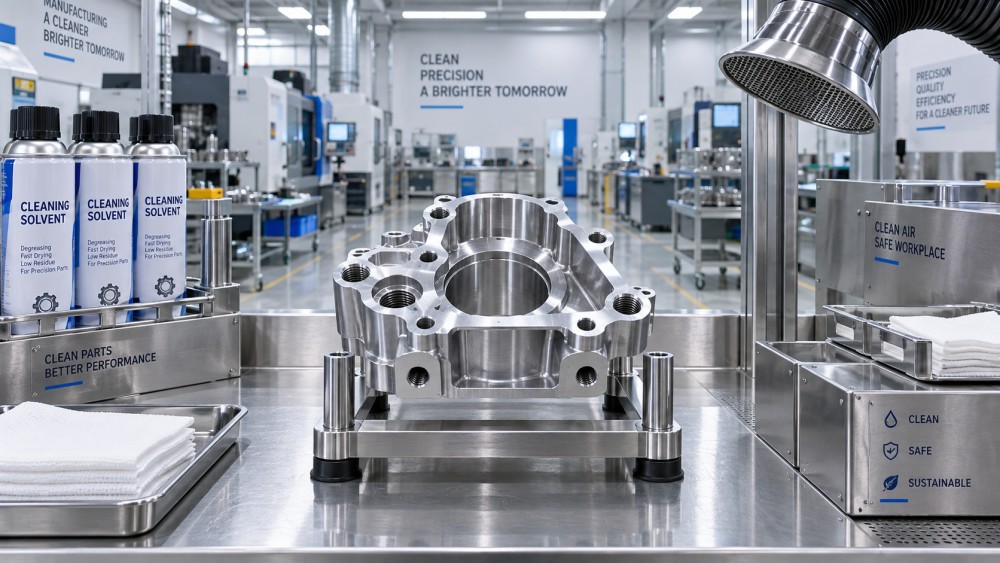
Drying itself is also more complex than a single evaporation value. On an open, flat surface, volatile solvent may disappear quickly. On a gearbox flange, electrical enclosure, machined casting, or heat exchanger component, liquid can remain in capillary gaps and low points. The cycle is governed by the last wet area, not the first dry surface. Part positioning and compressed-air assistance, where permitted and appropriately controlled, can therefore have as much influence on release time as the solvent selected.
Fast evaporation is useful only when it matches the task
Fast drying degreasing solvents are especially valuable where the next operation is moisture- or residue-sensitive, or where a part cannot remain out of service for long. Typical examples include pre-assembly cleaning of metal components, removal of cutting oils before inspection, preparation before bonding or sealing, maintenance cleaning of machinery, and cleaning of electronic or electrical hardware where water-based washing is impractical.
In these applications, a short drying interval can eliminate queue time between cleaning and production. A technician does not need to wait for rinse water to drain or for a slow solvent film to disappear before performing a visual inspection. A line can avoid reserving racks or floor space for parts awaiting dryness. For a maintenance shutdown, this can simplify work sequencing because cleaned components can move directly into measurement, repair, or reinstallation.
However, “fast drying” should not be confused with “highest possible volatility.” Extremely rapid evaporation can reduce dwell time to the point that the solvent does not dissolve thick or aged contamination effectively. It can also cause localized cooling, which may condense moisture from humid air on a cold metal surface. On large components, frequent reapplication may raise consumption and vapor load without improving cleaning quality.
The right evaporation profile depends on the soil, part mass, geometry, ambient temperature, airflow, and required cleanliness level. A moderate-drying product may be more productive for a heavily soiled part if it keeps the surface wet long enough to loosen the contaminant in one pass. A very fast-drying formulation may be preferable for a lightly contaminated component that must immediately enter an assembly or testing station.
Cleaning speed should be measured from dirty part to accepted part
Cycle-time improvement should be assessed at the process level. A useful comparison is not “how many seconds until the solvent disappears?” but “how long until the part meets the acceptance requirement and can proceed without rework?” This distinction prevents a common selection error: choosing a fast-evaporating solvent based on a demonstration on a clean metal coupon.
For project planning, the acceptance point should be defined before evaluating alternatives. It may be a visibly oil-free surface, absence of residue under ultraviolet inspection, a specified water-break response, a stable electrical contact, successful adhesive bonding, acceptable coating adhesion, or compliance with an internal contamination limit. Each endpoint can require a different balance of solvency, drying behavior, and verification.
A short controlled trial can reveal these differences without relying on generic performance claims. The test should use representative contamination, production parts rather than idealized panels, normal operators, actual ambient conditions, and the intended application method. Recording the time to cleaning acceptance, solvent use per part, rework frequency, and time spent waiting for dryness gives a more decision-relevant picture than evaporation speed alone.
The part geometry can defeat an otherwise good solvent
Complex geometry is a frequent source of missed savings. Blind holes, overlapping plates, cable bundles, porous castings, seams, threaded fittings, and enclosed housings retain liquid. A solvent with a short open-surface drying time may remain trapped inside these areas, creating delays or safety concerns when the part is energized, pressurized, heated, sealed, or returned to service.
Drainage must be designed into the cleaning sequence. Parts may need to be rotated, tilted, or mounted so that liquid exits low points before the final wipe. Where suitable, controlled air movement can accelerate evaporation, but it also increases vapor dispersion and may create static-related or ignition risks. The use of compressed air should be assessed against the solvent’s safety data, local procedures, electrical classification, and contamination-control requirements. Blowing solvent from a cavity onto adjacent surfaces is not a drying solution if it spreads dissolved oil into a clean area.
Application method also changes performance. Aerosols provide targeted delivery and may be convenient for maintenance tasks, but they can produce high local vapor concentrations and inconsistent coverage on large surfaces. Trigger sprays are easier to control but may not provide enough flushing force for deep features. Wipes reduce runoff and can combine solvent action with soil capture, though lint, wipe saturation, and operator technique need attention. Immersion or enclosed washing systems can provide repeatability, but drying capacity, extraction, and solvent recovery become central to the project design.
Material compatibility is a schedule issue, not only a quality issue
Fast drying solvents are often selected for metal cleaning, but industrial assemblies rarely consist of metal alone. Seals, cable jackets, labels, coatings, adhesives, elastomers, transparent plastics, composite materials, and painted surfaces may be present. A solvent that cleans a steel housing effectively can craze a clear polymer cover, soften a printed marking, swell a gasket, or undermine an adhesive bond.
These effects are not always immediate. Some materials show visible attack only after repeated exposure or after the solvent has evaporated and the part enters service. In a project environment, this creates a difficult failure mode: cleaning appears faster, but downstream assembly defects, leakage, cosmetic rejection, or field reliability concerns add more delay than the original process ever caused.
Compatibility assessment should reflect the real exposure condition. Brief wipe contact is different from soaking; a cool maintenance area is different from a hot enclosed machine; a new gasket is different from an aged polymer under stress. Technical data can narrow the options, but representative exposure tests remain important when the part includes sensitive materials or carries a high consequence of failure.
Surface finish requirements deserve equal attention. Some operations require a dry, visibly clean surface but tolerate a minor nonvolatile film. Others, particularly coating, precision inspection, bonding, and electrical contact applications, require very low residue. A fast evaporation rate does not guarantee residue-free cleaning. The solvent package may include components intended to control performance or handling, and the dissolved soil itself can remain if removal is incomplete. Verification should match the downstream requirement rather than rely only on visual appearance.
Safety controls can determine whether the time saving is real
Many rapid-drying solvents produce substantial vapor because the same volatility that shortens drying also accelerates vapor release. That can affect ventilation demand, worker exposure controls, ignition management, storage arrangements, waste handling, and the permitted location of cleaning work. If the facility must pause operations, isolate adjacent equipment, or move cleaning to a distant controlled area, an apparently faster solvent may not reduce the total task duration.
Flammability is a central consideration for many solvent systems. The relevant questions extend beyond whether a container carries a flammable classification. Project planning should examine potential ignition sources, electrical equipment suitability, static accumulation during transfer or spraying, hot surfaces, welding or grinding activities, and the possibility of vapor collecting in pits, cabinets, or enclosed equipment. Cleaning immediately before hot work requires a defined safe process rather than an assumption that a dry-feeling surface is free of flammable vapor.
Worker protection must also be aligned with the use pattern. A product used occasionally for spot cleaning presents a different exposure scenario from repeated manual cleaning throughout a shift. Open trays, spray application, enclosed equipment, and wipe-based work generate different vapor conditions. Safety data sheets provide essential hazard information, but the operating method determines the control measures actually needed at the worksite.
Environmental and compliance requirements can limit available choices as well. Solvent selection may be affected by volatile organic compound restrictions, hazardous-air-pollutant considerations, waste classification, transport rules, customer substance requirements, and internal sustainability policies. The applicable obligations depend on jurisdiction and chemistry. The practical point is that compliance should be reviewed before a pilot becomes embedded in a production schedule; replacing an accepted cleaner later can require renewed validation and disrupt the intended time savings.
A staged process can be faster than a one-solvent approach
When contamination is heavy, treating fast drying as the only performance goal can create repeated cleaning passes. A staged approach may be more efficient: use a more persistent or aqueous cleaner to remove bulk grease where the setup allows it, then use a fast drying solvent for final wipe, residue removal, or preparation immediately before the next operation. This separates bulk soil removal from final readiness.
The added step is justified only when it eliminates rework, reduces solvent consumption, or prevents bottlenecks downstream. It is not automatically better. On simple, lightly soiled parts, a single compatible fast-drying cleaner may remain the most efficient method. The decision turns on the total handling burden and acceptance requirement, not the number of process steps.
For maintenance tasks, the same logic can apply to zones within a machine. External surfaces with thick grease may need a controlled bulk-cleaning method, while sensors, connectors, precision interfaces, and inspection points may benefit from a rapid-drying final cleaner. Treating the entire asset with one product because it simplifies purchasing can create either unnecessary waiting or unacceptable material risk.
Build solvent selection into the work package
The most reliable gains occur when cleaning chemistry, work instructions, and facility controls are treated as one operating system. A solvent should be specified alongside the application quantity, contact time, wipe type, drainage orientation, acceptance check, ventilation condition, waste route, and restrictions on adjacent activities. Without these details, performance depends heavily on individual technique and the planned cycle time becomes difficult to reproduce.
Before release, it is useful to challenge the proposed process with the conditions most likely to disrupt it: cold parts, high humidity, difficult soil, recessed geometry, maximum production rate, and the full range of materials in the assembly. The purpose is not to make cleaning unnecessarily complex. It is to identify whether the time saved in evaporation is being lost elsewhere through incomplete degreasing, trapped liquid, incompatible materials, or safety-driven interruption.
Fast drying degreasing solvents can materially shorten cleaning cycles when they remove the target contamination in a single effective operation and allow the part to move promptly to its next validated state. Their strongest contribution is not faster evaporation in isolation, but a cleaner, more predictable handoff between maintenance, preparation, inspection, and production.
Related News
 Antioxidants & Natural PreservativesWhat Quality Checks Matter When Sourcing Butylparaben for Personal CareButylparaben for personal care sourcing guide: compare assay, impurities, physical performance, documentation, traceability, and supplier quality to reduce formulation risk.MORE+
 Nano-microcapsule FormulationsHow Encapsulated Flavors Protect Taste During Processing and StorageEncapsulated Flavors protect taste from heat, oxygen, moisture, and storage loss. Explore smarter release, carrier selection, and processing strategies.MORE+
 Chelated Trace Element FertilizersHow Greenhouse Fertigation Systems Reduce Water and Fertilizer WasteGreenhouse fertigation systems reduce water and fertilizer waste with precise dosing, uniform irrigation, drainage monitoring, and smarter crop-zone control. Learn practical strategies.MORE+
 Supercritical CO2 Essential OilsHow Natural Essential Oil Blends Improve Consistent Product FragranceNatural essential oil blends help brands achieve consistent, appealing fragrance across batches. Explore smart blend design, stability testing, and product compatibility strategies.MORE+
 Non-ionic Surfactants & DefoamersHow to Choose Non Ionic Low Foaming Surfactants for CIP CleaningNon ionic low foaming surfactants for CIP cleaning: learn how to balance wetting, foam control, compatibility, and rinseability for reliable cleaning performance.MORE+
 Nano-microcapsule FormulationsHow Food Grade Cyclodextrin Complexes Protect Sensitive FlavorsFood grade cyclodextrin inclusion complexes help protect sensitive flavors from oxidation, evaporation, and processing loss while supporting controlled release and consistent sensory quality.MORE+
 Polymer-Coated Water Soluble NPKHow Fertilizer Coating Polymers Improve NPK Granule ReleaseFertilizer coating polymers for NPK granules improve controlled nutrient release, reduce loss risks, and enhance product consistency. Discover key selection and process insights.MORE+
 Chelated Trace Element FertilizersWhat Diammonium Phosphate Means for Crop Nutrition PlanningDiammonium Phosphate: learn how DAP supports early phosphorus access, nitrogen budgeting, smart placement, and balanced crop nutrition planning.MORE+
 Maillard Reaction Savory FlavorsHow to Assess a Flavor Bases Supplier List for Reliable SourcingGlobal Fine Chemicals & Agrochemical Intelligence Network flavor bases supplier list: assess specs, samples, supply risk, and true cost to source with confidence.MORE+
 Hydrocolloids & EmulsifiersHow Konjac Gum Powder Improves Texture in Low-Calorie FoodsKonjac gum powder improves body, stability, and mouthfeel in low-calorie foods. Discover practical tips for smoother sauces, beverages, and reduced-fat formulations.MORE+
 Supercritical CO2 Essential OilsWhat to Check Before Choosing a Botanical Essential Oils ManufacturerChoose a botanical essential oils manufacturer with confidence. Explore key checks for purity, traceability, compliance, batch consistency, and reliable supply.MORE+
 Microencapsulated FragrancesHow Fragrance Carriers for Detergents Improve Scent PerformanceFragrance carriers for detergents improve stability, fabric deposition, and long-lasting scent. Explore practical solutions for better wash-to-wear fragrance performance.MORE+
 Antioxidants & Natural PreservativesWhen Propyl Gallate Antioxidant Is the Right Choice for Oil StabilityPropyl gallate antioxidant: learn when it is the right choice for oil stability, shelf-life protection, processing compatibility, and smarter formulation decisions.MORE+
 Antioxidants & Natural PreservativesHow Potassium Sorbate Extends Shelf Life in Food and Beverage ProductsPotassium Sorbate helps food and beverage brands control yeast and mold spoilage. Explore pH, dosage, processing, and packaging strategies for reliable shelf life.MORE+
 Antioxidants & Natural PreservativesHow to Source Bulk Herbal Extracts With Reliable Quality ControlBulk herbal extracts sourcing guide: compare suppliers, verify traceability, review CoAs, and build reliable quality controls for safer, consistent purchasing.MORE+
 Antioxidants & Natural PreservativesWhat to Check Before Sourcing Butylparaben for Personal Care FormulasButylparaben for personal care sourcing guide: check market eligibility, purity, supplier controls, formula compatibility, packaging, and total risk before buying.MORE+
 Targeted Bio-pesticides & APIsChoosing Microbial Fungicides for Foliar Diseases in Integrated Crop ProgramsMicrobial fungicides for foliar diseases: learn how to match biology, formulation, tank compatibility, and timing for stronger integrated crop protection.MORE+
 Targeted Bio-pesticides & APIsHow Microbial Insecticides Control Caterpillars With Lower Crop Residue RiskMicrobial insecticides for caterpillars help protect crops with targeted early-larval control and lower residue-management pressure. Learn timing, coverage, compliance, and scouting essentials.MORE+
 Microencapsulated FragrancesHow to Add Encapsulated Laundry Fragrances Without Weakening Wash ResultsEncapsulated laundry fragrances: learn how to boost long-lasting scent while protecting cleaning power, stability, foam control, and fabric care.MORE+
 Supercritical CO2 Essential OilsHow Aroma Ingredients Shape Lasting and Skin-Safe Personal Care ProductsAroma ingredients for personal care: discover how to achieve lasting scent, formulation stability, skin safety, and confident product performance.MORE+
 Targeted Bio-pesticides & APIsInsecticides Explained Through Labels, Active Ingredients, and SafetyInsecticides explained through labels, active ingredients, formulations, and safety. Learn how to compare products, manage risk, and make informed crop protection decisions.MORE+
 Heavy-duty Industrial DegreasersHow to Select Parts Wash Cleaners for Automotive ComponentsParts wash cleaners for automotive components: learn how to match chemistry, materials, rinsing, safety, and waste controls for reliable cleaning results.MORE+
 Chelated Trace Element FertilizersHow Precision Fertigation Systems Improve Water and Nutrient ControlPrecision fertigation systems improve water and nutrient control with accurate dosing, uniform irrigation, smart monitoring, and reduced waste. Discover how to optimize crop performance.MORE+
 Hydrocolloids & EmulsifiersHow Bulk Price Factors Affect Hydrocolloid Stabilizer Blend SourcingHydrocolloid stabilizer blends bulk price: compare dosage efficiency, quality consistency, logistics, and documentation to reduce total sourcing costs.MORE+
 Zero-Calorie Sweeteners & AcidulantsHow to Choose a Natural Sweeteners Supplier for Clean-Label ProductsNatural sweeteners supplier selection guide for clean-label products: compare formulation fit, traceability, documentation, and supply reliability.MORE+
 Non-ionic Surfactants & DefoamersWhat Cationic Surfactants Do and Where They Are UsedCationic Surfactants deliver antimicrobial action, conditioning, antistatic control, and surface treatment benefits. Explore key uses, compatibility, and safe selection tips.MORE+
 Targeted Bio-pesticides & APIsHow to Evaluate Pesticide Suspension Concentrates for Field StabilityPesticide Suspension Concentrates: learn how to evaluate field stability, redispersibility, dilution, tank-mix compatibility, and spray safety for reliable performance.MORE+
 Hydrocolloids & EmulsifiersHow Hydrocolloid Systems for Meat Products Improve Texture and YieldHydrocolloid systems for meat products improve yield, texture, water retention, and slicing quality. Explore practical formulation strategies for stable, high-performing meat products.MORE+
 Microencapsulated FragrancesHow Laundry Fragrances for Liquid Detergents Improve Scent LongevityLaundry fragrances for liquid detergents: discover how fragrance design, deposition, and encapsulation create lasting fabric freshness and stronger product appeal.MORE+
 Nano-microcapsule FormulationsChoosing Fragrance Preparations That Perform Well in Personal WashFragrance preparations for personal wash: learn how to select options that protect clarity, stability, foam, scent performance, and packaging compatibility.MORE+
 Controlled-Release ThermodynamicsModified Cyclodextrins Explained for Controlled Fragrance ReleaseModified cyclodextrins enable controlled fragrance release, odor control, and volatile-note protection. Explore how they optimize performance in detergents, fabric care, and more.MORE+
 Microencapsulated FragrancesHow Fragrance Delivery Systems Improve Fabric Softener LongevityFragrance delivery systems for fabric softeners improve scent longevity through smart protection, reliable deposition, and controlled release for lasting freshness.MORE+
 Supercritical CO2 Essential OilsHow to Evaluate a Natural Cardamom Oil Supplier for Reliable SupplyNatural cardamom oil supplier evaluation guide: verify botanical origin, purity, batch consistency, documentation, packaging, and delivery reliability for confident sourcing.MORE+
 Maillard Reaction Savory FlavorsHow Ethyl Maltol Purity Testing Supports Flavor Safety ComplianceEthyl Maltol purity testing strengthens flavor safety compliance through identity checks, impurity profiling, supplier verification, and audit-ready documentation.MORE+
 Microencapsulated FragrancesEssential Oil Extracts Compared for Fragrance and Wellness UsesEssential Oil Extracts compared for fragrance and wellness: explore scent profiles, extraction methods, stability, safety, and sourcing insights for smarter formulation choices.MORE+
 Zero-Calorie Sweeteners & AcidulantsWhat Drives Zero Calorie Sweeteners Bulk Price in 2026Zero calorie sweeteners bulk price in 2026: compare specifications, dosage, quality, freight, and supply risk to make smarter sourcing decisions.MORE+
 EPA FIFRA & FDA GRAS RegsSynthetic Food Preservatives Rules That Support Safer FormulasSynthetic Food Preservatives: learn the rules for safer formulas, compliant use levels, validated shelf life, labeling, and reliable microbial control.MORE+
 Micelle Fluidics & ChelationHow Anionic Industrial Dispersants Improve Coating StabilityAnionic industrial dispersants improve coating stability, pigment wetting, viscosity control, gloss, and storage performance. Learn how to select and test the right solution.MORE+
 Supercritical CO2 Essential OilsHow to Choose Eucalyptus Oil Grades for Clean, Consistent ProductsChoose the right Eucalyptus Oil grade with confidence. Compare cineole content, purity, origin, processing, documentation, and application fit for consistent products.MORE+
 Micelle Fluidics & ChelationWhat Are Cationic Surfactants and Where Are They Commonly Used?Cationic Surfactants deliver powerful surface affinity for disinfection, fabric softening, hair conditioning, antistatic control, and industrial treatments. Explore key uses and selection factors.MORE+







































